

Table of Contents

In the fast-paced world of digital investments, new platforms emerge daily, promising revolutionary technology and life-changing profits.
Recently, a platform known as iQuest (or AI Quest) has been making waves online.
It claims to possess a "Super AI" or a "Quantitative Trading Bot" that automatically executes trades in the cryptocurrency, forex, and stock markets 24/7, boasting a nearly 100% success rate.
Furthermore, some members have begun claiming that beyond trading, the platform also generates revenue through cloud computing, GPU rental, and automated data processing.
But are these bold claims of iQuest and its promoters actually true? Or is this another digital trap waiting to spring?
In this comprehensive review, we will dissect everything you need to know about AI Quest to determine if it is a legitimate opportunity or a dangerous scam.
What Exactly is iQuest (AI Quest)?
According to its marketing materials, iQuest is presented as an innovative AI-powered quantitative trading platform and financial management system.
Its primary stated mission is to provide ordinary people with the opportunity to earn passive income through advanced technology, supposedly requiring zero prior knowledge of the stock market or professional trading.
Promoters of the platform claim that iQuest earns its revenue through sophisticated trading strategies and shares these corporate profits with its investors.
Based on their official business presentation, the investment packages are structured as follows:
- Advanced Plan: 30% profit in 7 days.
- Proficient Plan: 70% profit in 15 days.
- Expert Plan: 150% profit in 30 days.
The burning question remains: Is this a legitimate and honorable way to earn money?
The Verdict: A Classic Ponzi Scheme
The answer is a definitive no. Despite the high-tech terminology, iQuest (AI Quest) is a classic Ponzi scheme cleverly disguised as quantitative trading.
This conclusion is based on several massive red flags that the platform cannot hide.
Red Flag #1: The Misrepresentation of Quantitative Trading
The way iQuest describes its operations is completely contrary to how genuine quantitative trading works.
Many people mistakenly believe that "AI Trading" simply means depositing money and watching it grow automatically.
In a legitimate setup, quantitative trading utilizes a database of historical values, Open, High, Close, and Low, to perform statistical analysis through mathematical models and algorithms.
While this helps identify trading opportunities in the live market, it does not guarantee profits.
More importantly, a real quantitative trading tool is exactly that, a tool.
You do not deposit your investment capital into the tool itself. Instead, you connect the tool to a legitimate trading exchange (like Binance, OKX, or Bybit) using an API Key.
This allows the bot to trade your funds while they remain in your personal, verified exchange account.
iQuest deviates from this in three critical ways:
- Direct Deposit: You are required to deposit your money into their platform, not your own exchange.
- No API Connection: They do not utilize third-party API connections for individual user transparency.
- Guaranteed Fixed Returns: Real trading fluctuates with the market; iQuest promises fixed percentages that are impossible in a live trading environment.
Red Flag #2: Total Lack of Transparency and Public Audits
In the world of finance, transparency is mandatory. If a company claims to be trading profitably, they should be able to provide a public audit.
For forex trading, this is easily done via platforms like Myfxbook.
iQuest has no public audit.
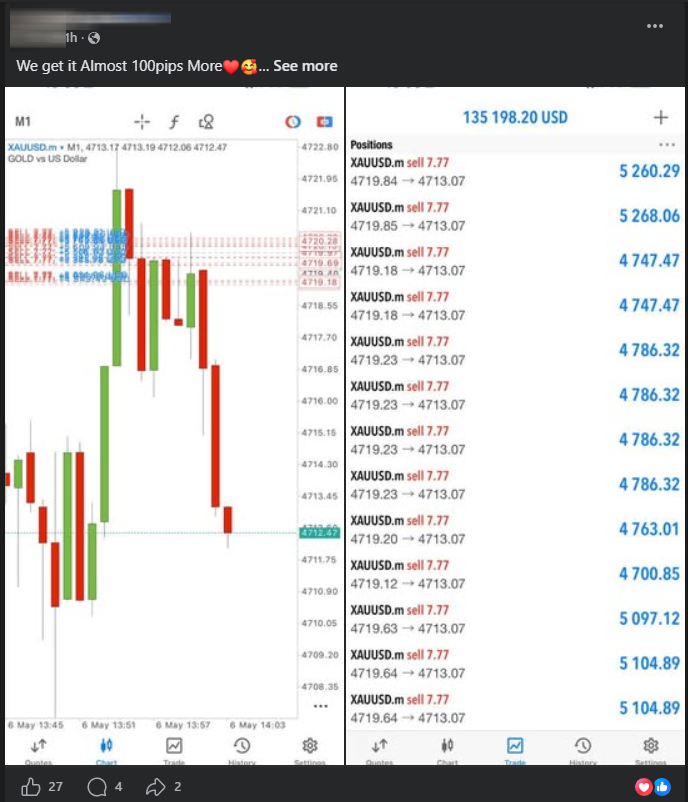
The screenshots of "profits" often shared online are easily fabricated and hold no legal or financial weight without independent verification.
Without a public audit, there is no proof that any actual trading is occurring.
Red Flag #3: The Mathematical Impossibility of the Returns
The returns promised by iQuest are not just sustainable, they are mathematically impossible in the real world.
Consider the Annualized Return (APR).
If you invest 1 million pesos and withdraw the 1.5 million profit monthly (keeping the principal for the next month), you would earn 18 million pesos in a year.
This is an 1,800% annual return.
To put this in perspective, the top hedge fund traders on Wall Street consider a 20% annual return to be a major success.
An 1,800% return exists nowhere in the reality of financial markets.
Additionally, the Profit Payout Ratio is unsustainable.
If 1,000 members each invest at the maximum payout level, the company would need to generate 1.5 billion pesos in net profit every single month just to cover the promised returns.
No legitimate trading bot or strategy can consistently generate that much net profit from a 1 billion capital base.
Red Flag #4: An 11-Level Pyramid Scheme
The most glaring sign of a Ponzi scheme is iQuest's affiliate program. Their commission structure is designed like a classic pyramid:
- Direct Referral: 10% of the recruit's profit.
- Levels 2 to 6: 2% of the recruits' profit.
- Levels 7 to 11: 1% of the recruits' profit.
This extreme depth in the referral system is a clear indicator that the platform relies on constant recruitment to pay out "profits" to earlier members, rather than actual trading revenue.
Live Market Trading vs. Ponzi Schemes: A Reality Check
Many people confuse these schemes with real trading because they believe that even in real markets, money just comes from other people's deposits. This is a fundamental misunderstanding.
- Value Creation: In the live market, you trade assets (like Bitcoin or Stocks) that have global value based on supply and demand. In a Ponzi scheme, there is no asset; the "profit" is simply a redistribution of money from the newest members to the oldest.
- Zero-Sum Game Mechanics: In legitimate trading, your "win" comes from a public exchange where the counter-party could be a global bank or an algorithm in another country. In a Ponzi scheme, your "win" comes directly from the pockets of your friends, neighbors, or the people you recruited.
- Liquidity and Verification: Real markets have liquidity; you can sell your Bitcoin in seconds and withdraw your money because it is verified by third-party auditors. In a Ponzi scheme, your withdrawal depends entirely on the administrator. If they decide to "lock" withdrawals or claim "maintenance," your money is gone because there was never any real liquidity to begin with.
Final Verdict on iQuest (AI Quest)
All evidence points to one conclusion: iQuest (AI Quest) is a fraudulent Ponzi Scheme. It uses the allure of "AI" and "Quantitative Trading" as a front for a recruitment-based financial trap.
Beyond the technical and mathematical red flags, the platform exhibits other suspicious behavior:
- Domain Cycling: They frequently change their domain names (e.g., official11.com), a common tactic for scams to stay ahead of being blocked or reported.
- Anonymous Leadership: The "CEO," Erica Aguilar, appears to be a front with no verifiable professional background in the trading or tech industry.
- No SEC License: In the Philippines, offering investment packages without a secondary license from the Securities and Exchange Commission (SEC) is illegal.
- Advance Fee Scam: The dashboard features a "Buy Premium" button required for withdrawals, a classic sign of an advance fee scam where they trick you into paying more money just to access your "earnings".
Do not invest in iQuest or AI Quest. Do not promote this platform. The profits shared by members today are the losses of the members joining tomorrow.
Protect your hard-earned money and stay away from "guaranteed" high-return schemes.
Investigated and Reported by Neil Yanto



Discussion (0)
Leave a comment
No comments yet. Be the first to share your thoughts!