If you’re a Filipino crypto user, the past couple of years have felt like a slow squeeze.
One day you can trade normally. The next day, the same link loads with errors.
Then the app disappears from the Play Store. And suddenly the question stops being “Which coin is pumping?” and becomes: “Are we being protected… or being cornered?”
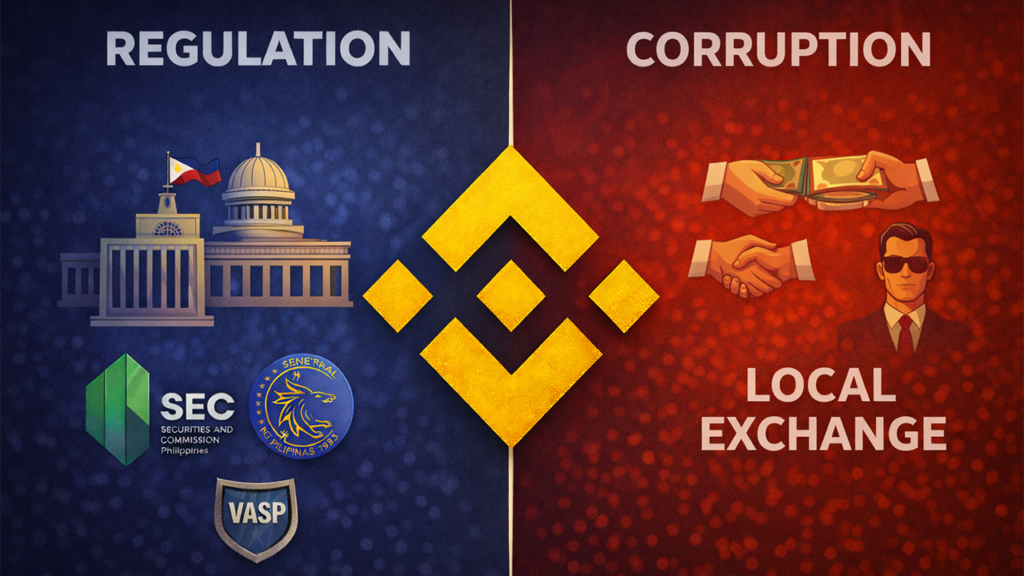
This blog post answers your exact question, is the pressure on Binance in the Philippines mainly about regulation, or is it corruption / local-exchange influence?
And more importantly: When will the Philippines become truly open enough to give ordinary people better options?
What’s happening to Binance in the Philippines right now
As of mid-February 2026, credible PH-focused reports say:
The Binance app is no longer available on the Philippine Google Play Store, and this is being linked to the SEC’s enforcement push.
Web access has been reported as restricted or unreliable across multiple local internet service providers, following the SEC’s request pathway through the NTC.
This didn’t come out of nowhere: the SEC’s actions trace back to a Nov. 28, 2023 advisory warning the public and stating Binance was not authorized to sell or offer securities in the Philippines, under the Securities Regulation Code.
By March 2024, the enforcement escalated into the NTC directing ISPs to block access after the SEC moved to proceed with the ban/blocks.
So yes, the “pressure” is not just vibes or rumors. It’s a documented regulatory sequence: advisory → grace period → request to block → app-store removals and access restrictions.
The official reason: “Regulation” (and what that really means)
When regulators say regulation, it often sounds like a clean, boring word. But on the ground, it means something very specific:
1) “You’re operating here. So register here.”
The Philippine SEC has repeatedly framed Binance as unregistered / not authorized for activities that fall under securities rules (their claim is tied to the Securities Regulation Code).
2) “If Filipinos can access it, we consider it offered to Filipinos.”
That’s why app stores and ISP blocks become the pressure points: you don’t have to raid an office if you can restrict distribution and access.
3) “Investor protection” is the headline goal
Regulators commonly cite scams, collapses, and consumer harm as context for stricter action against unregistered platforms.
In PH coverage, SEC leadership has pointed to investor protection concerns, and the government has used similar tactics before (like app takedowns in other industries).
But your real question is sharper: Regulation… or corruption?
Let’s deal with this honestly.
What we can say with evidence
The documented basis for the Binance squeeze in the Philippines is regulatory enforcement tied to authorization/licensing and securities-law framing.
That’s not speculation, those claims are stated in reporting about SEC actions and the SEC advisory timeline.
What we cannot responsibly claim without proof
“Corruption” is a serious accusation.
There is no solid public proof in the sources above that the Binance actions are driven by bribery or corrupt payoffs.
If anyone claims it as a fact, they need evidence, documents, investigations, convictions, whistleblowers, or verified reporting, not just the feeling that “something is off.”
So if you’re asking me to pick one as fact:
Based on available evidence, the pressure is primarily regulation, not proven corruption.
But that’s not the end of the story.
The uncomfortable middle: “Regulatory capture” (legal, but can still feel unfair)
Even without corruption, systems can still tilt.
Here’s the reality in many countries: local industry groups often lobby regulators.
And in the Philippines, there were reports about digital trade groups backing a Binance ban back in late 2023.
That doesn’t automatically mean corruption. It can mean:
local players want a level playing field
local players want less competition
regulators want control, reporting, and accountability
regulators prefer entities they can easily supervise locally
This is where ordinary users feel trapped: “If you block the biggest global exchange, do we actually get better protection… or just fewer choices?”
That emotional frustration is valid, especially if you’re a small trader, a side-hustler, or someone trying to protect savings from inflation and low wages.
Why Binance is a special target (compared to random scam sites)
Binance isn’t being treated like a tiny fly-by-night platform. It’s being treated like a high-impact gateway:
huge user base
huge liquidity
easy access for beginners
massive marketing reach
When a regulator wants to show it can “control the space,” it targets the biggest door first, because that’s where the most people walk in.
“If it’s regulation, why not just license them and move on?”
This is where the Philippines gets complicated.
The BSP licensing environment has been tight
The BSP has had periods where it closed/paused the regular application window for new VASP licenses for years starting September 2022 (as reported by major PH outlets), reflecting a cautious stance around risk management and oversight capacity.
Meanwhile, the SEC has been building a broader crypto-asset framework
By 2025, legal summaries and professional updates describe the SEC issuing rules/guidelines for crypto-asset service providers (CASP).
In plain English: the government has been tightening the rulebook, but rulebooks take time to implement cleanly, and enforcement often moves faster than licensing capacity.
That gap is where users suffer.
What happens in the next few years (2026–2029): realistic scenarios for PH crypto access
No fantasy predictions, just plausible tracks based on how regulation usually evolves.
Scenario A: “Controlled opening” (most likely)
The Philippines slowly expands regulated access by:
allowing more locally compliant providers
pushing stronger disclosure/KYC/AML requirements
requiring local presence, reporting, and consumer-protection safeguards
That aligns with how BSP VASP guidelines describe obligations like recordkeeping, controls, and supervisory enforcement frameworks.
Under this scenario, the PH becomes “open,” but only for exchanges willing to fully localize compliance, either directly or via local partnerships.
Scenario B: “Walled garden”
The PH keeps access narrow:
fewer exchanges
higher fees
fewer products (derivatives, futures, margin)
slower innovation
This is the nightmare for advanced users: you’re “protected,” but your tools are gone.
Scenario C: “Re-entry of global giants, licensed”
This is what many users hope for: a path where major global exchanges return under PH rules. But that requires:
clear licensing routes
consistent treatment across platforms
enforcement that targets behavior, not just brand names
If the rules stabilize and the licensing bottleneck loosens, this becomes more realistic, especially as SEC CASP rules mature and BSP capacity expands.
So when will the Philippines be “open” enough to give people better exchange options?
Here’s the hard truth:
The Philippines becomes meaningfully open when these three things happen at the same time:
Clear, workable licensing paths (not just rules on paper)
Consistent enforcement (same standards for local and foreign platforms)
User-first outcomes (competition allowed so fees drop and service improves)
If access restrictions continue without an equally fast expansion of legitimate options, people will do what people always do:
move to gray-market routes
use workarounds
trust random “agents” and OTC middlemen
become more vulnerable to scams
And that’s the irony: over-restriction can create the exact risk it claims to prevent.
Final answer to your question: Regulation or corruption?
Based on publicly reported evidence, it’s regulation.
But it’s also fair to say this: even without proven corruption, policy outcomes can still benefit certain players if competition shrinks and licensing is slow.
The presence of industry support for the ban shows that market interests do exist around this issue.
So the best framing is:
Regulation is the documented driver.
Corruption is not proven.
Market influence / lobbying is plausible and visible in the conversation, and it can shape what “regulation” looks like in practice.
Hi, I’m Neil Yanto, a content creator, entrepreneur, and the founder of an AI Search Engine built to protect people from scams and help them discover legitimate opportunities online.
The core purpose of my AI Search Engine is to review platforms, websites, and apps in real time, analyzing red flags, transparency, business models, and use...
A new platform called FlickerAlgo has been making waves online, claiming to be an advanced AI trading platform backed by a reputable investment firm. It promises high profits, server-based trading systems, and "secure cold wallet storage." But is it really legitimate—or just another scam designed to fool investors? In this review, we’ll break down all […]
Today, we will answer a question from one of our viewers on YouTube. Here’s their comment: “Sir, good day. Please review the (Cryptex decentralized finance staking program). It claims to operate on blockchain and generates 1% to 3% profit. Thank you, I’ll look forward to it.” In this blog, we will discuss whether Cryptex is […]
Today, we’re going to talk about Kantar Philippines, a platform claiming to be a legitimate survey site where you can earn money. But the big question is: Is it really legit? Or is there something fishy going on behind the scenes? Let’s find out together. What is Kantar? To answer whether Kantar Philippines is legit […]
Hi, I’m Neil Yanto — a content creator, entrepreneur, and the founder of an AI Search Engine built to protect people from scams and guide them toward real opportunities online. The main purpose of my AI Search Engine is to review platforms, websites, and apps in real-time — analyzing red flags, transparency, business models, and user feedback...Read More