

Table of Contents
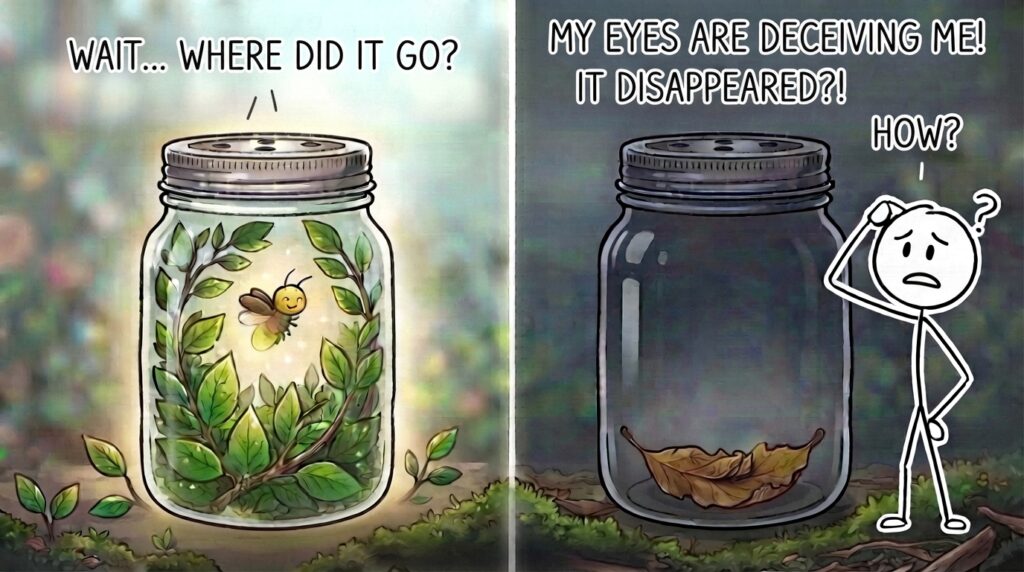
Have you ever caught a glowing firefly, put it inside a tightly sealed glass jar, and watched it shine before falling asleep, only to wake up the next morning and find it completely gone?
No open lid. No cracks in the glass. No escape route.
So... what actually happened?
Did it vanish into thin air like a ghost, or is there a bizarre scientific explanation behind the great disappearing act?
Let’s find out.
Today, we are diving deep into the fascinating, weird, and scientifically mind-blowing world of the firefly.
The Anatomy and Biology of Fireflies
Before we solve the mystery of how it escaped or disappeared, let's look at what fireflies actually are.
Fun fact right off the bat? Fireflies aren’t actually flies at all.
Surprise!
They are actually beetles belonging to the family Lampyridae.
So technically, calling them "fireflies" is a complete misnomer.
They are glowing beetles.
But "firefly" definitely sounds much cooler than "glow-beetle," so let's stick to the classic name.
Now, how do they do it?
How does their little lower abdomen, casually known as the tail or rear end, end up lighting up like a tiny neon bulb?
It’s all thanks to a marvelous chemical reaction called bioluminescence.
Think of it as nature’s very own glow-in-the-dark chemistry set, but way more efficient than anything human engineers have ever invented.
Inside the firefly’s specialized light organ, four main ingredients come together:
- Luciferin, a light-emitting compound.
- Luciferase, an enzyme that acts as a catalyst.
- Adenosine triphosphate (ATP), which provides the cellular energy.
- Oxygen.
When the firefly wants to flash, its nervous system triggers a rush of oxygen into the light organ.
The oxygen reacts with luciferin in the presence of luciferase and ATP, and boom, light is produced!
And here is the most mind-blowing part: unlike a regular incandescent light bulb, which wastes about ninety percent of its energy as heat and only ten percent as light, a firefly’s light is one hundred percent efficient.
It is what scientists call "cold light." Not a single shred of thermal energy is wasted.
If human lightbulbs were this efficient, our electric bills would practically be zero, and our bulbs would never burn out!
The Complex Communication and Social Behavior
So, why do they put on this dazzling light show in the night sky?
Is it just to look pretty for us humans?
Not quite.
As romantic as a flickering field of fireflies looks to us, for them, it’s basically a massive, high-stakes dating app in the dark.
Different species of fireflies have their own unique flashing patterns, sort of like secret Morse code.
A male will cruise through the air flashing a specific rhythm: flash... flash-flash... pause.
If a female sitting down in the grass likes what she sees, she will wait a precise number of seconds and flash back with her own specific reply.
It’s a literal conversation of light.
“Hey, I’m single, healthy, and ready to mingle!”
“Cool, come on over, I’m right by this fern!”
It’s beautiful, right?
Well... until you realize that nature can also be brutally savage.
Meet the Photuris fireflies, often called femme fatales.
The females of this genus have learned to master the specific flashing codes of other completely different firefly species.
They sit in the dark, mimic the mating signals of another species, and lure innocent, romantic males right to their doom.
When the poor male arrives expecting romance, the femme fatale attacks and eats him.
Why?
Because she needs the specific defensive chemical toxins found inside his body to protect her own future eggs from predators.
Talk about a toxic relationship! Talk about getting ghosted, literally and fatally.
Ecological Role and Habitat Dynamics
Beyond their glowing romance and predatory traps, fireflies play an essential role in their local ecosystems.
Did you know that adult fireflies actually spend a significant portion of their lives as predatory larvae?
Before they ever take flight, firefly larvae live in damp soil, under rotting logs, or beneath leaf litter.
And what do they eat?
They are voracious predators of garden pests, particularly snails, slugs, and earthworms.
They inject a paralyzing digestive enzyme into their prey and feed on them, helping to naturally control pest populations in forests, fields, and agricultural areas.
Furthermore, fireflies are exceptionally sensitive biological indicators of environmental health.
Because their larval stage requires specific moisture levels and undisturbed soil, and because adults are extremely vulnerable to light pollution and chemical pesticides, a declining firefly population is often the very first warning sign of ecosystem degradation, habitat loss, and chemical overuse in an area.
When the fireflies disappear from a neighborhood, it usually means the local soil chemistry and nocturnal habitat have been severely disrupted.
Solving the Mystery, Where Did the Firefly Go?
Now that we understand the deep biology and ecology of these creatures, let’s circle back to the grand mystery:
You caught one, put it in a jar, poked ventilation holes in the lid, screwed it shut, and by morning, it was gone.
How did it escape, or what actually happened?
Let’s look at the scientific reality through three distinct possibilities:
1. Physical Squeeze and Anatomy
When we catch a firefly in the dark, our eyes play tricks on us.
Because they are glowing so brightly against a dark background, our brains perceive them as much larger than they actually are.
In reality, most common adult fireflies are tiny, often ranging from just half a centimeter to about two centimeters long.
Their bodies are remarkably slender, soft-shelled, and flexible.
If the ventilation holes poked with a nail were even a fraction of a millimeter wide, or if the screw thread on the metal lid had a microscopic gap, a determined adult firefly could compress its soft exoskeleton and squeeze right through like liquid during the quiet hours of the night.
Insects are legendary escape artists.
2. Metamorphosis and Misidentification
We often assume every glowing bug is a flying adult beetle.
However, fireflies undergo complete metamorphosis: egg, larva, pupa, and adult. In certain species, adult females are completely flightless and wingless, resembling elongated larvae or glowworms.
If a ground-dwelling larval form or a wingless female was accidentally collected from the grass, its behavior, crawling capabilities, and flat body profile make navigating tight spaces or finding micro-fissures in containers entirely different from a standard flying beetle.
3. Dehydration and Disappearance in Plain Sight
Here is the most sobering truth of what happens when you trap a wild insect in a small glass jar overnight without food and with restricted airflow: Stress and metabolic collapse.
Fireflies have extremely high metabolic rates during their active hours.
Trapped inside a glass chamber, oxygen levels drop, carbon dioxide accumulates, and the acute stress of confinement takes a severe toll.
When a firefly dies inside a jar overnight, its soft, delicate body dries out rapidly in the enclosed microclimate.
By morning, its dark-brown or light-colored exoskeleton blends seamlessly into the shadows, behind the inner rim of the metal lid, or beneath any tiny speck of dust or condensation at the bottom of the jar.
To sleepy morning eyes glancing quickly through the glass, it looks completely empty.
But if you dumped the contents onto a white sheet of paper or inspected it with a magnifying glass, you would likely find a tragic, tiny, motionless shell curled up hidden from view.
The Lesson of the Wild
So, what is the ultimate takeaway?
Whether it squeezed through a microscopic gap in the lid or quietly passed away and blended into the shadows of the glass, the result is the same: wild creatures do not belong in jars.
That firefly wasn't meant to be a temporary bedside nightlight.
It was meant to roam the night air, dance under the moonlight, find its mate through flashes of bioluminescence, and perform its natural role in the ecosystem.
When we lock them away, we extinguish the very magic that made us capture them in the first place.
So, the next time you see those glowing sparks dancing across the grass, stop, watch, and appreciate the wonder of nature right where it belongs, out in the wild, totally free.
Thank you for watching, and until the next mystery, stay curious, stay amazed, and always respect the wild.



Discussion (0)
Leave a comment
No comments yet. Be the first to share your thoughts!