

Table of Contents

Recently, I received a question about my thoughts on RedShell, which is connected to redshellco.com — a platform that claims to operate a crab fattening and farming business.
The big question:
Is RedShell a legitimate crab farming business or just another investment scam?
Let’s break it down in detail — from how it works, to actual crab fattening economics, sustainability, red flags, and whether it’s a Ponzi scheme disguised as aquaculture.
What is RedShell?
RedShell is an online investment platform that claims to operate a crab farming business and promises investors guaranteed returns from 174% up to 1,000% in just a few months.
They offer multiple investment plans with fixed weekly ROI, and you can also earn through their multi-level referral program.
How Do You Earn in RedShell?
There are two main income sources:
- Passive Income from Investment – You put in money, RedShell says they’ll use it to buy “skinny” crabs, fatten them in their farms, then sell at a profit, giving you 2%–4% weekly returns (or higher, depending on the plan).
- Referral Commissions – RedShell has a 10-level deep referral system, paying 6% for direct referrals and 0.5% for indirect referrals.
💡 Code Analysis Proof:
Based on RedShell’s own backend code, referral bonuses are taken directly from the deposit of your downlines, NOT from actual crab sales.
This is a major pyramid scheme indicator.
Is It Sustainable Based on Real Crab Fattening?
To answer that, we need to understand real crab fattening in the Philippines.
📌 How Real Crab Fattening Works
- Buying Price of Skinny Crab: ₱350 – ₱450/kg
- Fattening Cycle: 15 days for male crabs, ~30 days for female crabs (average 15–20 days)
- Selling Price after Fattening: ₱1,000 – ₱2,400/kg depending on market and season
- Best Season: “Ber” months & Chinese New Year (high demand, higher prices)
Sample Computation (Real Crab Fattening)
| Season / Price Level | Buying Price (₱) | Selling Price (₱) | Profit (₱) | ROI (%) per Cycle |
|---|---|---|---|---|
| Normal – Low | 400 | 1,000 | 600 | 150% |
| Normal – High | 400 | 2,000 | 1,600 | 400% |
| Peak – Low | 400 | 2,300 | 1,900 | 475% |
| Peak – High | 400 | 2,400 | 2,000 | 500% |
These are the best possible selling prices under ideal conditions, but not consistent all year round due to market fluctuations, mortality, disease outbreaks, and seasonal demand — and this still does not include production costs or the initial investment required to build and operate a crab farm.
Why RedShell’s Weekly Payout is Unrealistic
In real crab farming:
- You cannot harvest and sell every week.
- ROI is per 15–20 days (male) or 30 days (female).
- Even in peak seasons, consistent weekly payouts are impossible without fresh investor money.
The “No Limit on Investor” Problem
One of the biggest sustainability issues: RedShell has no cap on the number of investors.
Based on actual production capacity from a 1,000-box crab farm, here’s the maximum sustainable investors before payouts exceed actual farm profit:
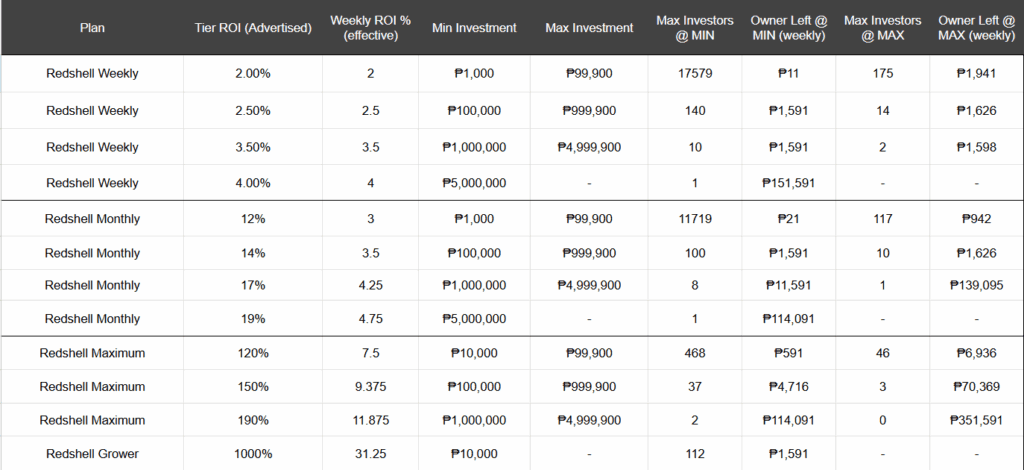
With no investor cap, once the number of investors exceeds the farm’s real production capacity, the only way to pay old investors is from new investor deposits — the core mechanism of a Ponzi scheme.
Unrealistic Weekly ROI
- 2% weekly → 171.8% annually.
- 4% weekly → 610.6% annually.
In real-world crab farming, even in efficient large-scale operations, 42%–66% annual ROI is realistic — nowhere near these figures.
Payout Schedule vs Biological Cycle
Crabs do not fatten in a single week — the minimum cycle is 15 days for males and 30 days for females.
If RedShell is paying weekly, it means investors are getting paid before any actual harvest happens.
Referral Commissions Taken from Deposits
Analysis of RedShell’s website code shows that referral payouts come from deposits made by new members, not from crab sales.
This is a hallmark of pyramid/Ponzi schemes.
100% Capital Protection Claim
No legitimate agribusiness can guarantee both your full capital and fixed profits.
Real crab farming faces mortality risk, disease outbreaks, typhoons, price crashes, and market delays.
Fixed Tiered Income Regardless of Market
In real crab farming:
- Prices fluctuate by season.
- Mortality rates vary.
- Demand changes constantly.
A fixed return of 2%, 4%, 120%, or 1,000% ignores all these realities and is a clear sign it’s not tied to genuine farming operations.
Hypothetical Production Requirements
If one investor puts in ₱100,000 and earns 4% weekly → that’s ₱4,000 in weekly payouts.
If there are 100 such investors → ₱400,000 in weekly payouts.
If the profit per kilo is ₱2,000, they would need to sell 200 kilos per week — that’s 10,400 kilos per year.
This would require a massive crab farm — which RedShell has not shown evidence of owning or operating.
Red Flags in RedShell
- Guaranteed 174%–1,000% ROI → Impossible in real crab farming.
- Weekly payouts despite 15–30 day cycles → Paying without harvest.
- Unrealistic annual ROI → Far above 42%–66% real-world returns.
- Referral commissions from deposits → Ponzi/Pyramid structure.
- 100% capital protection claim → “Too good to be true” promise.
- Fixed income despite market fluctuations → Not possible in genuine aquaculture.
Final Analysis – Scam or Legit?
- The crab fattening business appears to be just a front.
- Payouts likely come from new investor deposits rather than actual crab sales.
- This is a traditional Ponzi scheme with a multi-level marketing twist.
Conclusion
If you’re thinking of investing in RedShell, think twice.
Real crab farming can be profitable, but not through guaranteed fixed weekly returns — and definitely not in a scheme that depends on new investor money to pay old ones.
💡 Recommendation: Avoid this investment. If you want to get into crab farming, do it directly and manage your own production, where you control the risks and rewards.



Discussion (0)
Leave a comment
No comments yet. Be the first to share your thoughts!