

Table of Contents
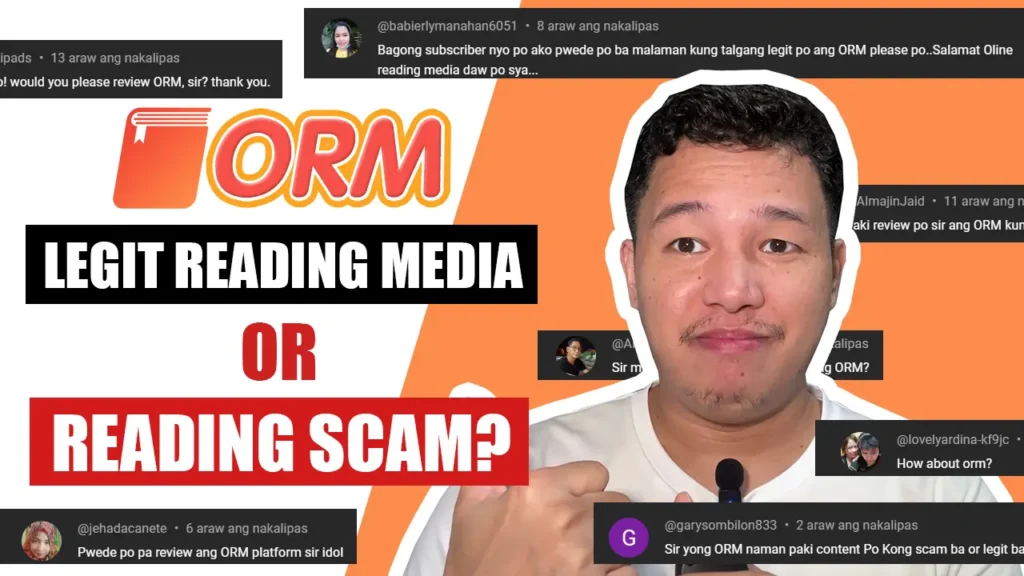
One of the most frequently asked questions on my YouTube channel is whether Online Reading Media (ORM) is a legitimate platform or just another scam.
What is Online Reading Media?
According to their company profile, ORM is an online platform where employees can supposedly earn money by reading books and novels. They claim to pay their employees daily for completing reading tasks. The company also states that their revenue comes from promotion fees paid by authors and media platforms, which serves as the source of income that allows them to pay users.
But the real question is: Is this true?
Based on my analysis, the answer is no. After carefully reviewing the platform, I found several red flags that are similar to other platforms I have reviewed before, many of which have already shut down.
How Can We Identify a Scam Platform?
Many people argue that a platform cannot be a scam if users are able to withdraw money. But is that really the case?
From my experience with various money-making platforms, I’ve observed a common strategy used by these systems: they pay the early users—especially those who recruit others—so they can serve as testimonials. These initial success stories attract new investors, bringing more money into the system.
For example, if they pay 10 people who each recruit 100 new users, more money flows in than what they initially paid out. However, once withdrawals exceed incoming funds, issues arise, and eventually, the platform collapses.
This cycle has repeated itself in many platforms before they completely shut down. Unfortunately, despite this pattern being a classic scam strategy, many people still fall for it.
Now, let’s analyze why ORM raises multiple red flags and why it is not recommended.
Red Flag #1: The Business Model is Unclear
ORM claims that they generate revenue through promotion fees paid by authors and media platforms, which they then use to compensate users for reading tasks. However, after thoroughly checking the platform, I found no concrete evidence that any actual advertisers, authors, or publishing companies are paying ORM.
Why is this suspicious?
- Common Sense Perspective: If you were an author or publisher, would you pay for an article to be displayed for just 20 seconds without a clear distribution channel? Any legitimate publisher would want proper attribution and exposure for their work.
- Technical Perspective: I examined the platform’s code and found no proof that the articles are coming from actual advertisers or publishers. There are no API requests or direct integrations with any publishing platforms or external databases.
- Legitimate reading platforms like Wattpad, Kindle, or Google Books have proper databases full of books, news articles, and novels, but ORM does not.
- No Verification of Reading Activity: Authentic reading platforms track user engagement, such as how many words were read, scroll depth, and reading time. ORM lacks any such tracking system.
This suggests that ORM is not actually working with real advertisers or authors, making their revenue model highly questionable.
Red Flag #2: Fake Tasks
How do users earn money? By completing reading tasks. However, based on my investigation, these tasks are fake.
Why are these tasks considered fake?
- Users are not actually required to read the articles. They just need to keep the page open for a few seconds before receiving a reward.
- There is no validation to check whether a user has truly read the content.
- Other legitimate reading platforms ensure that users actually engage with the content before rewarding them, but ORM does not.
Because of this, ORM’s task system is designed in a way that mimics activity without requiring actual engagement, making it highly unsustainable.
Red Flag #3: Fake Office Address
Many platforms use registered business addresses to appear legitimate. ORM claims to be registered in Colorado, but does this automatically mean they are a real company?
Why is this a red flag?
- A business registration in Colorado only proves that the company is a legal entity in the state—it does not confirm that they are actually operating or running a legitimate business.
- Some states, such as Colorado, Wyoming, and Delaware, have very relaxed business registration rules, making them hotspots for shady companies looking for easy registration.
In simpler terms: Just because a company is registered doesn’t mean it has a real office or legitimate operations.
Red Flag #4: Signs of a Ponzi Scheme
ORM exhibits characteristics of a Ponzi scheme, which is a type of scam that pays older investors with money from new investors.
How does ORM resemble a Ponzi scheme?
- There is no clear external source of revenue aside from user deposits and recruitment.
- Early users and top recruiters are paid first to make the platform look legitimate.
- Once recruitment slows down, withdrawals become delayed or impossible, leading to the platform’s collapse.
This model is unsustainable and has led to the downfall of many similar platforms.
Red Flag #5: Pyramid Scheme-Like Activity
A pyramid scheme is another common scam where earnings are based on recruitment rather than actual product sales or services.
Why does ORM look like a pyramid scheme?
- Users are encouraged to invite others to earn more rewards.
- The system rewards recruitment over actual reading activity.
- Without new recruits, the platform would fail to sustain payments.
This makes ORM heavily reliant on new users, a key characteristic of a pyramid scheme.
Red Flag #6: Questionable Payment Methods
One of the biggest concerns about ORM is its payment authentication process.
Why is this risky?
- Some scams use fake payment processors to give the illusion that withdrawals are being processed.
- No official banking partners or secure payment gateways are mentioned in ORM’s documentation.
- Users risk exposing sensitive information when using these systems.
This lack of transparency in payments raises major security concerns for anyone using the platform.
Final Verdict: Is ORM Legitimate or a Scam?
Based on all the red flags discussed above, ORM is too good to be true. The platform should be avoided at all costs for the following reasons:
✅ No real proof of external revenue sources.
✅ Fake tasks that do not require actual reading.
✅ Suspicious business registration with no real office presence.
✅ Ponzi and pyramid scheme-like activities.
✅ Unverified and risky payment methods.
Should You Invest in ORM?
No. ORM follows the same pattern as other scam platforms that eventually shut down, leaving users with lost money and unpaid withdrawals.
What Do You Think?
What are your thoughts on ORM? Have you made any money from it? Or do you believe it is just another scam waiting to collapse?
Leave a comment below to share your experience and help others decide whether ORM is a legitimate opportunity or something to avoid.
That’s it for today’s topic—until next time!



Discussion (0)
Leave a comment
No comments yet. Be the first to share your thoughts!