

Table of Contents

Let’s talk about this new so-called online earning opportunity that has been circulating lately — GCash Rental, sometimes also marketed as Self Rental.
For those who still don’t have any idea what this is, let’s break it down:
What is GCash Rental?
GCash Rental refers to the act of “renting out” or “allowing someone else to use” your GCash account through third-party platforms like HDPay in exchange for daily profits.
The idea is simple:
- You deposit money into your GCash account.
- You connect your account to their system.
- The third-party platform uses your account to move money in and out.
- In return, they promise you 1% to 2% daily profit.
At first glance, it looks like passive income: you don’t need to do anything — just put money in your GCash account, connect it to HDPay or similar apps, and wait for your money to “grow.”
How Much Can You Earn?
It depends on the rate set by the platform. Most of these sites advertise 1% to 2% daily return.
- If you have ₱10,000 in your GCash, they claim you can earn ₱100–₱200 daily.
- In a month, this supposedly adds up to ₱3,000–₱6,000.
- If you put ₱100,000, you could “earn” ₱30,000 or more per month.
It sounds attractive, especially to those looking for “easy money.” But before you get tempted, the important question is:
Is this legal?
The Straight Answer: No, It’s Not Legal
The income you see from GCash Rental does not come from legitimate sources. It is connected to illegal activities and is part of a Money Laundering Scheme.
How Does GCash Rental Actually Work?
Let’s use an example:
Meet Juan and Peter
- Juan has a legitimate business. It’s properly registered, complete with permits from the Mayor’s Office, BIR, SEC, or even PAGCOR. Everything is legal on the surface.
- Peter runs illegal operations — scam hubs, unregulated online casinos, shady lending apps, phishing sites, Ponzi schemes, and more.
Peter needs Juan’s help to move money, but here’s the problem: If Juan and Peter transact directly, they will get flagged under AMLA (Anti-Money Laundering Act). It will be traceable, and both could be charged.
So, what do they do?
They use a third-party layer — this is where GCash Rental platforms come in.
Where Do You Come In?
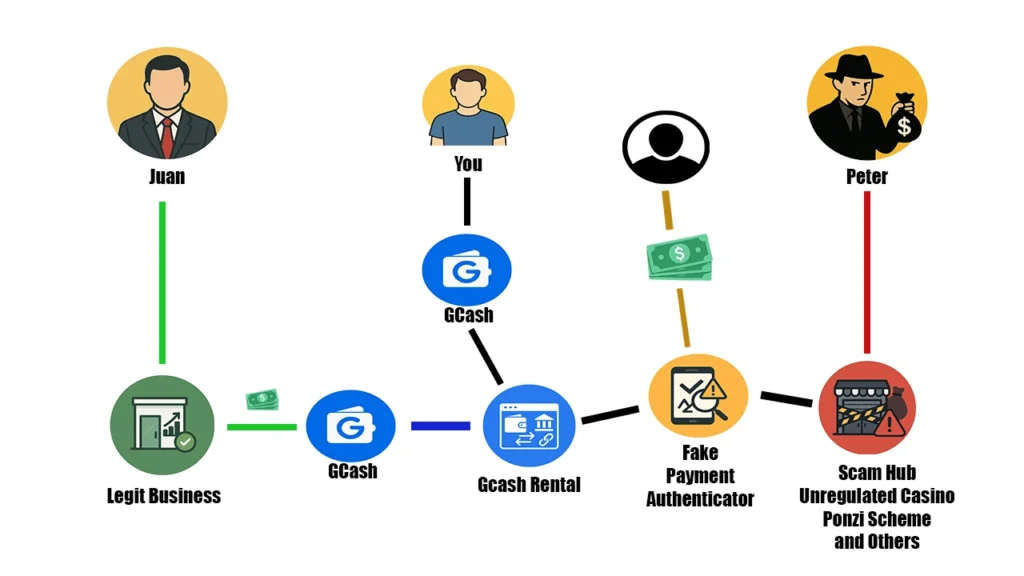
You, the ordinary user, get lured in by the promise of 1% to 2% daily passive income.
- You provide your GCash account.
- You deposit money as a “float” (₱1,000, ₱10,000, etc.).
- The rental service connects your account to a Fake Payment Authenticator.
This Fake Payment Authenticator is used by:
- Unregulated gambling operators
- Scam hubs
- Phishing websites
- Ponzi and pyramid schemes
- Dating scams, text scams, crypto fraud, and other illicit businesses
When people send money to these illegal hubs, the funds are funneled into your GCash account (alongside hundreds of other rented accounts). But the money doesn’t stay with you.
- Once it enters, it’s quickly transferred out to other accounts.
- The flow creates a chain that eventually reaches Juan’s legal business.
- In Juan’s books, it shows up as consultancy fees, e-commerce sales, marketing revenue, coaching, seminars, etc.
By the time it reaches Juan, the money looks clean — even though it came from scams.
This is Classic Money Laundering
The process perfectly fits the Money Laundering Cycle:
- Placement – Dirty money enters the financial system via rented GCash accounts.
- Layering – It is moved through multiple accounts to obscure its origin.
- Integration – It reappears in Juan’s legal business as legitimate income.
You are essentially serving as a money mule — a bridge for illegal money to move.
Why There Is No Such Thing as Legitimate GCash Rental
Some people ask: “Isn’t there at least one GCash Rental platform that’s legal?”
The answer: None. Zero.
Here’s why:
- It Violates GCash Terms of Service
- Your GCash account is personal. Renting it out or giving access to third parties is strictly forbidden.
- If your account is flagged in a suspicious transaction, you are legally accountable because it’s registered under your name.
- It Is Considered Money Mule Activity
- Even if they call it an “investment” or “passive income,” under the AMLA, it is treated as participation in money laundering.
- No Licensed Company Offers It
- Legitimate businesses use regulated payment gateways like Bux, PayMongo, DragonPay, AsiaPay, or UPay.
- Ask yourself: if GCash Rental was legal, why wouldn’t companies just use these trusted, BSP-regulated providers?
The Risks of Joining GCash Rental
1. Legal Consequences
- Possible 7–14 years imprisonment
- ₱3M–₱15M fines
- Your name may get flagged in AMLA watchlists
2. Financial Loss
- Your float money (₱10,000, ₱20,000, or more) can get frozen when your GCash account is banned.
- Many have reported being blocked from withdrawing after being flagged.
3. Reputation Damage
- You can be blacklisted by banks and financial institutions.
- Your digital financial identity may be tainted permanently.
4. Moral Responsibility
- While you’re earning 1%–2% daily, ordinary victims are losing their life savings to scams.
- By renting your account, you become part of the scam ecosystem — you are enabling scammers to operate.
Real Reports from Victims
Many people who tried GCash Rental ended up with:
- Frozen GCash accounts
- Locked funds (₱10,000 or more gone)
- No support from GCash — because you violated the Terms of Service
Legit Alternatives
If you really want to earn with GCash, use regulated features like:
- GCash Invest Money (mutual funds/UITFs)
- GSave (interest-bearing savings accounts)
- GInsure
- GCredit
These are all BSP-regulated and legal.
Final Thoughts
There is no such thing as a legitimate GCash Rental. Every platform offering it is part of an illegal network tied to scams, unregulated gambling, and fraud.
The promise of 1% to 2% daily return is the bait.
The reality: you risk losing your money, your account, your reputation, and your freedom.
So ask yourself:
- Is it worth earning a few pesos daily while becoming part of a scam that victimizes thousands of Filipinos?
- Is it worth risking jail time, frozen accounts, and criminal records?
The wise answer is simple: Stay away. Don’t rent your GCash. Don’t be a money mule.
- Do you think it’s worth it just because of the promised returns?
- Or do you agree that it’s a trap that should be avoided?
Drop your opinion in the comments — let’s spread awareness so fewer people fall into this scam ecosystem.


Discussion (0)
Leave a comment
No comments yet. Be the first to share your thoughts!