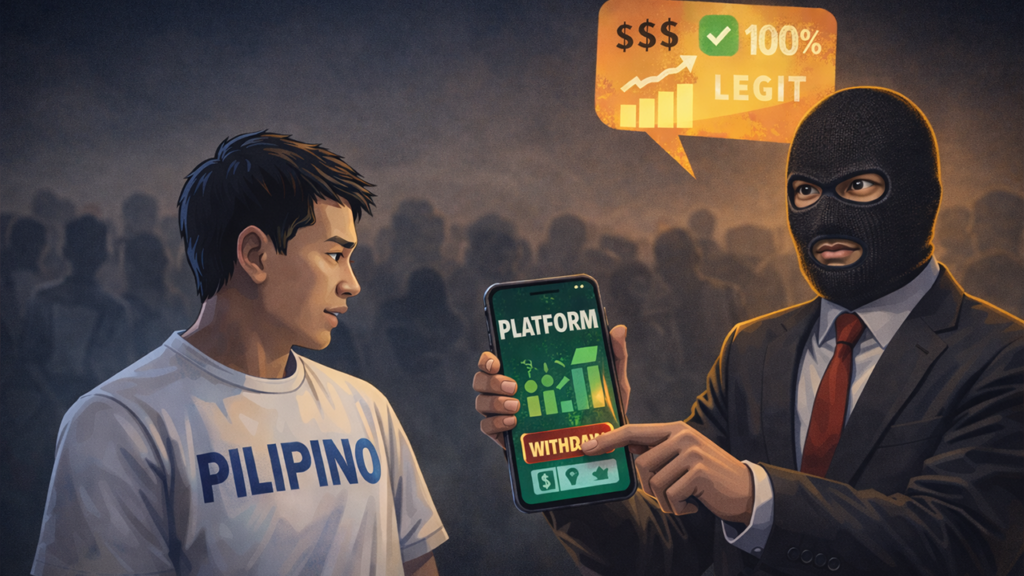
Filipinos fall for scams at an alarming rate compared to many other countries in Southeast Asia.
In recent years, the Philippines has repeatedly ranked among countries heavily targeted by online scam, crypto schemes, fake investment platforms, task-based earning apps, referral pyramids, and impersonation fraud.
What’s more concerning is not just the number of scams, but how quickly many people believe them.
Why does this happen?
This article explores the issue using a research-informed approach, blending behavioral psychology, socioeconomic realities, digital literacy gaps, and cultural patterns, while keeping the discussion practical and grounded.
Economic Pressure and the Urgency Effect
In behavioral economics, scarcity changes decision-making.
When people feel financially pressured, their brain shifts into short-term survival mode.
Long-term risk evaluation becomes weaker. Immediate relief becomes more attractive.
In the Philippines:
Many households live paycheck-to-paycheck
A large percentage depend on remittances
Underemployment remains common
Inflation impacts daily essentials
When someone encounters a message like:
“Earn ₱1,500 per day with just your phone.” “Guaranteed 5% daily income.” “Limited slots only.”
The brain does not process it as “Is this regulated?”
It processes it as: “This could solve my problem right now.”
Research in scarcity theory shows that financial stress reduces cognitive bandwidth.
People under pressure are statistically more vulnerable to high-reward promises.
Social Proof in a Relationship-Based Culture
The Philippines is highly relationship-driven.
Trust often comes from:
Family
Friends
Church members
Workmates
Community groups
Scammers understand this.
Instead of cold marketing, they use:
“PM me for details”
“Kumita na ako dito.”
“Legit po ito, tested na.”
Screenshots of withdrawals
When a known person shares it, skepticism drops.
In collectivist cultures, social validation is stronger than institutional validation. A recommendation from a cousin may feel more trustworthy than a warning from a regulatory body.
Hi, I’m Neil Yanto, a content creator, entrepreneur, and the founder of an AI Search Engine built to protect people from scams and help them discover legitimate opportunities online.
The core purpose of my AI Search Engine is to review platforms, websites, and apps in real time, analyzing red flags, transparency, business models, and use...
A new platform called FlickerAlgo has been making waves online, claiming to be an advanced AI trading platform backed by a reputable investment firm. It promises high profits, server-based trading systems, and "secure cold wallet storage." But is it really legitimate—or just another scam designed to fool investors? In this review, we’ll break down all […]
Today, we will answer a question from one of our viewers on YouTube. Here’s their comment: “Sir, good day. Please review the (Cryptex decentralized finance staking program). It claims to operate on blockchain and generates 1% to 3% profit. Thank you, I’ll look forward to it.” In this blog, we will discuss whether Cryptex is […]
Today, we’re going to talk about Kantar Philippines, a platform claiming to be a legitimate survey site where you can earn money. But the big question is: Is it really legit? Or is there something fishy going on behind the scenes? Let’s find out together. What is Kantar? To answer whether Kantar Philippines is legit […]
Hi, I’m Neil Yanto — a content creator, entrepreneur, and the founder of an AI Search Engine built to protect people from scams and guide them toward real opportunities online. The main purpose of my AI Search Engine is to review platforms, websites, and apps in real-time — analyzing red flags, transparency, business models, and user feedback...Read More