This article reviews the website https://www.arm333.top/, a platform publicly known as ARM AI.
ARM AI is a relatively new online platform that promotes itself as an AI-powered quantitative trading system.
According to its own descriptions, the platform claims to use artificial intelligence and automated trading strategies to generate profits from the market through what it calls quantitative profit.
At first glance, the concept sounds attractive—AI trading, daily profits, automation, and passive income.
However, the real question is not how good it sounds, but how it actually works, how users are supposed to earn, and whether this system reflects legitimate quantitative trading or something else entirely.
This article breaks everything down step by step.
ARM AI presents itself as a platform that combines:
Users are told that they do not need trading experience. The system allegedly performs all trading activities automatically, while users simply deposit funds, activate daily tasks, and collect profits.
The platform heavily uses terms such as:
However, these terms are marketing claims. To understand whether they reflect real trading, we must look at how users are expected to earn.
ARM AI offers two primary earning mechanisms:
Both are closely tied to the amount of money a user deposits.
On ARM AI, quantitative trading is not traditional trading. Instead, it works as a daily automated task system.
Here is how it operates:
Each quantization produces a guaranteed return, depending on the user’s VIP level.
The platform ties profits directly to VIP tiers:
As the deposit increases, the claimed profit ratio also increases.
This means profit is not determined by market performance, strategy accuracy, or risk management. Instead, it is determined by:
In legitimate trading systems, profits fluctuate. In ARM AI, profits are presented as predictable and fixed.
Aside from quantitative trading, ARM AI also offers investment plans that promise daily interest.
Examples include:
Again, returns are calculated purely based on how much money is invested. There is no explanation of:
The system operates as a deposit-in, interest-out model.
ARM AI places heavy emphasis on referrals.
The commission structure is as follows:
In addition, the platform promotes an agent cooperation system, where users who recruit more investors and build larger teams can earn higher rewards.
The platform even allows and encourages multiple account creation, enabling users to chain referrals across different accounts to maximize commissions.
This structure shows that recruitment is not optional—it is a core revenue driver of the platform.
To answer that, we must examine the red flags.
After examining the platform, there is no evidence of real trading activity.
Missing elements include:
What is presented as “trading history” appears to be hardcoded data, not live market results.
In short, there is no proof that any trading actually happens.
ARM AI claims to use artificial intelligence, yet:
Without real trading, AI cannot exist in this context. The term “AI” is used purely as a promotional label, not as a functional system.
In real trading:
In ARM AI:
This structure does not reflect trading. It reflects a deposit-based payout system.
ARM AI’s investment programs do not generate external revenue. There is:
New deposits are used to pay earlier participants. This is the defining structure of a Ponzi scheme.
Once deposits slow down, the system has no source of funds.
Referral commissions come only from deposits, not from legitimate earnings.
There is no product, no service fee, and no trading revenue that funds commissions. All payouts are derived from new investor money.
This reinforces the Ponzi structure.
Allowing and encouraging multiple accounts is:
Legitimate platforms strictly prohibit this behavior.
No trading system—manual, automated, or AI-driven—can guarantee daily profits.
There is always:
ARM AI presents profits as fixed, consistent, and risk-free, which is a major red flag.
ARM AI provides:
Any platform soliciting investments without these is automatically high-risk.
Platforms like this typically:
Early recruiters may profit. Late participants almost always lose.
After carefully analyzing how ARM AI operates, where profits come from, and how the platform is structured, the conclusion is clear.
ARM AI (arm333.top) is NOT a legitimate AI trading platform. It is a scam.
ARM AI uses attractive buzzwords—AI, quantization, automation, and daily profit—but none of these claims are supported by real trading activity, real artificial intelligence, or transparent business operations.
All earning mechanisms on the platform are tied to:
Not to:
This structure matches the characteristics of a Ponzi-style investment scam, where money from new investors is used to pay earlier participants.
While ARM AI may appear appealing at first—especially with its promises of AI trading and daily profits—a deeper examination reveals that:
For these reasons, ARM AI (arm333.top) should be avoided. Users are strongly advised not to invest in this platform, as the risk of losing funds is extremely high.
Always remember:
Real trading involves risk, transparency, and verifiable execution—not guaranteed profits and referral-driven income.

Larsen & Toubro
Official website: https://www.lasentoupro.shop/
Lasentoupro.shop is an online earning platform that presents itself as an easy way to make money through a mobile-app–style system.
Although it looks and behaves like a mobile application, it is actually a web-based platform designed to imitate the experience of popular earning apps.
From the moment users enter the platform, they are shown balances, coins, daily rewards, lucky spins, and recharge options.
The interface is intentionally designed to create the impression that money is easy to earn and constantly accumulating.
However, once the system is analyzed more closely, serious concerns emerge regarding how money actually flows into and out of the platform.
To make things clear and transparent for readers, the table below summarizes all the ways Lasentoupro.shop claims users can earn, alongside what those methods realistically mean.
| Earning Method | How It Is Presented | What It Really Means |
|---|---|---|
| Recharge / Top-Up | Users deposit money (e.g., RM40) to unlock earnings and features | This is the primary source of funds; without recharging, earning potential is extremely limited |
| Task Rewards | Simple tasks that supposedly generate income | No proof of advertisers or companies paying for these tasks |
| Invite Friends / Team Income | Bonuses when referrals join and recharge | Earnings depend heavily on recruiting new users |
| Lucky Wheel / Lottery | Guaranteed or random rewards through spins | Gamified feature encouraging deposits |
| Daily Attendance | Small rewards for logging in daily | Habit-building mechanism to keep users engaged |
This structure clearly shows that all earning methods are directly or indirectly tied to user deposits, not to real external revenue.
The most important feature of Lasentoupro.shop is its recharge (top-up) system.
Users are required to send money through a QR-code payment within a limited time window.
There is no widely recognized payment processor, no escrow service, and no buyer protection.
After recharging, users unlock higher earning potential, access to more tasks, and additional rewards.
This creates a psychological push where users feel that earning more money is simply a matter of depositing more funds.
In legitimate earning platforms, deposits—if required at all—are clearly tied to real products or services, often refundable, and protected by established payment systems.
In this case, the recharge appears to exist primarily to keep the platform funded.
Lasentoupro.shop claims that users can earn by completing tasks.
However, the platform never explains who pays for these tasks.
There are no visible advertisers, no client marketplace, and no explanation of how task completion creates real economic value.
In legitimate task-based platforms, companies pay for marketing exposure, user testing, data collection, or labor.
Here, tasks appear to be internal activities that do not generate outside income.
This strongly suggests that task rewards are funded using money deposited by users, rather than from real business operations.
The invite-friends or team-income system is strongly emphasized.
Users are encouraged to recruit others and earn when their referrals recharge.
Over time, the focus shifts away from completing tasks and toward building a network.
When a platform rewards recruitment more than productivity, it becomes structurally unstable.
Income growth depends on a continuous supply of new users rather than on sustainable revenue.
Once new deposits slow down, payouts commonly become delayed, restricted, or entirely blocked.
Lasentoupro.shop uses lucky wheels, guaranteed rewards, coins, progress indicators, and daily attendance bonuses.
These features are not proof of legitimacy.
They are engagement tools designed to trigger excitement, anticipation, and habit formation.
Such mechanics are frequently used in high-risk platforms to distract users from asking critical questions, such as where the money comes from, how withdrawals are funded, and who is legally responsible for the platform.
One of the most serious issues with Lasentoupro.shop is the lack of transparency.
The platform does not clearly disclose who owns or operates it.
There is no company registration information, no physical business address, no regulatory license, and no legal documentation outlining user protections.
Without transparency, users have no reliable way to verify legitimacy or pursue accountability if the platform disappears.
This alone places the platform in a high-risk category.
Another critical red flag is possible brand impersonation or brand misuse. The name “Lasentoupro” does not correspond to any known, verifiable, or legally established company.
The platform provides no evidence that the brand name is registered, trademarked, or linked to a legitimate business entity.
This tactic is commonly used by scam-type platforms.
By using a professional-sounding or foreign-style brand name, operators create a false sense of legitimacy.
Users may assume the platform is backed by a real company, even when no such company exists.
When a platform uses an unverified or fabricated brand identity, it becomes easy for operators to disappear and later relaunch under a different name.
Once the website shuts down, users are left with no company to contact, no legal entity to report, and no realistic way to recover funds.
A platform does not need to stop paying immediately to be considered a scam.
Many high-risk platforms pay early users using funds from new users.
This creates temporary trust and positive testimonials that encourage more deposits.
Lasentoupro.shop shows all the classic characteristics of this model.
Users must deposit money to earn, income grows through recruitment, there is no proven external revenue source, no verified company ownership, and signs of brand impersonation.
This structure is not sustainable.
When deposits slow down, platforms like this typically begin delaying withdrawals, introducing new requirements, or silently blocking payouts. Eventually, the website disappears, and most users lose money.
Final Verdict: NOT SAFE AT ALL
Lasentoupro.shop is not legit, not sustainable, and not safe. The risk level is extremely high. Users should avoid depositing money, avoid recruiting others, and avoid engaging with the platform entirely.
This is not a platform to “test” or “try and see.” It is something to avoid completely.
If a platform requires upfront deposits, fails to explain where earnings come from, relies heavily on referrals, hides company ownership, and uses an unverified brand identity, it should be treated as dangerous.
Protect your money, protect your reputation, and never confuse early payouts with legitimacy.
At first glance, the idea of a “new beginning” in 2026 sounds exciting.
A fresh start. New opportunities. A chance to recover, rebuild, and try again.
But here is the uncomfortable truth:
👉 2026 is shaping up to be one of the most dangerous years when it comes to scams and fraud.
Not because people are careless.
Not because technology is bad.
But because everything has changed at the same time.
This year is what many people now refer to as a Reset Year.
The term Reset Year does not mean luck, superstition, or a simple calendar reset.
It is a conceptual term used to describe a period where major shifts happen simultaneously in:
From 2020 to 2024, the world experienced:
During this period, people learned survival.
In 2025, the world entered a transition phase:
Now comes 2026.
This is not just another year.
It is the point where human desperation, advanced technology, and refined scam tactics collide.
Scammers thrive on timing and emotion.
In 2026, many people are:
At the same time:
This combination creates the perfect environment for advanced scams.
In the past, scams were easier to spot:
In 2026, that version of scams is mostly gone.
Modern scams now use:
Some scams now look more professional than real businesses.
They may appear as:
Because of this, even intelligent and experienced people can fall into traps.
If scams no longer look like scams, then your old instincts are no longer enough.
You need a new way of thinking.
Below are the most important principles to help you identify scams and fraud in 2026.
In the past, many people entered platforms simply because:
That mindset is now dangerous.
In 2026, the most important question is no longer:
“Can I earn money now?”
The real questions are:
Earning money temporarily does not automatically mean something is legitimate.
Short-term payouts can be part of the illusion.
This is one of the most critical rules.
Every legitimate income system has a clear and explainable source of money, such as:
In scams:
If you cannot explain in one clear sentence where the money comes from, that is a major red flag.
This question alone exposes many scams.
Ask yourself:
Legitimate businesses can survive without constant new members.
Ponzi-style systems collapse the moment recruitment slows down.
If growth is required just to sustain payouts, the structure is unstable.
In 2026, scammers often use AI as a shield:
This is false.
In real business and real investing:
Any platform that promises:
👉 is a scam—no exceptions.
A very common scam pattern looks like this:
In legitimate platforms:
If you must pay more money just to access your own earnings, something is wrong.
Many scams now revolve around:
The key question is not whether AI is mentioned, but:
If AI exists only in words and promises—but you cannot interact with it—then it is likely an illusion.
Not all referral systems are scams.
Legitimate referral or affiliate systems have these characteristics:
Red flags appear when:
If income comes from people rather than products, the structure is a scam.
That is no longer affiliate marketing—it is a pyramid structure.
The most effective scams in 2026 do not rely on technology.
They rely on emotion.
Common phrases include:
Pressure and urgency are used to override rational thinking.
Legitimate opportunities do not require rushed decisions.
If you are unsure, follow these personal rules:
2026 is a Reset Year.
Not just for opportunities—but also for scams.
Scams will look smarter.
They will sound more professional.
They will feel more convincing.
Your protection is not fear.
Your protection is understanding.
If you approach every opportunity with clarity instead of emotion,
you greatly reduce your risk—no matter how advanced scams become.
Website Reviewed: gpuunits.com, gpuunits.net, gpuunits.cc, gpunit.org, gpunit.net,
The explosive growth of artificial intelligence (AI), machine learning, and GPU-accelerated computing has opened a massive global market for GPU cloud providers.
Companies like CoreWeave, Lambda Labs, RunPod, and others are scaling rapidly as global demand for GPU compute increases.
Naturally, investors and ordinary individuals are becoming curious about how to participate in this booming industry.
This demand has given birth to a new wave of online investment platforms claiming that you can “earn passive income” by investing in GPUs — even without touching any hardware or running AI tasks yourself.
One such platform gaining attention is GPUNIT (gpuunits.com, gpuunits.net, gpuunits.cc), a website that advertises itself as an “AI GPU cluster investment provider” with daily ROI ranging from 1.4% to 7.2% per day.
At first glance, GPUNIT looks polished and futuristic. It uses high-end GPU images, sleek interfaces, and marketing phrases that sound extremely similar to real GPU cloud providers.
But the moment you dig deeper, many questions arise:
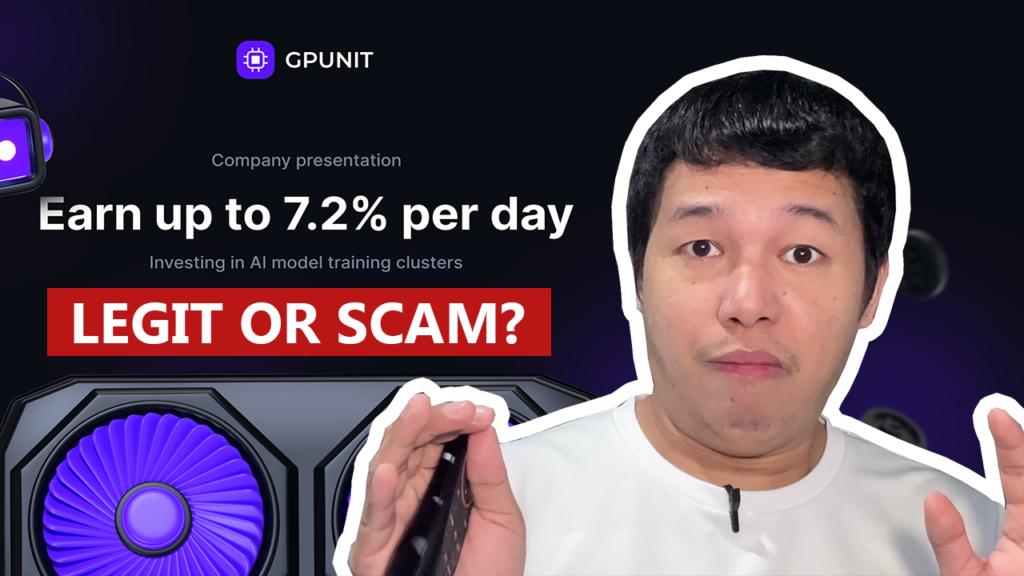
GPUNIT (gpuunits.com) presents itself as a high-tech AI GPU cloud infrastructure provider supposedly based in Australia. According to its PDF presentation and website materials, the company claims to be:
GPUNIT prominently features hardware such as:
However, unlike real GPU cloud providers, GPUNIT does not allow users to rent or use GPUs. There is no compute dashboard, no workload management platform, no API integration, and no usage-based billing.
Instead, the website converts GPU hardware into fixed-rate investment packages where users deposit money and receive a guaranteed percentage every day.
This is not how any real GPU business in the world operates.
GPUNIT offers four primary investment plans, each supposedly tied to a specific CPU or GPU model.
The platform claims that by investing in these plans, you are essentially “purchasing GPU compute capacity” that generates passive income through AI training workloads.
But there's one major issue:
None.
Not CoreWeave.
Not Lambda Labs.
Not RunPod.
Not AWS.
Not GCP.
Not any private data center provider.
Because such returns are not possible in the real world.
According to GPUNIT, the earning process works like this:
This is not a GPU business model.
This is an investment scheme model.
Legitimate GPU operators earn revenue through:
GPUNIT does not offer any of these legitimate services.
To understand why GPUNIT's promises are unrealistic, let’s look at real data from the GPU cloud industry:
Companies like:
…operate massive GPU clusters used by AI researchers and enterprises.
These companies spend millions on:
Because of these extremely high operational costs, the true profit margin of real GPU providers is usually around 5%–15% per YEAR.
Not per day.
Not per month.
Per year.
And here is the important truth:
Real GPU companies do NOT:
Real GPU companies let you rent GPUs, not invest in them.
This alone destroys GPUNIT’s entire premise.
Let’s take their Nvidia H100 plan as an example.
That means one $5,000 GPU investment yields more than 25× its value in one year.
This is not only impossible in the GPU industry — it’s impossible in any legitimate business sector.
Even if GPUNIT owned thousands of Nvidia H100 GPUs:
These numbers are mathematically inconsistent with real-world economics.
GPUNIT uses a 4-level MLM referral system, paying commissions as follows:
This multi-tier referral model is a defining characteristic of:
Legitimate GPU companies never use multi-level marketing to attract users.
Why?
Because real businesses rely on actual customers, not recruitment-driven revenue.
When a “tech company” suddenly uses MLM, it’s no longer a tech company.
It becomes an investment scheme.
Below are the major red flags that strongly indicate GPUNIT is not a legitimate GPU provider.
All genuine investment professionals, financial regulators, and economists agree:
Returns fluctuate.
Markets fluctuate.
AI compute demand fluctuates.
Costs fluctuate.
No legitimate business can pay fixed daily profit.
GPUNIT claims to operate AI GPU clusters, but:
In short:
There is zero evidence that GPUNIT owns or operates GPUs.
GPUNIT displays a certificate supposedly from the Australian Securities and Investments Commission (ASIC).
But:
Company registration does NOT mean the business is legitimate.
Ponzi schemes frequently use fake or meaningless certificates to appear authentic.
GPUNIT’s PDF claims they have 435 million AUD in capital.
If that were true:
But GPUNIT has none of these.
Legitimate GPU cloud providers work with:
But GPUNIT does not show:
Instead, GPUNIT’s only “customers” are investors.
This is another Ponzi hallmark.
A Ponzi scheme operates by:
The moment a company promises fixed high daily ROI, the model becomes unsustainable, regardless of the industry.
Every HYIP follows the same pattern:
GPUNIT’s model fits this exact lifecycle.
If GPUNIT were a real investment platform, they would need:
They have none.
Ponzi schemes often use domains less than a year old.
Real infrastructure companies exist for years before marketing themselves globally.
GPUNIT is too new to have:
Its domain age is consistent with a typical HYIP scam.
After analyzing the platform’s business model, ROI structure, operations, financial claims, marketing materials, and technical feasibility, one conclusion becomes clear:
Instead:
Everything — from the unrealistic returns to the MLM structure to the fake certificates — aligns with standard HYIP fraud patterns.
Real GPU companies do not:
GPUNIT does all of these.
The platform uses AI/GPU terminology purely as marketing bait.
There is no technical foundation.
No real service.
No GPU compute.
No verifiable operations.
No sustainable business model.
GPUNIT is built to collapse — and the only question is when, not if.
Acccat (acccat.com and acccat.net), also written as “Acccat Intelligent Technology,” presents itself as an advanced artificial intelligence company founded in 2018 and headquartered in Toronto, Canada.
According to its website, the company’s mission is to lead a global revolution in AI development, expand the practical applications of artificial intelligence, and create a positive impact on humanity.
Alongside these technological ambitions, Acccat claims to offer an AI-powered quantitative trading system that allegedly allows ordinary users to profit daily with minimal time investment—sometimes as short as five to ten minutes per day.
In recent months, the platform has been heavily promoted across various regions, especially in Asia and the Middle East, often accompanied by attractive graphics, reward announcements, and aggressive recruitment messaging.
Acccat markets itself as a global AI brand with hundreds of thousands of active users, international regulatory oversight, and even disaster-level loss protection for its traders.
These are bold claims that naturally attract attention—but also demand careful scrutiny.
This review will cover everything the platform publicly claims, what its products and services involve, how the income system works, and finally a long-form, in-depth red-flag analysis to determine whether Acccat appears legitimate or whether the operation fits the patterns of a modern investment scam.
According to information available on the website, Acccat presents itself as:
The language used in the company’s narrative is extremely ambitious, implying a level of technological sophistication normally associated with major AI corporations and global financial institutions.
Throughout its website, Acccat positions itself as a world-class AI company engaged in large-scale research and commercialization of AI tools.
Acccat’s core offering is described as an AI computing-power trading system, which supposedly uses AI to:
According to the platform, their system continuously monitors more than 20 major cryptocurrency exchanges.
They claim that their AI can detect arbitrage opportunities in milliseconds, automatically buying at a low price on one platform and selling at a higher price on another.
They also describe their system as capable of processing massive amounts of market data, analyzing technical indicators, reading market sentiment from online platforms like Twitter and Reddit, monitoring global news, and even predicting price movements based on real-time sentiment shifts.
In addition to the trading system, Acccat markets:
The website portrays these offerings as part of a sophisticated and evolving AI ecosystem.
Acccat’s income model is not limited to its alleged AI arbitrage system. The platform includes a multi-layered earnings structure, combining:
Users supposedly earn daily profits by allowing the AI to perform arbitrage.
Income depends on VIP level (VIP1, VIP2, VIP3), with higher VIP levels receiving significantly higher daily returns.
Acccat offers:
These bonuses are based solely on getting people to sign up and deposit.
When a user upgrades to a higher VIP level (especially VIP2 or VIP3), the inviter receives substantial bonuses ranging from:
This is one of the most aggressively promoted parts of the platform.
To qualify, users must:
Weekly salary depends on:
Growth percentages range from 16% to 34%, multiplied by fixed USDT values assigned to each member in the team.
The VIP2 and VIP3 levels dramatically increase team-based earnings.
The more members one upgrades to VIP2 and VIP3, the higher the commission and weekly salary.
The website claims that users who become “core leaders” may receive:
The platform claims that a user with a team of 100 members may “apply for an Acccat employee contract” and receive quarterly dividends ranging from 800 to 100,000 USDT.
These income systems collectively create a multi-layered structure where recruiting more members and encouraging them to upgrade is central to increasing income. The structure strongly emphasizes team-building and member expansion, suggesting that recruitment plays a major role in the earnings mechanism.
Acccat claims several things regarding legitimacy, licensing, and regulation:
These statements, if true, would position Acccat as one of the most heavily regulated and uniquely insured financial entities in the world.
However, the platform provides no direct links to regulatory filings, no licenses issued by financial regulators, and no independent verification that any major regulatory body actually oversees its operations.
The guarantee of “100% loss coverage” due to extreme market events is unprecedented in the trading industry and raises significant questions.
The website also attempts to associate its identity with global AI development, charitable work, and international expansion, presenting the brand as an emerging global AI leader.
Acccat’s description of its AI technology is extremely impressive on paper:
However, the platform does not provide:
In other words, the technical descriptions do not correspond with how professional quantitative trading platforms operate.
The system imposes strict limitations before withdrawals are allowed:
These rules give the platform full control over when or whether a user can withdraw funds, and they restrict public discussion of the platform.
After examining every public claim, structural design, income mechanism, and regulatory statement, multiple critical red flags emerge. Each of these is extremely serious and aligns with characteristics seen in modern Ponzi schemes, smart-deposit scams, and recruitment-based financial frauds.
Below is the full and deeply detailed breakdown.
Although Acccat advertises itself as an AI trading platform, the highest earnings are tied to:
This design is identical to multi-level pyramid operations where earlier members benefit from the deposits of newer members. The trading system becomes secondary; recruitment becomes the primary source of revenue.
Authentic quantitative trading platforms show:
Acccat does not show any of these.
All claims of arbitrage and high-frequency trading remain unprovable. The platform gives users “results,” but does not provide direct evidence that trades occur in real markets.
Acccat states that if the market experiences violent fluctuations caused by major global events such as war, politics, or natural disasters, the platform will cover 100% of user trading losses.
This is unprecedented and impossible in legitimate trading. Even the world’s largest hedge funds, insurance companies, and financial institutions cannot guarantee full reimbursement of market losses. Market risk is inherent and unavoidable in all trading environments.
Any company claiming full loss coverage contradicts financial realities and strongly suggests that no real trading is taking place.
Acccat claims to be supervised by:
None of these bodies publicly list Acccat as a regulated entity.
The claims appear to be designed to create an illusion of authority and trustworthiness. The absence of transparency or documentation strongly suggests that these claims are inaccurate or fabricated.
A basic business name registration in Canada merely states that an individual registered a business name. It does not license a company to:
It is not a financial license.
It is not a regulatory approval.
Relying on such a document to imply financial legitimacy is misleading.
Acccat’s messaging uses strong emotional triggers:
These phrases are classic hooks used in investment scams to lure users into depositing and recruiting aggressively.
Scams commonly delay withdrawals to maintain liquidity.
Acccat does this by requiring users to:
These restrictions give the platform power to deny or delay withdrawals indefinitely.
The income system heavily depends on:
This design is classic pyramid structure:
the system collapses when recruitment slows.
Acccat claims to have:
These statements are disproportionate to what the platform can demonstrate.
There is no verifiable information about:
The company identity remains largely anonymous.
Based on a comprehensive review of all available information, Acccat does not exhibit the characteristics of a legitimate financial trading platform. Instead, its structure, earnings mechanisms, marketing approach, and internal rules strongly resemble modern digital Ponzi operations that combine:
These elements collectively indicate that Acccat aligns overwhelmingly with the patterns of an investment scam rather than a credible AI trading company.
The operation presents significant and numerous red flags, and users should avoid depositing funds or participating in its recruitment structure.

Website under review: legacyasiainternational.com
Associated online store: sophix.store
“Earn ₱60,000 a month without doing anything, just by investing.”
That’s the bold promise of Legacy Asia International, a platform presenting itself as a profit-sharing opportunity combined with product sales, specifically through its Sophix skincare line.
Legacy Asia claims that the profits shared with its investors come from e-commerce sales and cryptocurrency trading activities, allowing them to provide what they describe as consistent and guaranteed income.
But here’s the central question: Is Legacy Asia a genuine profit-sharing model, or is it just another cleverly disguised scam?
Let’s break it down in detail.
According to their pitch, making money with Legacy Asia requires nothing more than investing your money.
All you do is pick a plan, invest, and wait for your promised return to “mature.”
They brand this as “profit-sharing”, claiming earnings are derived from sales of Sophix skincare and other products.
But is this really how legitimate profit-sharing works?
In real businesses, profit-sharing is directly tied to actual and verifiable profits from products or services. Here are three common models:
👉 None of these legitimate structures guarantee fixed ROI in cycles like 22% in 5 days or 88% in 25 days.
Legacy Asia fits more into what is known as Structured ROI — fixed profit promised at fixed cycles regardless of actual business sales.
Legitimate examples of Structured ROI are:
In all these legitimate cases, the ROI is reasonable (3–10% per year), regulated, and backed by audited financials.
Legacy Asia, by contrast, promises 22% in just 5 days — that’s over 1,600% annually if cycled. This is mathematically impossible for a real product-based company to sustain.
One major red flag: Legacy Asia does not hold a secondary license from the SEC.
Here’s why that matters:
Let’s test their Econ Plan with 100 people each investing ₱1,000:
To cover that, they would need to sell in 5 days:
And this doesn’t even include operating costs, marketing, shipping, staff, or referral bonuses (10% direct referral + 1% up to the 8th level).
If scaled to thousands of investors, the math becomes completely unsustainable.
When recruitment slows, payouts collapse. The system cannot sustain itself on product sales alone because their online store sophix.store shows very low web traffic — meaning minimal real sales.
Under the Howey Test (used by SEC to determine if an offering is a security):
Legacy Asia fits all four points. That means it is legally considered a security/investment contract. Without a license, it is automatically an illegal investment scheme.
After examining Legacy Asia’s structure, promises, and compliance:
👉 Verdict: Legacy Asia International (legacyasiainternational.com) is not a legitimate profit-sharing system. It strongly resembles a Ponzi and Pyramid scheme disguised with skincare products from sophix.store.
The so-called “profit-sharing” is not based on real audited profits, but on continuous inflow of new money. When recruitment slows, the system will collapse, leaving later investors with losses.
⚠️ Recommendation: Avoid investing. This platform should not be promoted as a legitimate opportunity.
💬 What do you think about Legacy Asia International?
Leave your opinion in the comments below — your insight could help protect others from potential scams.

Classification: 🛑 Not Safe – liont1.cc shows no advertiser integration, no client- or server-confirmed rewards for rating trailers, relies on invite trees, and hard-brands “Lionsgate” in public config. ❌ Failed Neil Yanto Review Standard.
All technical proof below is taken only from the code and network responses you provided. I did not add any code that isn’t in your files.
liont1.cc, m.liont1.ccwap.torinvista.net, torinvista.net, m.torinvista.com, torinvista.com, torinvista.cc, video.torinvista.ccThese domains share the same playbook (identical or near-identical templates, plans, and flows), indicating a multi-domain cloning scheme.
A real ad-funded or research-funded task model will exhibit all (or most) of the following:
{ reward: ..., balance: ... } (plus a ledger entry).Reality check: Mainstream advertisers don’t pay for arbitrary “star ratings” on trailers. They pay for ad impressions/completions or survey completions via official SDKs/platforms. If a site claims “rate trailers = get paid,” you should see verifiable ad/survey integrations and server responses that credit rewards.
Per your request, I won’t mention the specific filename for the user JSON snippet. For all snippets below, I’ll also explain exactly why each is a scam/suspicious signal.
t.ajax({
  type:"POST",
  url: $url_post_json + "/movie/score",
  async: !0,
  dataType: "json",
  contentType: "application/json;charset=utf-8",
  data: o()({
    movieId: e.$route.query.id,
    userLevel: e.$route.query.level,
    score: e.rateValue,
    content: e.commentValue
  }),
  success: function(t){ /* ... */ }
})
Why this is a red flag: A real earn flow either previews how much you’ll earn or returns a reward in the server response. Here, the client just sends a star score and comment. There’s no earnings formula in the UI and no rate card bound to this action.
t.ajax({
  type:"POST",
  url: $url_post_json + "/movie/watch",
  async: !0,
  dataType: "json",
  contentType: "application/json;charset=utf-8",
  data: o()({ movieId: e.$route.query.id })
})
Why this is a red flag: It only records that you watched something. There’s no computation of any reward tied to the event. A genuine watch-to-earn will correlate watch events with ad beacons and then credit the account.
t.ajax({
  type:"POST",
  url: $url_post_json + "/movie/findTask",
  async: !0,
  dataType: "json",
  contentType: "application/json;charset=utf-8",
  data: i()({ userLevel: a /* ... */ }),
  success: function(e){ /* ... */ }
})
Why this is a red flag: Listing tasks isn’t the problem; it’s the complete absence of a rate card or reward schema per task in both client strings and returned JSON.
{"status":500,"message":"System error, please contact customer service","timestamp":"1758428921544"}
{"status":500,"message":"System error, please contact customer service","timestamp":"1758428932880"}
{"status":500,"message":"System error, please contact customer service","timestamp":"1758428970903"}
Why this is a red flag: In any legitimate earn flow, the server would reliably return success with a reward and balance update after a rating or completed view. Here, every core endpoint for the “movie” feature returns 500 — meaning no actual crediting happens.
{"status":100,"message":"SUCCESS","data":[{"content":"<h2><strong>Withdrawal Policy</strong> ... processed within <strong>2 to 96 hours</strong> ... ₱100–₱1,999: <strong>5%</strong> ... ₱80,000 and above: <strong>No fee</strong> ..."}]}
Why this is a red flag: Fake task sites often polish the withdraw page and policy to look legitimate. But a glossy withdrawal policy is meaningless if the system never proves where earnings come from or credits rewards from tasks.
t.$Ftofixeds(
  t.amount - Number(t.indexShowLevelData.withdrawFeeRate),
  2
)
Why this is a red flag: This is cosmetic math for showing a net amount after a fee. It is not a “per-rating reward formula.” Scam sites commonly implement fee displays while omitting real ad/research monetization code.
var $server_terrace_name='Lionsgate';
var $server_terrace_names='Lionsgate';
var $oss_url='//down.liont.net/web/lionsgate';
Why this is a red flag: Real partnerships show up as SDK keys, campaign tags, or official advertiser integrations—not just a brand name hard-coded into a public JS config. This looks like brand impersonation rather than sponsorship.
{
"parentId": 593282,
"useridPath": "602|543890|544806|588053|591169|593065|593282|789370|",
"usernamePath": "PH001008|wilsvaron|Kielle.。*♡|Lany|Kenkenpottt|Kineah|Clyxza|haromusika|",
"inviteCode": "uNoRU63F",
"points": 0,
"balance": "24.00"
}
Why this is a red flag: That hierarchical path and invite code indicate a recruitment-centric model (MLM-like). Meanwhile, points: 0 contradicts the promise that rating/watching earns something. This is consistent with Ponzi-style funnels where money flows from new recruits, not advertisers.
googletag, adsbygoogle, ima3, vast, vpaid, VAST URLs, quartile beacons, survey SDKs, or study IDs.{ reward, balance } after tasks.These absences torpedo the entire “rate trailers, get paid” claim.
| Aspect | Legit Advertiser/Survey Model | liont1.cc Pattern |
|---|---|---|
| Monetization hooks | Ad/Survey SDKs, VAST/IMA beacons, verified study IDs | None (no SDKs, no beacons) |
| Reward confirmation | Server JSON returns {reward, balance} + ledger | 500 errors on core movie endpoints |
| Rate transparency | Clear per-task/view pricing | No rate card or pricing strings |
| Earnings history | Task → Reward → Balance with timestamps | Absent |
| Brand relationship | SDK keys/campaign tags in code | Hard-coded “Lionsgate” string only |
| Growth model | Advertiser/sponsor budgets | Invite tree / recruitment pattern |
You flagged that media and pages are served via torinvista domains (torinvista.cc, video.torinvista.cc, etc.), and that these sites share the same template/plan/flow. That’s consistent with multi-domain cloning used to keep funnels running when one domain is blocked or reported. Changing logos or colors doesn’t create a real advertiser integration—and we still see no ad SDKs, no reward JSONs, and no ledger.
Yes. Based solely on the code and network responses you supplied, liont1.cc (and its connected domains) operate a fake “rate-to-earn” façade:
🛑 Not Safe. ❌ Failed Neil Yanto Review Standard.
Avoid depositing funds, sharing IDs, or linking wallets/banks. If needed, cite the code/JSON evidence above to warn others.
A. Rating submit (no reward fields)
url:$url_post_json+"/movie/score",
contentType:"application/json;charset=utf-8",
data:o()({ movieId:e.$route.query.id, userLevel:e.$route.query.level, score:e.rateValue, content:e.commentValue })
Why suspicious: Sends a rating, not a reward. A real flow would reflect a paid event and confirm it server-side.
B. Watch log (no earnings linkage)
url:$url_post_json+"/movie/watch",
contentType:"application/json;charset=utf-8",
data:o()({ movieId:this.$route.query.id })
Why suspicious: Logs a watch, but no ad beacons or crediting logic.
C. System errors on core movie endpoints
{"status":500,"message":"System error, please contact customer service"}
Why suspicious: If earnings were real, these endpoints would consistently return success + reward.
D. Withdrawal policy JSON (veneer)
{"status":100,"message":"SUCCESS","data":[{"content":"<h2><strong>Withdrawal Policy</strong> ...</h2>"}]}
Why suspicious: Policy text without any verifiable upstream earnings is classic façade behavior.
E. Invite tree with points still 0
{ "parentId":593282, "useridPath":"602|...|789370|", "inviteCode":"uNoRU63F", "points":0, "balance":"24.00" }
Why suspicious: Recruitment structure + no points earned from “tasks” ⇒ Ponzi-style posture.
F. Hard-coded “Lionsgate” label
var $server_terrace_name='Lionsgate';
Why suspicious: Label-only branding without real advertiser integration—hallmark of brand impersonation.

When you see a platform that uses a familiar global brand name, it’s easy to think you’ve discovered something reliable. But in the case of akqavideo.com, appearances are deceiving. This site claims to be connected with AKQA, a well-known global digital design and innovation agency. At first glance, it might look professional and trustworthy, but a deeper investigation reveals a very different reality.
Let’s break it down.
The official AKQA is a respected company in the field of digital design, multimedia, and innovation. Founded in 1994, AKQA has worked with some of the largest corporations in the world — Microsoft, McDonald’s, BMW, Coca-Cola, and many others. Its reputation as a global leader comes from delivering real value: digital product development, websites, mobile apps, UX/UI design, analytics, media strategies, and marketing innovation.
But here’s the catch: akqavideo.com has no connection at all to akqa.com.
The real AKQA’s official domain is akqa.com. Yet akqavideo.com shamelessly uses AKQA’s name, brand, and even its company profile to appear legitimate. This is a textbook case of brand impersonation and cybersquatting — tactics that fraudulent platforms use to gain quick trust from unsuspecting users.
If akqavideo.com has no link to AKQA, why borrow their identity? The answer is simple: to mislead people. By copying a trusted brand, the site hopes to convince visitors that it is a safe and profitable platform.
But the truth is very different. akqavideo.com is not a design agency. It is a so-called “tasking platform” that operates like a Ponzi scheme.
A legitimate business generates revenue through products or services. But akqavideo.com has neither.
The site claims you can earn money by completing “tasks,” usually involving watching videos. However, these tasks are hardcoded — fake activities programmed to give the illusion of work. Watching these videos doesn’t create any profit for the platform because:
This is the classic hallmark of a Ponzi scheme. The only income stream comes from new deposits.
The so-called tasks on akqavideo.com are not tied to any real business function. They are designed purely as a distraction — something for users to do while believing they’re “earning.”
The code behind the platform reveals that tasks are pre-programmed, meaning users’ actions don’t actually matter. Whether you watch a video or not, the system can still record “completion.” This is why these tasks are essentially fake work.
Akqavideo.com offers VIP packages, fund projects, and referral rewards. At first glance, these look like typical earning opportunities. But ask yourself: where will the payouts come from?
This is a pure recycling of funds — another clear sign of a Ponzi scheme. Add the referral bonuses, and you see the outline of a pyramid scheme as well.
One of the most dangerous discoveries is the platform’s use of fake payment systems.
Instead of secure APIs like the official GCash payment gateway, akqavideo.com uses shady, non-existent domains to process transactions. This creates massive risks:
Why would a legitimate company use fake payment authenticators? The answer is obvious: no real business would.
Every time you provide personal details — your name, email, or e-wallet number — you risk exposing yourself to identity theft. With no real security measures in place, your information is vulnerable to misuse.
The platform relies heavily on hype. They use:
All designed to convince you that real people are earning money. But a genuine business doesn’t need fake materials to prove its worth.
Legitimate companies provide clear policies. If something goes wrong, you know who to contact and what process to follow.
Akqavideo.com offers none of this. Their terms are incomplete, vague, or missing altogether. There is no accountability, no legal entity behind the site, and no proper refund process.
Reports from users show a disturbing pattern:
This is a common exit strategy in Ponzi operations. Pay a little in the beginning, then disappear once enough money has been collected.
Let’s summarize the findings:
The evidence is undeniable. akqavideo.com is not a real business — it is a Ponzi scheme disguised as a tasking platform.
It impersonates AKQA, misleads users with fake tasks, and relies entirely on new investor money. Worse, it uses fake payment authenticators that put your financial accounts at serious risk.
Would a legitimate global agency like AKQA ever need to operate this way? Absolutely not. That alone should tell you everything.
👉 The safest decision is to stay away. Don’t invest, don’t promote, and don’t risk your personal information.
And now I’ll leave the question to you:
Share your opinion below. The more people speak up, the harder it becomes for schemes like this to fool others.

Have you heard of Tier One Online Services (tierone.to)? Some people are asking whether it’s a trusted trading platform or if it’s just another scheme like Aurora, which turned out to be nothing more than a Ponzi disguised as an investment opportunity.
In this blog, let’s dig deeper. We’ll break down how Tier One actually works, what it promises, and why its system is not sustainable despite the bold claims.
According to the platform itself, Tier One promotes itself as the “number one trading platform” — long-term, trusted, and allegedly a legitimate passive income opportunity.
The big question is:
Before answering, let’s examine how people supposedly earn money inside Tier One.
Tier One offers two main investment plans:
That’s not all. Tier One also pays out commissions for recruiting new members:
On top of this, they introduced credits:
At first glance, the system looks attractive: quick profits, referral bonuses, and even consumer products. But this raises the critical question:
Where does the company actually earn the money to pay investors?
Tier One claims that their profits come from cryptocurrency trading. On their website, you’ll even find screenshots of supposed trade profits, often showing millions of pesos earned from Ethereum futures.
But are these claims legitimate? Are these screenshots reliable proof that Tier One is really earning through trading?
The short answer is: No.
After investigating the platform, it’s clear that Tier One Online Services operates as a Ponzi scheme. None of the so-called profits come from legitimate trading. Instead, all payouts — whether from plans, recruitment commissions, or credits — come from the money deposited by new investors.
Here are the major red flags:
The trading screenshots shown on Tier One’s site are not proof of real trading activity. Anyone can fabricate or edit screenshots from demo accounts, Excel sheets, or PDFs.
Real proof of trading requires verifiable, third-party-verified records such as:
These records show actual trades, profits, and losses. Without this, screenshots are meaningless. If Tier One truly trades, they should be able to connect their broker account to a transparent, real-time tracking service. The fact that they haven’t is a huge red flag.
This level of return is mathematically impossible to sustain in real trading.
Let’s use compounding math:
Now imagine thousands of investors doing the same. The total money owed would exceed the entire market capitalization of cryptocurrencies. This is why such returns are impossible in reality.
Since no legitimate trading proof exists, the only source of payout is money from new recruits. This is the core definition of a Ponzi scheme.
The system only lasts as long as new money keeps coming in. Once withdrawals exceed deposits, the entire scheme collapses.
This is why early participants sometimes boast that they “made money” — but when the platform shuts down, they disappear silently, leaving later investors with nothing.
Some investors claim they “earn daily.” But here’s the truth:
As long as there are new investors, withdrawals are processed. But once the inflow slows down, withdrawals are delayed or denied. This is a classic Ponzi tactic: keep balances growing on-screen to trick investors into believing the system is real.
If Tier One truly had a trading strategy that guaranteed 20% to 50% returns within days, why would they need investors at all?
Think about it:
The fact that they’re aggressively recruiting investors proves that their real income comes from deposits, not trading.
To summarize, Tier One is unsustainable for several reasons:
This mismatch between their claims (“we earn from trading”) and reality (“we rely on new deposits”) guarantees that the system will collapse — it’s only a matter of time.
Tier One, just like Aurora and Netflex before it, is a Ponzi scheme disguised as a trading investment platform. It hides behind fancy words like “trading” and “passive income,” but the mechanics are the same:
The absence of market risk — replaced with “guaranteed profit” — is itself a giant red flag. Real investments always carry risk. When someone removes risk and promises fixed profit, it’s no longer investing, it’s scamming.
🚨 My advice: Avoid Tier One. Do not invest. And definitely do not promote it to others. Doing so only feeds the cycle and hurts more people in the end.
Now I’d like to hear from you: What’s your opinion on Tier One? Do you think it’s legit or just another Ponzi in disguise? Share your thoughts in the comments below.

Promise on the table: “450% income after 3 days, 15% reinvest bonus, and 10% deposit bonus.”
That’s what AuroraPhil is currently advertising to would-be investors.
Domain: auroraphil.com • www.auroraphil.com
You’re probably asking: can real trading deliver percentages like that?
Let’s examine everything—exactly and completely—based on what the site and its promoters show publicly, what users report in open groups, what can be inferred from the domain/ownership signals, and what we can verify (or fail to verify) from their “proof of trading.”
AuroraPhil is an investment website spreading through Facebook groups via referral links (the URLs typically include a parameter like AURORAREFER=...).
The pitch revolves around fixed-term packages where you “invest” into a plan and receive a pre-declared return after a short period.
The headline claim they push most aggressively is the “coin Holder Package” promising 450% in just 3 days, plus a 15% reinvest bonus and 10% deposit bonus.
They also float other packages such as 290% in 5 days (with 12% reinvest + 10% deposit bonus), and, in different materials, 25% in 6 days and 90% in 16 days (some posts even show 9% in 16 days—the inconsistency is itself noteworthy). A “SUPER VIP ACCESS” tier is also mentioned, implying extra benefits if you put in more money.
How it’s framed: deposit → wait the stated days → withdraw your “profit” → optionally refer others to boost earnings.
This is the classic HYIP (high-yield investment program) workflow where the returns are fixed and schedule-based, not variable the way real market-driven trading results fluctuate.
Important identity note: We found no claim from auroraphil.com or its promoters that they are affiliated with Aurora (O.A.) Philippines, Inc. (the furniture company at auroraphils.com). The two appear unrelated, and the investment site does not publicly present itself as connected to the furniture business.
In videos and posts, a person presented as the CEO goes live to show that they “trade” on an exchange (most often named as Bybit) as a form of transparency. Two realities collide with this pitch:

From their livestreams and screenshots, multiple concrete signs indicate a mocked or fabricated trading interface, not a live exchange account:
$79,749.40) with no Bid/Ask, no Index/Mark variants.Bottom line: What’s shown is best explained as a demo/mockup built to impress non-traders, not evidence of actual, externally verifiable trading.

AuroraPhil leans hard on recruitment. Aside from package returns, the materials describe a multi-level referral payout:
This pyramid-shaped structure pays out from incoming deposits rather than from a real, external product or service, which is characteristic of Ponzi economics: earlier participants are paid using money from later participants.
They reference or imply a coin/token, but no transparent proof is provided. To establish a real token, a project should present on-chain facts:
AuroraPhil’s dashboard-only balances (if any) are not evidence of a live token. Without contract addresses, listings, and on-chain activity, the “coin” reads as a narrative layer rather than a real asset.
/auth/register?AURORAREFER=...).From a newcomer’s perspective, two things feel attractive: easy onboarding (email + referral) and pre-declared payouts (you “know” the number on paper).
Unfortunately, those are precisely the two levers HYIPs use to accelerate deposits before people complete due diligence.
Classification: Not Safe.
AuroraPhil (auroraphil.com) fits the risk profile of a Ponzi-style HYIP: extreme fixed returns, referral-centric growth, mocked trading proof, opaque domain/ownership, no audit or custody, and regulatory exposure. The prudent course is to avoid depositing funds and avoid recruiting others.
Bottom line: Given the totality of signals, AuroraPhil is Not Safe.