
Filipinos fall for scams at an alarming rate compared to many other countries in Southeast Asia.
In recent years, the Philippines has repeatedly ranked among countries heavily targeted by online scam, crypto schemes, fake investment platforms, task-based earning apps, referral pyramids, and impersonation fraud.
What’s more concerning is not just the number of scams, but how quickly many people believe them.
Why does this happen?
This article explores the issue using a research-informed approach, blending behavioral psychology, socioeconomic realities, digital literacy gaps, and cultural patterns, while keeping the discussion practical and grounded.
In behavioral economics, scarcity changes decision-making.
When people feel financially pressured, their brain shifts into short-term survival mode.
Long-term risk evaluation becomes weaker. Immediate relief becomes more attractive.
In the Philippines:
When someone encounters a message like:
“Earn ₱1,500 per day with just your phone.”
“Guaranteed 5% daily income.”
“Limited slots only.”
The brain does not process it as “Is this regulated?”
It processes it as:
“This could solve my problem right now.”
Research in scarcity theory shows that financial stress reduces cognitive bandwidth.
People under pressure are statistically more vulnerable to high-reward promises.
The Philippines is highly relationship-driven.
Trust often comes from:
Scammers understand this.
Instead of cold marketing, they use:
When a known person shares it, skepticism drops.
In collectivist cultures, social validation is stronger than institutional validation.
A recommendation from a cousin may feel more trustworthy than a warning from a regulatory body.
That’s powerful.
And dangerous.
Many scam platforms look professional:
Psychological studies show that design quality heavily influences perceived credibility.
If a website:
People assume legitimacy.
The average user does not verify:
The appearance of structure becomes mistaken for actual structure.
This is not an insult, it’s a systemic issue.
Many people:
If someone promises 5% daily profit, a financially trained person immediately asks:
“Where is that yield coming from?”
“What’s the underlying asset?”
“How is capital protected?”
But without financial literacy, returns are evaluated emotionally, not structurally.
Digital literacy gaps also mean:
This makes them ideal targets.
There is a psychological phenomenon called optimism bias.
People believe:
Even when red flags exist, hope overrides logic.
In fact, many victims see the warning signs but choose to ignore them.
Because hope feels better than doubt.
Here’s a controversial but important angle.
Some Filipinos distrust:
When authorities warn about a platform, some people react with:
“Pinipigilan lang nila kasi ayaw nila kumita tayo.”
This mindset creates a counter-psychology effect.
Warnings are interpreted as suppression.
Scammers exploit this by positioning themselves as:
It becomes emotional rebellion, not investment logic.
Many scam platforms use a structured recruitment model:
This transforms victims into recruiters.
Once someone invites others:
This is known in behavioral studies as commitment escalation.
The deeper someone gets involved, the harder it is to admit it’s a scam.
Legitimate sources:
Scammers:
Human psychology prefers immediate feedback.
Truth is slow.
Scams are fast.
Guess which one wins attention?
When content creators or analysts publish warnings, reactions often include:
Ironically, scammers rarely get asked for proof.
This reflects confirmation bias.
People seek information that supports what they already want to believe.
If someone wants to earn easily, they’ll reject content that contradicts that hope.
Not entirely.
Scams exist globally.
But in the Philippine setting, several factors combine:
This creates a high-risk environment.
Believing a scam is not about being “bobo.”
It’s about:
Scammers are not lucky.
They are strategic.
They study behavior.
The real solution is not shame.
It’s education, critical thinking, and structural awareness.
Before trusting any platform, ask:
If you cannot answer those clearly, pause.
Because in finance,
when something feels too easy, someone else is carrying the risk — and it might be you.

In the past 24 hours, Coinbase has found itself at the center of a renewed conversation in the crypto space, not because of an outage, not because of a regulatory crackdown, and not because of a hack, but because of positioning.
A strong macro statement from CEO Brian Armstrong, combined with the expansion of a USDC rewards program offering up to 3.5% APY, has ignited discussions across trading communities, investor groups, and social media feeds.
This doesn’t look like a random update.
It looks strategic.
The real question is:
Is Coinbase quietly shifting into a new phase of its business model?
When Brian Armstrong publicly described Bitcoin as an “inflation-resistant asset” and called crypto the “path to economic freedom,” it wasn’t just motivational rhetoric.
Timing matters.
Markets are volatile.
Global inflation narratives are resurfacing.
Equity markets are reacting to earnings cycles.
When the CEO of a publicly traded exchange reinforces Bitcoin’s macro thesis during this environment, it sends multiple signals:
This wasn’t hype language. It was positioning language.
And positioning during volatility is never accidental.
Alongside the macro narrative, Coinbase rolled out or expanded its USDC rewards structure, offering up to 3.5% APY for eligible users.
At first glance, this sounds simple:
Hold USDC.
Earn yield.
Balances remain accessible.
But in crypto, yield programs carry history.
After the collapse of centralized lending platforms in past cycles, yield products are viewed with caution. Investors now ask:
Coinbase clarified that the program is not a lending or deposit account product and that balances remain accessible without additional requirements.
That clarification matters.
This is not DeFi farming.
This is not a locked staking contract.
This is not a high-risk double-digit APY model.
Instead, it appears to be a controlled, subscription-linked incentive model designed to:
This is not about explosive growth.
It’s about stability.
Another layer to the discussion is Coinbase’s recent earnings reaction. Stock volatility following earnings has revived questions about:
Historically, exchanges thrive during bull markets and struggle during sideways or declining cycles.
That’s a structural weakness in the exchange business model.
So what does Coinbase do?
It builds subscription products.
It introduces yield-based incentives.
It reinforces long-term Bitcoin conviction.
This combination reduces reliance on speculative trading frenzy.
It signals evolution.
If you connect the dots:
You begin to see a pattern.
Coinbase may be repositioning itself as:
Not just an exchange.
Not just a brokerage.
But a crypto financial infrastructure provider.
That’s a different category.
And if that shift is real, it changes how the market evaluates the company.
Crypto companies have made bullish statements before.
Exchanges have offered yield products before.
So why does this feel like a new issue?
Because the industry has matured.
Investors are no longer impressed by hype.
They look for sustainability.
A 3.5% USDC yield is not aggressive.
It’s conservative.
Calling Bitcoin inflation-resistant is not new.
But repeating it now, during market tension, reinforces conviction.
This feels less like marketing.
It feels like groundwork.
None of this removes structural risks:
Even large platforms are not immune to industry-wide shocks.
But risk assessment today is different from prior cycles.
The conversation is no longer about explosive gains.
It’s about resilience.
Is Coinbase preparing for the next bull cycle
or preparing for a long, steady consolidation era?
If it’s the second, then the recent moves make sense.
Encourage stablecoin holding.
Promote macro Bitcoin conviction.
Strengthen subscription revenue.
Stabilize user base.
That’s not a hype strategy.
That’s a survival-and-expansion strategy.
Coinbase’s recent developments aren’t dramatic headlines.
There’s no crash.
No scandal.
No emergency.
But sometimes, the most important shifts in crypto happen quietly.
A CEO reinforces long-term conviction.
A platform introduces measured yield.
A company adapts to earnings pressure.
That combination suggests something deeper than a news cycle.
It suggests transition.
And whether that transition leads to renewed dominance or slow structural strengthening will become clear in the months ahead.
For now, one thing is certain:
Coinbase is not standing still.

Institutional shift from crypto to gold is becoming one of the most discussed capital rotation themes in 2026.
Over the past few years, institutional capital played a massive role in legitimizing crypto.
Public companies added Bitcoin to their balance sheets. Hedge funds launched digital asset divisions.
Even asset managers introduced crypto ETFs.
But recently, capital flow patterns suggest something interesting: some large institutions are gradually increasing exposure to gold while reducing or rebalancing crypto holdings.
This is not necessarily a “crypto is dead” narrative.
It’s more about risk management, macro positioning, and capital preservation.
Let’s break it down clearly.
When institutions first entered Bitcoin, the thesis was powerful:
Companies like MicroStrategy aggressively accumulated Bitcoin as a treasury strategy.
Asset managers such as BlackRock and Fidelity Investments entered the space through ETFs and custody services.
Crypto moved from “retail speculation” to “institutional allocation.”
But markets move in cycles.
When global uncertainty rises, geopolitical tensions, slowing growth, high interest rates, institutions shift toward capital preservation.
Gold has a 5,000-year track record as a store of value. Bitcoin has about 15 years.
In uncertain macro conditions, institutions prefer assets with:
Gold checks those boxes.
Gold is:
Unlike crypto, gold is not facing regulatory debates in the same way.
Central banks across multiple countries have been increasing gold reserves.
That sends a signal: when governments prepare for turbulence, they accumulate gold, not Bitcoin.
Institutions pay attention to that.
Bitcoin’s volatility is attractive in bull markets but painful during corrections.
For institutions managing billions:
Risk committees prioritize capital preservation before chasing upside.
When liquidity tightens and rates stay elevated, speculative assets often get reduced.
Crypto continues to face:
While the space is maturing, large institutions still factor regulatory clarity heavily into allocation decisions.
Gold, on the other hand, has zero regulatory existential risk.
Not necessarily.
This looks more like capital rotation, not abandonment.
Institutional portfolios often rebalance depending on:
In risk-off phases → Gold benefits.
In risk-on phases → Crypto outperforms.
Markets breathe. Capital rotates.
Let’s move into analysis.
Bitcoin historically rallies when:
If global central banks shift toward easing, crypto is usually among the first high-beta assets to respond.
Historically, Bitcoin experiences major bull cycles following halving events.
The pattern often looks like:
But the timing depends heavily on macro liquidity.
Bitcoin may begin a sustained upward move when:
When capital flows back into risk assets, Bitcoin typically leads altcoins.
Bitcoin usually forms a base before strong rallies:
Once key resistance levels break with volume, institutional momentum often returns.
If macro tightening persists → Bitcoin may stay range-bound.
If rate cuts begin within the next few quarters → a meaningful rally could start within 3–6 months after confirmed easing.
Historically, Bitcoin tends to move before the broader market fully realizes the macro shift.
That means accumulation often happens while sentiment is still cautious.
Institutions moving from crypto to gold doesn’t mean crypto is finished.
It signals caution.
Gold represents stability.
Bitcoin represents asymmetric upside.
In uncertain times, institutions protect capital first.
In expansion cycles, they seek growth.
The key question isn’t whether Bitcoin will rise again.
It’s whether global liquidity conditions will shift back to risk-on.
When they do, Bitcoin historically moves fast, and institutions rotate back just as quietly as they exited.
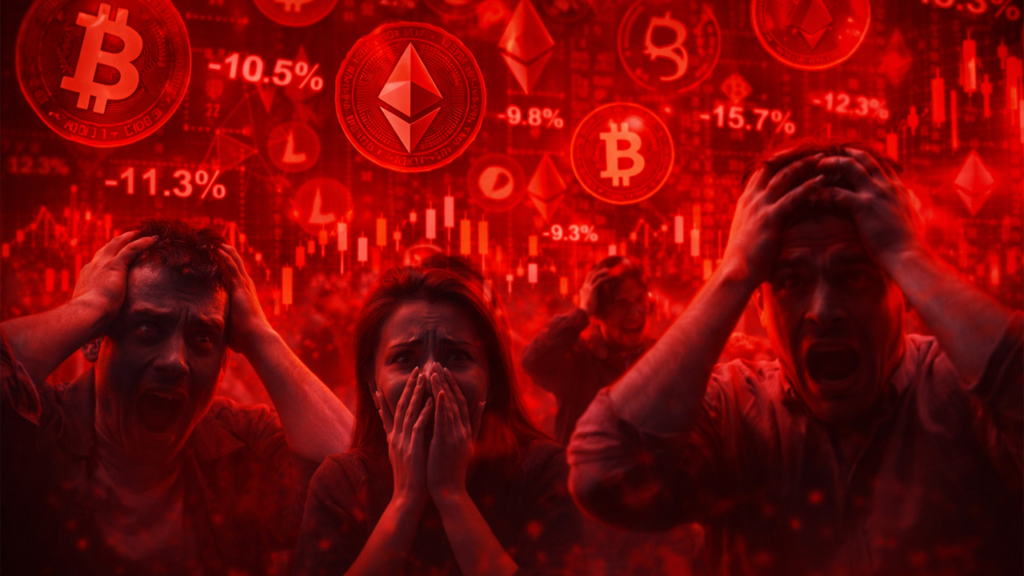
Why is crypto down today? As of February 23, 2026 (Philippine Time), the crypto market is trading lower across major assets, with Bitcoin, Ethereum, XRP, and many altcoins showing continued weakness.
Market sentiment has shifted toward caution, and investors are trying to understand what is driving the latest decline.
In this detailed breakdown, we’ll analyze the real reasons behind today’s crypto drop, whether this is panic or a healthy correction, and what traders should watch next.
Bitcoin (BTC) remains below key psychological levels around $65,000–$68,000, struggling to reclaim bullish momentum.
Ethereum (ETH) is trading under pressure near the $1,900–$2,000 range, while many altcoins are either consolidating or extending recent losses.
The Fear & Greed Index has moved toward extreme fear territory, reflecting cautious investor behavior and reduced risk appetite.
When sentiment drops to this level, selling pressure tends to increase as traders protect capital instead of taking new positions.
So if you're asking why is crypto down today, the answer begins with sentiment — but it doesn’t end there.
There isn’t one single event causing the drop. Instead, several factors are combining to push prices lower.
Crypto markets are now heavily correlated with traditional financial markets.
Recent uncertainty surrounding U.S. trade policy, interest rate outlooks, and global economic conditions has weakened overall risk appetite.
When macroeconomic conditions become unstable, investors often reduce exposure to high-risk assets, and crypto is still considered a high-beta risk asset.
This broader risk-off sentiment contributes significantly to why crypto is down today.
The crypto market has had a weak start to 2026. Bitcoin has posted one of its worst year-to-date performances in recent history, declining significantly compared to previous cycle highs.
Repeated failed rallies have exhausted bullish momentum.
When buyers repeatedly fail to push prices above resistance levels, sellers gain confidence and technical weakness builds.
This ongoing structural weakness is another major reason why crypto is down today.
Crypto markets are highly leveraged.
When prices drop below important support zones, automated liquidations can trigger cascading sell-offs.
Liquidity thins out during uncertainty, meaning fewer buyers are willing to step in at lower levels.
Once stop-losses and margin calls begin to activate, downward momentum accelerates, even without major news headlines.
Ongoing debates around crypto regulation, stablecoin oversight, and global compliance frameworks continue to create hesitation among institutional investors.
Capital tends to wait for clarity.
When regulatory direction is uncertain, institutions often delay large allocations, reducing upward momentum in the market.
Historically, crypto performs in tandem with technology stocks and other speculative assets.
When equity markets decline, crypto frequently follows.
Institutional capital rotation out of high-risk sectors can amplify selling pressure in digital assets, reinforcing today’s weakness.
While the red candles may look dramatic, current conditions suggest this is more of a prolonged corrective phase rather than a sudden flash crash.
Prices have been grinding lower over several weeks.
Sentiment remains defensive, but we are not yet seeing widespread capitulation behavior typical of major bottoms.
Extreme fear often appears near cycle lows — but it can also persist longer than many expect.
If you're monitoring the market closely, here are important zones:
Bitcoin Support: $62,000–$64,000
A clean break below this range could invite deeper downside.
Ethereum Range: $1,900–$2,000
Failure to hold this cluster may extend selling pressure.
Reclaiming resistance levels above recent highs would be the first signal that downside momentum is weakening.
Current community discussions reflect:
• Liquidity concerns
• Reduced buyer conviction
• Waiting for macro clarity
• Selective long-term accumulation strategies
Many experienced traders are staying defensive rather than aggressively buying dips.
To summarize, why is crypto down today comes down to a combination of:
There is no single catastrophic event, instead, the market is reacting to layered pressures across multiple fronts.
For short-term traders, volatility is likely to remain elevated. For long-term investors, patience and risk management are crucial during corrective phases.
Markets move in cycles. Whether this becomes a deeper drawdown or stabilizes near support levels will depend largely on macro developments and renewed buying interest.

Across social media platforms in the Philippines, crypto casinos are gaining visibility.
Influencers post large wins.
Referral systems spread aggressively.
Telegram and Facebook groups circulate screenshots of multipliers and jackpot payouts.
At first glance, the attraction is understandable.
Crypto casinos offer speed, simplicity, and the promise of fast returns.
But when examined from an economic, behavioral, and probabilistic perspective, a different picture emerges.
This article analyzes why crypto casinos are becoming popular among Filipinos — and whether they truly offer a viable path to long-term wealth compared to disciplined crypto trading and investing.
Crypto casinos present an emotionally compelling story: small capital can turn into large profit within minutes.
This narrative is especially powerful in developing economies where income growth may feel slow and limited.
However, emotional appeal must be separated from structural reality.
Crypto casinos operate on a house-edge model.
This means that mathematically, over a large number of repetitions, the platform retains a statistical advantage.
The games are not neutral systems.
They are engineered to generate profit for the operator.
A player may win in the short term.
But repeated participation over time statistically reduces capital rather than grows it.
The system is not designed for player wealth accumulation.
It is designed for platform profitability.
Several socio-economic factors contribute to the attraction:
But behavioral attraction does not override probability.
When people chase fast gains, they often underestimate long-term statistical loss.
Crypto casinos are fundamentally negative-expectancy systems for players.
If a game has even a small house edge — say 2% to 5% — that edge compounds against the player over repeated plays.
This is not speculation.
It is mathematical design.
In contrast:
Crypto trading is risk-based but not structurally negative by default.
Profitability depends on strategy, risk management, and emotional discipline.
While many traders lose due to poor execution, the system itself does not guarantee loss.
Long-term crypto investing, when focused on fundamentally strong projects, benefits from network growth, adoption cycles, and compounding.
While volatility exists, the structural mechanism allows for long-term capital appreciation.
One system extracts value from participants.
The other allows participants to accumulate value from growth.
Sustainable wealth typically grows through:
Crypto casinos fail the first requirement.
They do not offer positive expectancy for regular participants.
The more frequently a person plays, the more the statistical edge works against them.
Trading and investing, while risky, allow for positive expectancy when skill, patience, and discipline are applied.
If someone participates repeatedly in crypto casinos over years, without strict limits, the probability of ending up financially ahead is low.
If someone studies markets, manages risk, avoids overleverage, and invests in fundamentally strong tokens during growth cycles, the probability of wealth accumulation is significantly higher.
So to answer directly:
Crypto casinos are not a reliable path to wealth.
They are structured as entertainment systems with embedded loss probability.
Crypto trading and long-term investing, when done properly, are far more likely to generate sustainable financial growth over time.
If the goal is excitement, crypto casinos can provide stimulation — but at financial risk.
If the goal is long-term wealth, financial independence, and capital growth, disciplined trading and investing offer a structurally superior path.
In the long run, wealth is built on compounding and probability — not on games designed with a house edge.
If the objective is to grow money rather than gamble it, the rational choice is clear.

For those who have no idea what Novaluxia is, or if this is the first time you are hearing the name, this article is for you.
According to their website, Novaluxia claims to be an AI-powered social commerce platform in the Philippines. They say they combine AI technology and social interaction to make shopping easier, more enjoyable, and more affordable for users inside the platform.
Inside Novaluxia, users can shop in a built-in mall, participate in what they call group buying, join lucky draws, earn reward points, upgrade memberships, and unlock higher earning tiers.
But the real question most people are asking is this:
Is Novaluxia truly e-commerce? Is it a marketplace platform? Is it social commerce? Is it community commerce? Or is it something else entirely?
Before we answer that, we need to define what real e-commerce actually is.
E-commerce is direct online buying and selling. In traditional e-commerce, the process is simple. A seller lists a product, a buyer purchases the product, the product is delivered, and the transaction ends.
The seller earns from product margin.
For example, if someone buys a product for ₱500 and sells it for ₱2,500, and spends ₱1,000 on ads and shipping, the profit is ₱1,000. The core income driver is product sales. No product sold means no revenue.
That is the foundation of real e-commerce.
An e-commerce platform is a marketplace like Lazada or Shopee. The platform acts as a bridge between sellers and buyers.
Sellers list products. Buyers purchase those products. The platform handles payment processing and logistics. The platform earns from commission per sale, sponsored listings, transaction fees, and logistics services.
But again, the core revenue still comes from product sales.
Social e-commerce adds content and influencers into the equation. TikTok Shop is a clear example.
There are three major parties involved: the seller, the creator or affiliate, and the buyer. The creator earns commission from product sales. The platform earns commission and advertising fees.
The core revenue still comes from product sales.
Community e-commerce is group-based buying. Examples include co-operatives, Facebook selling groups, Discord groups, and Telegram communities.
The concept is simple. A community gathers buyers together to unlock better pricing or exclusive deals. Revenue still comes from product margin or commission.
In legitimate group buying, there is a minimum required number of buyers. Once the target is reached, all participants receive the product at a discounted price. If the target is not reached, the order is canceled and the money is refunded.
Everyone who joins expects to receive the product.
Novaluxia does not fully match traditional e-commerce.
In traditional e-commerce, you choose a product, pay for it, and receive it. There are no raffle mechanics. There is no “win or lose” outcome. The goal is to obtain the product.
In Novaluxia’s group buying, the mechanics are different.
When you participate in NovaBolt group buying, you choose a group that is close to completion, click join, and pay ₱1,000. When the group reaches 100 participants, only one participant wins the product through a raffle.
The rest lose.
That already differs from legitimate group buying, where everyone gets the product once the minimum number of buyers is reached.
Even more concerning, if you win, you have the option not to claim the product and instead get your money back. In legitimate group buying, people join because they want to buy the product at a discount. Here, participants are not necessarily interested in receiving the product.
This leads to a crucial observation: the main motivation appears to be earning bonus points.
If you lose the raffle, you receive bonus points. Those points can be converted into peso.
For example, if you lose and you have no recruits, you might receive 10 bonus points. If you have recruits, you might receive 13 or even 18 points.
This changes the purpose of participation. The focus shifts from buying a product to earning points.
Now the important question arises: where does the money for those points come from?
If 100 participants each contribute ₱1,000, the total pool for that cycle becomes ₱100,000. Out of those 100 participants, 99 will have their ₱1,000 refunded and, in addition, receive 10 bonus points each, which is equivalent to ₱990 distributed by the platform on top of returning their original capital.
If the winner chooses not to claim the product and gets refunded, then no product sale occurred.
If the winner claims the product, the platform still distributes 990 pesos while collecting only ₱1,000 from the winner. How does that cover product cost, logistics, platform operations, and still generate profit?
Unless the product cost is extremely low, the math raises sustainability concerns.
Another red flag is the referral requirement.
If you have no recruits, you can only participate in Daily Use group buying up to 100 times. After that, you must upgrade.
How do you upgrade?
You recruit two active members.
In legitimate group buying or traditional e-commerce, you do not need to recruit people to continue buying products. Here, recruitment unlocks earning potential.
That shifts the business focus from product demand to network expansion.
In normal e-commerce, coupons come from sales events, minimum spend requirements, seller promotions, or loyalty programs.
In Novaluxia, coupons are earned through recruitment activity. The more active your recruits are, the more benefits you unlock.
This suggests that growth and participation are prioritized over retail sales.
SVIP reportedly costs ₱4,000. It allegedly offers weekly fixed income of ₱1,600. In three months, the claim is that you can earn ₱19,200 plus recover your capital.
Fixed weekly income is not typical e-commerce terminology. It resembles investment language.
If earnings are fixed regardless of actual product sales performance, the question remains: what funds those payouts?
If the payout depends on continuous new member deposits, the structure becomes growth-dependent.
Members can earn 16% from Level 1 recruits and 4% from Level 2 recruits.
This resembles a multi-level compensation structure. Again, the focus appears to be network activity rather than product sales.
Across all earning streams inside Novaluxia, where does the profit originate?
Is there public audit documentation showing that revenue primarily comes from product sales?
Are there transparent supplier relationships and commission disclosures?
Or does the platform rely heavily on participant deposits and upgrade fees?
Based on the structure observed, it appears that product sales are not the main engine driving payouts.
Based on the structure, mechanics, and compensation model explained above, Novaluxia is not recommended.
This conclusion is not based on emotion or bias. It is based on structural analysis.
The primary concern is sustainability.
In legitimate e-commerce, revenue is driven by real product demand. Buyers purchase products because they want them. Sellers earn from margin. Platforms earn from commission per sale. Everything revolves around product movement.
In Novaluxia’s case, the dominant behavior appears to revolve around earning points, unlocking tiers, recruiting members, and accessing higher reward levels. The product itself does not seem to be the core driver of activity. In fact, even when someone wins a product, they have the option not to claim it. That alone shows that consumption is not the priority.
Another major concern is the growth dependency of the system. If participation rewards, upgrade benefits, and team commissions depend heavily on recruitment and continued inflow of new members, then the long-term stability of payouts becomes questionable. Any model that relies more on new participant deposits than on verified product sales carries inherent risk.
The presence of:
creates a structure that resembles high-risk financial ecosystems rather than traditional e-commerce.
There is also limited transparency regarding:
Without those elements, it becomes difficult to verify whether the payout system is truly backed by retail economics or by internal circulation of participant funds.
Because of these structural risks, it is not advisable to:
Deposit significant amounts of money.
Upgrade based on promised fixed returns.
Recruit friends and family without full understanding of the risks.
Provide sensitive personal identification information without verified security standards.
Even if early participants are currently receiving payouts, that does not automatically mean the system is sustainable long term. Growth-dependent systems can appear profitable in early phases but become unstable once expansion slows down.
The idea of community-driven commerce and shared value sounds attractive. However, execution and economic foundation matter more than branding.
For these reasons, Novaluxia carries high financial risk and is not recommended for participation, especially for individuals who cannot afford to lose their capital.
As always, do your own research, verify information independently, and never invest money you are not prepared to lose.

If you’re a Filipino crypto user, the past couple of years have felt like a slow squeeze.
One day you can trade normally. The next day, the same link loads with errors.
Then the app disappears from the Play Store. And suddenly the question stops being “Which coin is pumping?” and becomes: “Are we being protected… or being cornered?”
This blog post answers your exact question, is the pressure on Binance in the Philippines mainly about regulation, or is it corruption / local-exchange influence?
And more importantly: When will the Philippines become truly open enough to give ordinary people better options?
As of mid-February 2026, credible PH-focused reports say:
So yes, the “pressure” is not just vibes or rumors. It’s a documented regulatory sequence: advisory → grace period → request to block → app-store removals and access restrictions.
When regulators say regulation, it often sounds like a clean, boring word. But on the ground, it means something very specific:
The Philippine SEC has repeatedly framed Binance as unregistered / not authorized for activities that fall under securities rules (their claim is tied to the Securities Regulation Code).
That’s why app stores and ISP blocks become the pressure points: you don’t have to raid an office if you can restrict distribution and access.
Regulators commonly cite scams, collapses, and consumer harm as context for stricter action against unregistered platforms.
In PH coverage, SEC leadership has pointed to investor protection concerns, and the government has used similar tactics before (like app takedowns in other industries).
Let’s deal with this honestly.
The documented basis for the Binance squeeze in the Philippines is regulatory enforcement tied to authorization/licensing and securities-law framing.
That’s not speculation, those claims are stated in reporting about SEC actions and the SEC advisory timeline.
“Corruption” is a serious accusation.
There is no solid public proof in the sources above that the Binance actions are driven by bribery or corrupt payoffs.
If anyone claims it as a fact, they need evidence, documents, investigations, convictions, whistleblowers, or verified reporting, not just the feeling that “something is off.”
So if you’re asking me to pick one as fact:
Based on available evidence, the pressure is primarily regulation, not proven corruption.
But that’s not the end of the story.
Even without corruption, systems can still tilt.
Here’s the reality in many countries: local industry groups often lobby regulators.
And in the Philippines, there were reports about digital trade groups backing a Binance ban back in late 2023.
That doesn’t automatically mean corruption. It can mean:
This is where ordinary users feel trapped:
“If you block the biggest global exchange, do we actually get better protection… or just fewer choices?”
That emotional frustration is valid, especially if you’re a small trader, a side-hustler, or someone trying to protect savings from inflation and low wages.
Binance isn’t being treated like a tiny fly-by-night platform. It’s being treated like a high-impact gateway:
When a regulator wants to show it can “control the space,” it targets the biggest door first, because that’s where the most people walk in.
This is where the Philippines gets complicated.
The BSP has had periods where it closed/paused the regular application window for new VASP licenses for years starting September 2022 (as reported by major PH outlets), reflecting a cautious stance around risk management and oversight capacity.
By 2025, legal summaries and professional updates describe the SEC issuing rules/guidelines for crypto-asset service providers (CASP).
In plain English: the government has been tightening the rulebook, but rulebooks take time to implement cleanly, and enforcement often moves faster than licensing capacity.
That gap is where users suffer.
No fantasy predictions, just plausible tracks based on how regulation usually evolves.
The Philippines slowly expands regulated access by:
That aligns with how BSP VASP guidelines describe obligations like recordkeeping, controls, and supervisory enforcement frameworks.
Under this scenario, the PH becomes “open,” but only for exchanges willing to fully localize compliance, either directly or via local partnerships.
The PH keeps access narrow:
This is the nightmare for advanced users: you’re “protected,” but your tools are gone.
This is what many users hope for: a path where major global exchanges return under PH rules. But that requires:
If the rules stabilize and the licensing bottleneck loosens, this becomes more realistic, especially as SEC CASP rules mature and BSP capacity expands.
Here’s the hard truth:
The Philippines becomes meaningfully open when these three things happen at the same time:
If access restrictions continue without an equally fast expansion of legitimate options, people will do what people always do:
And that’s the irony: over-restriction can create the exact risk it claims to prevent.
Based on publicly reported evidence, it’s regulation.
But it’s also fair to say this: even without proven corruption, policy outcomes can still benefit certain players if competition shrinks and licensing is slow.
The presence of industry support for the ban shows that market interests do exist around this issue.
So the best framing is:

The crypto market moves fast — but when a privacy-focused Ethereum project suddenly starts trending across exchanges and search platforms, it usually means something bigger is happening behind the scenes.
Over the past 24 hours, Aztec Network’s token has experienced a noticeable surge in trading activity, accompanied by a spike in global search interest.
The main catalyst? Fresh liquidity inflows and strong volume activity following listings and renewed attention from Korean trading communities.
Let’s break down what’s happening, why it matters, and whether this move signals sustainable growth or short-term speculation.
Aztec Network is a privacy-first Layer 2 solution built on Ethereum. Its core mission is to bring programmable privacy to smart contracts, something that traditional public blockchains struggle to provide.
Unlike basic token privacy mixers, Aztec is focused on enabling private DeFi, confidential transactions, and zero-knowledge (ZK) smart contract execution.
The protocol leverages advanced cryptographic techniques, particularly zero-knowledge proofs, to allow users to interact with applications without exposing sensitive financial data on-chain.
In simple terms:
As regulatory discussions around privacy intensify globally, projects like Aztec often sit at the intersection of innovation and controversy, which makes them highly reactive to market sentiment.
The recent surge in volume appears closely tied to increased visibility and trading activity from Korean exchanges and communities.
Korean crypto markets are historically known for:
When a token gains traction in Korean markets, trading volume can spike dramatically in a short period.
Over the last 24 hours:
This kind of synchronized spike, price + volume + search interest, typically indicates that a new wave of participants has entered the market.
When analyzing sudden surges, one key question matters:
Is this organic accumulation or short-term speculative momentum?
There are a few signs to consider:
If volume is heavily concentrated in a single exchange or region, it may indicate localized speculation rather than global adoption.
If liquidity is thin and price moves aggressively with relatively small capital, volatility can reverse quickly.
Sudden hype cycles often appear before major corrections, especially if narratives spread faster than fundamentals.
That said, increased visibility is not inherently negative. Exposure can accelerate ecosystem growth, especially for infrastructure projects like Aztec that rely on developer and protocol-level adoption.
Privacy-focused projects tend to cycle in relevance depending on:
Recently, broader discussions around on-chain privacy, MEV protection, and confidential transaction layers have resurfaced in Ethereum development circles.
Aztec’s technology positions it as more than just a token, it is infrastructure for private smart contract execution.
If the market begins rotating capital back into privacy narratives, Aztec could benefit from that macro shift.
From a structural perspective, sudden spikes often fall into two patterns:
The next 48–72 hours typically determine which scenario dominates.
Momentum-driven moves require follow-through. Without sustained buying pressure, early entrants may begin taking profits, triggering volatility.
It’s important not to confuse exchange listings with institutional accumulation.
While Korean market participation can increase liquidity dramatically, it does not automatically mean:
True long-term growth usually comes from:
Volume spikes are attention signals, not confirmation of structural adoption.
Privacy projects operate in a sensitive regulatory space.
Potential risks include:
Additionally, fast price increases can attract leveraged trading, which increases liquidation risk during pullbacks.
If leverage builds up too quickly, even minor corrections can trigger cascading liquidations.
Unlike older privacy coins that focus purely on anonymous payments, Aztec’s differentiation lies in programmable privacy.
That means:
This programmable flexibility gives Aztec a more modular design compared to single-purpose privacy chains.
That architectural distinction is often overlooked during hype cycles, but it matters long term.
The recent surge in Aztec Network’s token activity highlights how quickly capital can rotate into niche narratives, especially when fueled by regional exchange momentum.
The key questions moving forward are:
Short-term volatility is almost guaranteed.
Long-term sustainability depends on adoption, ecosystem growth, and how the privacy narrative evolves within Ethereum’s roadmap.
For now, Aztec Network has regained the market’s attention.
Whether it keeps it, that depends on what happens next.

If you’ve been in crypto long enough, you already know one thing:
“Safe” doesn’t mean perfect. It means understanding the risks before you trust a platform with your money.
In the Philippines, one name that always comes up is PDAX (Philippine Digital Asset Exchange). It’s local. It’s known. It’s regulated. But the real question many people quietly ask is:
Is PDAX actually safe? Or are there better and safer alternatives?
Let’s break this down properly, no hype, no hate, no favoritism.
PDAX gained traction because:
For many beginners, that already feels “safer” compared to random foreign exchanges.
But safety in crypto isn’t just about regulation.
It’s about:
And this is where things get more interesting.
In February 2021, during a major Bitcoin rally, PDAX experienced a serious outage.
Users reported:
At the same time, there was a controversial case involving a Bitcoin trade executed at an unusually low price, followed by discussions about reversing the transaction.
Why does this matter?
Because in crypto, availability is part of safety.
If you cannot access your funds during extreme market movement, that’s risk.
If abnormal trades create disputes about finality, that affects trust.
This doesn’t mean the platform is fraudulent.
But it does mean that operational robustness is a legitimate concern when evaluating safety.
Many people misunderstand this.
There are different types of safety:
Let’s evaluate PDAX across these dimensions.
PDAX is listed in BSP directories as a Virtual Asset Service Provider.
This gives:
For Filipino users who prefer a local framework, this is a plus.
Direct PHP deposits and withdrawals make it convenient for beginners.
You don’t need:
That convenience lowers entry barriers.
Compared to global exchanges with complex interfaces, PDAX is simpler.
For non-technical users, that’s helpful.
Now let’s discuss the more critical side.
This is not speculation. It happened.
During a high-volume Bitcoin rally, the system struggled.
In crypto, exchange downtime during volatility is one of the biggest risk indicators because:
A safe exchange should perform strongest during stress.
PDAX operates on a smaller scale compared to global giants like Binance, Coinbase, or Kraken.
Large exchanges typically have:
Scale doesn’t automatically mean safer, but infrastructure maturity matters.
This is important.
Major exchanges like Binance provide:
PDAX does not publicly offer a comparable robust trading API ecosystem like Binance.
Why does this matter?
Because:
Lack of strong API access limits:
For serious traders, this is a disadvantage.
Global exchanges typically offer:
Smaller exchanges often face:
Liquidity impacts real trading safety, especially during volatility.
Some large exchanges publish Proof of Reserves or third-party audits.
While PoR is not perfect, it adds transparency.
PDAX does not prominently market public cryptographic reserve verification comparable to major global players.
Transparency builds confidence.
Let’s be clear: this section is about caution signals, not claims of wrongdoing.
These are not proof of danger.
But they are risk variables.
Instead of naming specific exchanges, let’s define criteria.
An exchange may be safer if it has:
If a platform checks more of these boxes, it may offer higher operational resilience.
Even the biggest exchanges have faced:
Crypto safety rule number one:
If you do not control the private keys, you do not fully control the asset.
The safest long-term strategy for large holdings is:
That applies whether you use PDAX or Binance.
Here’s the balanced answer.
PDAX is not an obvious scam platform.
It is not an anonymous offshore exchange.
It has regulatory presence and operates publicly.
However:
It is smaller in scale.
It has experienced operational stress in the past.
It lacks advanced API infrastructure comparable to major global exchanges.
It does not provide the same level of global-scale transparency tooling.
For beginners who want PHP access and local familiarity, it may be acceptable.
For advanced traders, high-frequency traders, or large capital holders, infrastructure depth becomes more critical.
If you are using PDAX:
If you are comparing exchanges:
Don’t ask “Which one is safe?”
Ask:
Safety in crypto is not about brand loyalty.
It’s about risk management.
And the smartest users don’t trust blindly, they compare objectively.
That’s how you stay ahead.

If you checked your crypto watchlist this morning and blinked twice at snx, you’re not alone.
The Synthetix token has been turning heads with an unexpected uptick in price and a noticeable jump in trading activity, something that didn’t just happen out of the blue.
Let’s unpack what’s really driving snx’s surge today, the data behind it, and whether this momentum has teeth or is just another temporary crypto whim.
For weeks leading up to today, snx was drifting in a familiar pattern — low volatility, sideways price action, and a sense of wait-and-see from traders.
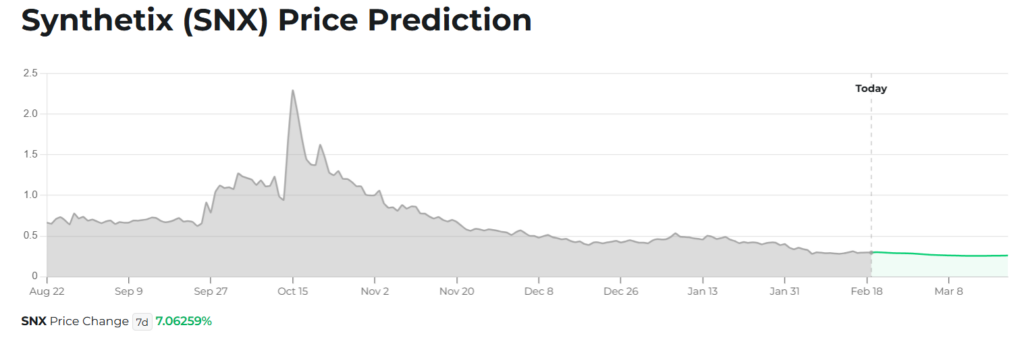
It wasn’t that snx was dead; rather, it had been digesting extended selling pressure after a long period of red candles on the charts.
In fact, over the past month, snx generally underperformed compared to the broader crypto market, with mixed signals and bearish technicals holding back real conviction.
But then something shifted.
Right now, data from multiple market sources show snx trading noticeably higher on the day, with price gains in the double digits and an equally impressive expansion in 24-hour trading volume.
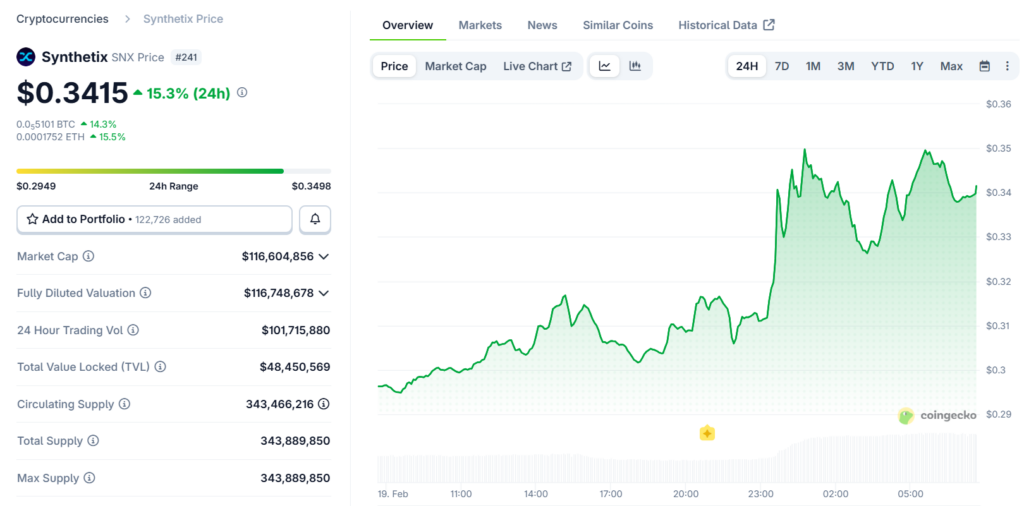
According to CoinGecko, snx’s trading volume has spiked nearly 15.3% in the last 24 hours, while price has outperformed some of its peers.
On other platforms like Binance and TradingView, traders are already talking about strong buying pressure. The token broke above key short-term resistance zones, and buyers stepped in aggressively, typical signs of renewed interest.
But here’s where it gets interesting: this isn’t just random volatility.
Instead of beating around the bush, here are the prime factors that traders and investors are pointing to today:
One of the biggest drivers behind the renewed optimism is the recent launch of Synthetix’s perpetual decentralized exchange (Perp DEX) on Ethereum.
This is a pivot back to Ethereum mainnet after years of focusing on Layer-2 deployments, and it matters. Derivatives trading is one of the largest parts of DeFi, drawing massive volume and liquidity.
This strategic move positions snx right back at the heart of decentralized derivatives, where traders are actively deployed and where capital flows fast.
Across lower timeframes (like 4H charts), snx recently broke above key moving averages and its short-term trading structure flipped bullish.
In crypto, that’s often when technical traders throw in fresh entries, creating a self-reinforcing upward move.
While snx’s broader trend wasn’t the strongest until recently, today’s activity shows retail traders waking up and short-term momentum players jumping back in.
That’s reflected in how both price and volume are advancing together, a hallmark of genuine interest versus a stale pump.
Let’s be blunt: snx hasn’t suddenly found a miracle fundamental overnight.
Its long-term price history is still far below previous all-time highs, and macro conditions in crypto are cautious.
But this isn’t typical noise, either.
Here’s my honest take:
Yes, this rally looks real enough for traders — breakouts, buyer pressure, and fresh volume can fuel a continuation for the next few sessions. The Perp DEX rollout adds a tangible product catalyst into the mix that wasn’t there before.
The key question is whether demand holds once today’s excitement fades. Right now, bulls would need consistent liquidity flows and continued protocol adoption — not just a one-day price jump — to sustain higher levels.
snx still faces stiff competition from other DeFi and derivatives platforms.
Its fundamentals matter: user activity on the Synthetix protocol, growth in synthetic assets trading, and real adoption of its new DEX feature, these variables are far bigger than today’s chart patterns.
Since today’s move didn’t come out of nowhere, keep an eye on:
🔥 Volume retention over the next few sessions — if volume stays high, the rally could stick.
🔥 Support levels around recent breakouts — a failure here could send snx back into consolidation.
🔥 Macro sentiment in crypto markets — snx often dances with Bitcoin and Ethereum trends.
Yes, snx’s price pumping and volume surging today is a meaningful event, backed by real catalysts like the Perp DEX launch and stronger participation.
But don’t mistake a short-term spike for a full trend reversal, the bigger picture still matters.
If you’re thinking about entering a position or timing exits, watch how this momentum evolves in the next few hours and days.
This isn’t just FOMO, the market is reacting to product momentum, and you can feel it in the data.
But the next question cryptotraders ask tomorrow might be even more important: “Can snx keep this pace?”