
If you’ve been in crypto long enough, you already know one thing:
“Safe” doesn’t mean perfect. It means understanding the risks before you trust a platform with your money.
In the Philippines, one name that always comes up is PDAX (Philippine Digital Asset Exchange). It’s local. It’s known. It’s regulated. But the real question many people quietly ask is:
Is PDAX actually safe? Or are there better and safer alternatives?
Let’s break this down properly, no hype, no hate, no favoritism.
PDAX gained traction because:
For many beginners, that already feels “safer” compared to random foreign exchanges.
But safety in crypto isn’t just about regulation.
It’s about:
And this is where things get more interesting.
In February 2021, during a major Bitcoin rally, PDAX experienced a serious outage.
Users reported:
At the same time, there was a controversial case involving a Bitcoin trade executed at an unusually low price, followed by discussions about reversing the transaction.
Why does this matter?
Because in crypto, availability is part of safety.
If you cannot access your funds during extreme market movement, that’s risk.
If abnormal trades create disputes about finality, that affects trust.
This doesn’t mean the platform is fraudulent.
But it does mean that operational robustness is a legitimate concern when evaluating safety.
Many people misunderstand this.
There are different types of safety:
Let’s evaluate PDAX across these dimensions.
PDAX is listed in BSP directories as a Virtual Asset Service Provider.
This gives:
For Filipino users who prefer a local framework, this is a plus.
Direct PHP deposits and withdrawals make it convenient for beginners.
You don’t need:
That convenience lowers entry barriers.
Compared to global exchanges with complex interfaces, PDAX is simpler.
For non-technical users, that’s helpful.
Now let’s discuss the more critical side.
This is not speculation. It happened.
During a high-volume Bitcoin rally, the system struggled.
In crypto, exchange downtime during volatility is one of the biggest risk indicators because:
A safe exchange should perform strongest during stress.
PDAX operates on a smaller scale compared to global giants like Binance, Coinbase, or Kraken.
Large exchanges typically have:
Scale doesn’t automatically mean safer, but infrastructure maturity matters.
This is important.
Major exchanges like Binance provide:
PDAX does not publicly offer a comparable robust trading API ecosystem like Binance.
Why does this matter?
Because:
Lack of strong API access limits:
For serious traders, this is a disadvantage.
Global exchanges typically offer:
Smaller exchanges often face:
Liquidity impacts real trading safety, especially during volatility.
Some large exchanges publish Proof of Reserves or third-party audits.
While PoR is not perfect, it adds transparency.
PDAX does not prominently market public cryptographic reserve verification comparable to major global players.
Transparency builds confidence.
Let’s be clear: this section is about caution signals, not claims of wrongdoing.
These are not proof of danger.
But they are risk variables.
Instead of naming specific exchanges, let’s define criteria.
An exchange may be safer if it has:
If a platform checks more of these boxes, it may offer higher operational resilience.
Even the biggest exchanges have faced:
Crypto safety rule number one:
If you do not control the private keys, you do not fully control the asset.
The safest long-term strategy for large holdings is:
That applies whether you use PDAX or Binance.
Here’s the balanced answer.
PDAX is not an obvious scam platform.
It is not an anonymous offshore exchange.
It has regulatory presence and operates publicly.
However:
It is smaller in scale.
It has experienced operational stress in the past.
It lacks advanced API infrastructure comparable to major global exchanges.
It does not provide the same level of global-scale transparency tooling.
For beginners who want PHP access and local familiarity, it may be acceptable.
For advanced traders, high-frequency traders, or large capital holders, infrastructure depth becomes more critical.
If you are using PDAX:
If you are comparing exchanges:
Don’t ask “Which one is safe?”
Ask:
Safety in crypto is not about brand loyalty.
It’s about risk management.
And the smartest users don’t trust blindly, they compare objectively.
That’s how you stay ahead.

If you checked your crypto watchlist this morning and blinked twice at snx, you’re not alone.
The Synthetix token has been turning heads with an unexpected uptick in price and a noticeable jump in trading activity, something that didn’t just happen out of the blue.
Let’s unpack what’s really driving snx’s surge today, the data behind it, and whether this momentum has teeth or is just another temporary crypto whim.
For weeks leading up to today, snx was drifting in a familiar pattern — low volatility, sideways price action, and a sense of wait-and-see from traders.
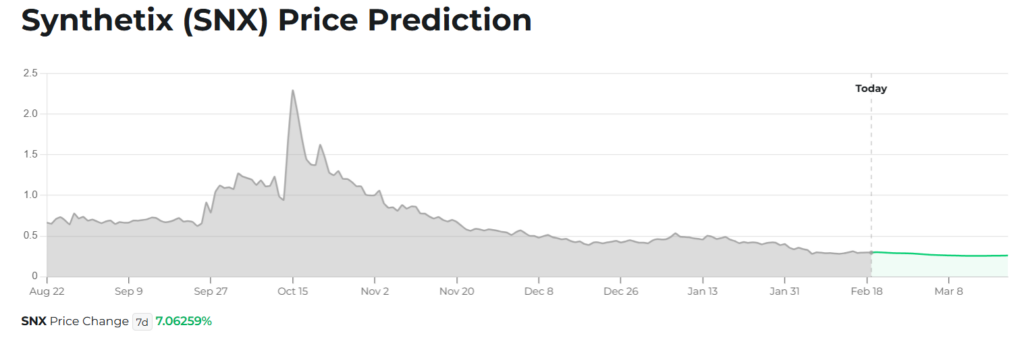
It wasn’t that snx was dead; rather, it had been digesting extended selling pressure after a long period of red candles on the charts.
In fact, over the past month, snx generally underperformed compared to the broader crypto market, with mixed signals and bearish technicals holding back real conviction.
But then something shifted.
Right now, data from multiple market sources show snx trading noticeably higher on the day, with price gains in the double digits and an equally impressive expansion in 24-hour trading volume.
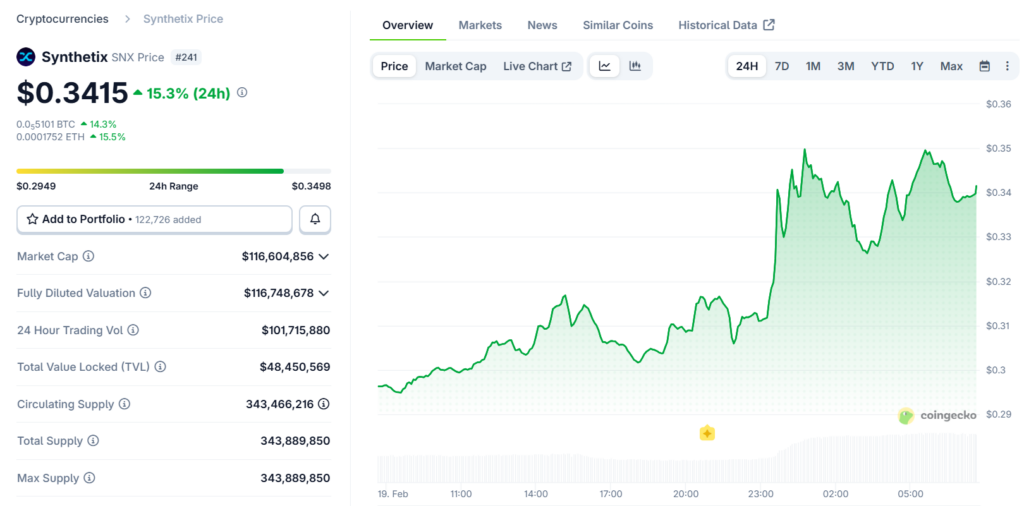
According to CoinGecko, snx’s trading volume has spiked nearly 15.3% in the last 24 hours, while price has outperformed some of its peers.
On other platforms like Binance and TradingView, traders are already talking about strong buying pressure. The token broke above key short-term resistance zones, and buyers stepped in aggressively, typical signs of renewed interest.
But here’s where it gets interesting: this isn’t just random volatility.
Instead of beating around the bush, here are the prime factors that traders and investors are pointing to today:
One of the biggest drivers behind the renewed optimism is the recent launch of Synthetix’s perpetual decentralized exchange (Perp DEX) on Ethereum.
This is a pivot back to Ethereum mainnet after years of focusing on Layer-2 deployments, and it matters. Derivatives trading is one of the largest parts of DeFi, drawing massive volume and liquidity.
This strategic move positions snx right back at the heart of decentralized derivatives, where traders are actively deployed and where capital flows fast.
Across lower timeframes (like 4H charts), snx recently broke above key moving averages and its short-term trading structure flipped bullish.
In crypto, that’s often when technical traders throw in fresh entries, creating a self-reinforcing upward move.
While snx’s broader trend wasn’t the strongest until recently, today’s activity shows retail traders waking up and short-term momentum players jumping back in.
That’s reflected in how both price and volume are advancing together, a hallmark of genuine interest versus a stale pump.
Let’s be blunt: snx hasn’t suddenly found a miracle fundamental overnight.
Its long-term price history is still far below previous all-time highs, and macro conditions in crypto are cautious.
But this isn’t typical noise, either.
Here’s my honest take:
Yes, this rally looks real enough for traders — breakouts, buyer pressure, and fresh volume can fuel a continuation for the next few sessions. The Perp DEX rollout adds a tangible product catalyst into the mix that wasn’t there before.
The key question is whether demand holds once today’s excitement fades. Right now, bulls would need consistent liquidity flows and continued protocol adoption — not just a one-day price jump — to sustain higher levels.
snx still faces stiff competition from other DeFi and derivatives platforms.
Its fundamentals matter: user activity on the Synthetix protocol, growth in synthetic assets trading, and real adoption of its new DEX feature, these variables are far bigger than today’s chart patterns.
Since today’s move didn’t come out of nowhere, keep an eye on:
🔥 Volume retention over the next few sessions — if volume stays high, the rally could stick.
🔥 Support levels around recent breakouts — a failure here could send snx back into consolidation.
🔥 Macro sentiment in crypto markets — snx often dances with Bitcoin and Ethereum trends.
Yes, snx’s price pumping and volume surging today is a meaningful event, backed by real catalysts like the Perp DEX launch and stronger participation.
But don’t mistake a short-term spike for a full trend reversal, the bigger picture still matters.
If you’re thinking about entering a position or timing exits, watch how this momentum evolves in the next few hours and days.
This isn’t just FOMO, the market is reacting to product momentum, and you can feel it in the data.
But the next question cryptotraders ask tomorrow might be even more important: “Can snx keep this pace?”

The cryptocurrency industry continues to expand globally, and regional exchanges are starting to gain stronger recognition.
One platform that has steadily built its presence is VALR — a South Africa–based exchange that has grown beyond its local market and entered broader international discussions.
As traders look for reliable platforms with strong liquidity and fiat access, this exchange has become part of the conversation. But how competitive is it in 2026? Let’s examine its structure, activity, and overall positioning.
Founded in 2018, VALR began as a regional cryptocurrency exchange serving African markets. Over time, it expanded its offerings to include advanced trading tools, futures products, and broader digital asset support.
Today, it operates as a centralized exchange providing:
Its strong integration with local banking systems has made it especially attractive to traders in Africa, while its product expansion has opened the door to international users.
Liquidity remains one of the most important factors when evaluating any exchange. Active order books typically lead to:
Trading activity on VALR is often concentrated in:
For traders who rely on consistent order flow, stable liquidity is a key indicator of platform health.
The exchange offers standard spot trading with multiple order types suitable for both beginner and advanced traders. Users can execute market and limit orders depending on their strategy.
More experienced traders can access derivatives markets, allowing both long and short positions. Futures trading introduces leverage, which increases opportunity but also significantly increases risk.
Risk management becomes essential when using leverage, especially during periods of high volatility.
One of the platform’s strongest advantages is its fiat integration. Users can deposit and withdraw local currency more easily compared to many international exchanges.
This simplifies onboarding for first-time crypto investors and reduces friction in entering the market.
Cost efficiency plays a major role in trader decision-making.
Typical considerations include:
Competitive fee structures benefit high-frequency traders, while long-term investors focus more on security and asset protection.
Security remains one of the most critical evaluation points for any centralized exchange.
Important factors include:
While centralized platforms provide convenience, they also introduce counterparty risk. Investors should always consider personal wallet storage for long-term holdings.
This platform may appeal to:
Regional Traders:
Those who benefit from strong local currency integration.
Active Traders:
Users seeking both spot and derivatives markets.
Diversified Investors:
Traders who prefer spreading funds across multiple exchanges rather than relying on a single global platform.
However, risk awareness remains essential, especially when dealing with leveraged products.
No exchange operates without risk. Investors should consider:
Diversification and disciplined risk management are critical components of long-term sustainability.
The exchange has transitioned from being a regional platform into a growing participant in the broader crypto ecosystem. Its strengths lie in accessibility, expanding product offerings, and steady infrastructure development.
Whether it evolves into a major global competitor depends on continued liquidity growth, compliance alignment, and security transparency.
For traders exploring alternative exchanges with emerging market influence, this platform remains one to monitor closely in 2026.

In recent trading sessions, Aster (ASTER) has drawn renewed interest from crypto traders after evidenced data shows elevated perpetual futures open interest growth and expanded derivatives activity, particularly connected to Binance’s perpetual markets.
This combination has impacted both price dynamics and market structure around ASTER.
As of the latest live market data, ASTER trades around $0.70–$0.71, with 24-hour spot volume near ~$90–$120 million on major exchanges, including its Binance listing.
Let’s break down what’s happening behind the scenes, from derivatives positioning to technical breakout potential vs. fake pump risks.
One of the clearest signals from derivatives markets is Open Interest (OI), essentially the total value of active futures positions.
According to recent derivatives data, ASTER’s futures open interest sits around ~$357 million, and has grown by about 16% over a short recent period, suggesting fresh capital entering the market rather than mere shorts being squeezed out.
Importantly:
This opens the door to a momentum-based uptrend if price continues upward and retail sentiment stays constructive.
Another structural observation comes from volume profiles:
This divergence matters because:
A rally led by derivatives volume can drive price higher quickly, but it also increases volatility risk and short-term reversals if leverage becomes crowded.
Derivatives-driven momentum is often less stable than a rally backed by increasing spot liquidity.
From a price pattern perspective, ASTER’s recent action shows:
Price has not made a clear runaway breakout yet, but structure is constructive when price respects support zones while derivatives positioning rises.
Bullish Scenario:
Bearish/False Pump Scenario:
Given the current structure and data divergence, both scenarios remain plausible, and traders should treat both as part of normal derivatives-driven markets.
Retail behavior, as indicated by open interest and funding dynamics, signals that:
This kind of positioning dynamic contributes to momentum if it continues, but becomes a vulnerability if the balance tips:
These are characteristics seen in derivatives-driven spikes rather than organic spot accumulation.
Here’s the balanced read on ASTER right now:
✔ Elevated open interest suggests active positioning
✔ Price structure is holding key technical supports
✔ Spot markets remain liquid and active
✖ Spot volume has not surged as dramatically as perpetual activity
✖ Funding and leverage crowding could create volatility
✖ A stalled breakout near resistance could invite a retracement
The recent price behavior in ASTER is not simply a static chart pattern, it reflects derivatives-driven momentum riding on increased perpetual futures participation.
Genuine breakouts usually show both spot inflows and derivatives growth.
Right now, ASTER data suggests a strong interest from leverage-based participants, which can sustain movements for now, but also means risk management is crucial.
If price continues to climb with more spot volume confirming it, this could evolve into a genuine structural breakout. If not, the market could experience a short squeeze reversal or funding-led repricing.
This is the type of setup where technical structure, derivatives metrics, and retail positioning must be read together, because derivatives dynamics are currently driving the narrative more than spot trend alone.
In a market defined by ups and downs, not all crypto narratives are driven purely by price action.
Some projects gain traction not simply because of dramatic rallies, but due to evolving fundamentals and real-world positioning.
LCX Crypto (LCX) stands out as one such token — one that has been under pressure from recent price weakness but is becoming a focal point in discussions about regulated digital assets and utility-driven crypto ecosystems.
LCX, short for Liechtenstein Cryptoassets Exchange, started as a compliance-first digital asset platform with strong European regulatory backing.
Over time, the project expanded beyond exchange services into a broader suite of blockchain and tokenization products.
The native token, LCX, serves multiple roles inside the ecosystem — including fee utilities, platform incentives, and governance features tied to certain protocol activities.
What differentiates LCX from many other altcoins is the emphasis on compliance and regulatory alignment.
At a time when regulators worldwide are tightening their gaze on digital asset markets, LCX has carved a reputation for transparency, licensing credentials, and an institutional-ready framework.
Unlike some of the high-volatility cryptocurrencies that explode with massive parabolic moves, LCX has been experiencing price pressure in recent months.
The reasons are multifaceted:
Despite these headwinds, price action alone doesn’t tell the full story.
Rather than disappearing from investor consciousness, LCX has maintained steady interest from certain segments of the market — particularly those who care about regulatory compliance and ecosystem functionality.
One of the central themes now emerging around LCX is utility, not speculation.
Here’s where the conversation becomes interesting:
This utility-centered perspective is why some investors have reframed LCX — not as a speculative token for fast trades, but as a digital infrastructure token with potential staying power if regulatory clarity continues to become a market priority.
For months, traders have been wary of regulation headlines because they often correlate with short-term price drops. LCX — as a regulated entity — sits at the intersection of this paradox.
On one hand:
On the other hand:
In other words, LCX’s regulated identity may be one of its greatest strengths in the long run — even if it creates short-term price friction in a risk-on market environment.
From a purely price-centric lens, LCX might appear underwhelming compared to tokens making headlines with explosive moves. But that’s only half the picture.
Here’s how different investor types might view the token:
Short-term traders:
May find LCX’s current price action less exciting due to consolidation and lower volatility.
Utility-focused investors:
Could see value in LCX’s broader ecosystem, regulatory positioning, and real-world product adoption.
Institutional allocators:
Might be drawn to LCX’s compliance framework and licensing pedigree, which makes it a more palatable digital asset compared to unregulated alternatives.
In that sense, LCX isn’t just another token — it’s a case study on how compliance and utility can become differentiators in a crowded market.
While LCX may be facing price pressure in the short term, what sets it apart is a narrative that extends beyond charts.
The ongoing dialogue around utility, regulation, and institutional access means LCX deserves attention from investors who are thinking about the future milestones of crypto, rather than immediate pump-and-dump cycles.
If crypto adoption continues to mature — and regulators increasingly shape market access — tokens like LCX that straddle innovation and compliance may ultimately be the ones that thrive.

In the ever-evolving world of decentralized finance (DeFi), certain tokens rise from obscurity to prominence, capturing momentum not just from traders but also from institutional players and broader market interest.
One such token that’s been trending in the crypto space lately is Orca (ORCA) — the native token of a fast-growing decentralized exchange on the Orca ecosystem.
Orca isn’t just another token — it’s the utility and governance token tied to one of the most user-friendly decentralized exchanges built on the Solana blockchain.
Orca as a platform was launched in 2021 as an automated market maker (AMM) DEX designed to make token swaps fast, cheap, and accessible for both beginners and seasoned DeFi users.
It leverages Solana’s extremely low fees and high transaction speeds to offer a seamless user experience that many other DEXs struggle to match.
As an AMM, Orca replaces traditional order books with liquidity pools, allowing traders to swap assets directly through smart contracts and rewards liquidity providers (LPs) for participating in the ecosystem.
Orca has recently experienced unusually strong price activity, standing out among other altcoins despite broader market volatility.
For example, there have been instances where ORCA’s price jumped sharply — at one point rallying more than 60% in just a short span as shorts were squeezed and whale buying pushed prices higher.
According to live pricing and market data from several aggregators, the ORCA token has seen significant short-term gains and strong trading volume spikes.
As of the latest data, ORCA’s price has surged well above recent lows and is showing healthier levels of interest compared to its long-term averages.
Over the last year, ORCA’s price performance has swung wildly — from highs over $20 in earlier market cycles to lows around $0.35 — showing just how volatile and opportunity-rich the DeFi landscape can be.
There are a few key reasons why ORCA has been gaining traction:
Unlike many tokens that have limited community involvement, ORCA includes governance features that allow token holders to vote on proposals affecting the future of the protocol.
This decentralized governance narrative resonates with people who believe in community-driven innovation.
Solana has been one of the most talked-about blockchains in the last few years due to its capability to process thousands of transactions per second with almost negligible fees.
Orca directly benefits from Solana’s resurgence in DeFi activity — if Solana thrives, so do protocols built on it.
Crypto isn’t just a retail phenomenon anymore. Hedge funds, boutique crypto investment groups, and high-net-worth individuals are increasingly allocating to promising DeFi projects.
Big buy orders or “whale” activity — especially when it triggers forced liquidations like short squeezes — often signal deeper liquidity and interest from larger market participants.
This kind of demand dynamic naturally attracts more attention from both traders and institutions looking for alpha opportunities.
One reason ORCA has staying power as more than just a speculative token is its utility within the Orca DEX ecosystem:
These fundamentals are why many long-term DeFi investors keep an eye on ORCA — it’s not just about short-term momentum, but about its role in a functional ecosystem.
Most analytical models right now suggest that ORCA is likely to trade in a defined channel over the next 12–18 months, with potential upside tied closely to Solana’s DeFi health and Orca’s governance initiatives.
Some optimistic price predictions — assuming strong buybacks, protocol improvements, and broader adoption — envision ORCA reclaiming higher price levels if market conditions stabilize.
That said, no forecast is guaranteed, especially in crypto markets where sentiment and macro factors can shift rapidly.
Whether ORCA is a “good investment” ultimately depends on your risk tolerance and belief in Solana’s DeFi future. Here’s a concise framing:
Pros
Cons
Orca (ORCA) is trending not just because of a temporary price spike, but because it represents a real, functioning DeFi product on one of crypto’s most exciting ecosystems, Solana.
Whether it’s institutional interest, governance participation, or renewed liquidity trends, ORCA has become a signal token for anyone tracking Solana DeFi.
For traders and investors alike, staying informed about price catalysts, network developments, and macro trends will be key to navigating ORCA’s next chapter.

Before the U.S. stock market opened this week, Nasdaq futures showed mixed signals, reflecting broader sentiment in tech stocks and investor caution:
This kind of pre-market movement — especially in Nasdaq futures — provides early clues about the trading psychology feeding into the tech-heavy index. But what does it actually mean?
Nasdaq futures are derivative contracts that represent expectations of where the Nasdaq index will trade in the future. They trade nearly 24/7, giving investors a window into market sentiment before the official opening bell.
📌 Traders use them to estimate:
For example, if Nasdaq futures spike before the open, it often signals optimism in tech names that could carry through to the cash market.
The Nasdaq index has a heavy concentration of growth and technology companies. Tech stocks tend to be higher beta — meaning they exhibit greater price swings relative to the broader market. So pre-market futures fluctuations often translate into sharper moves in these names once markets open.
Here’s why:
In simple terms, a spike in Nasdaq futures suggests stronger early buying interest among institutional traders, and conversely, a drop hints at fear or repositioning — both of which spill into the regular session and amplify tech stock trends.
Last week, markets experienced a bout of tech volatility:
This kind of rhythm — futures leading sentiment changes, followed by tech stock repricing — is exactly why traders monitor Nasdaq futures closely each morning.
Futures are not the market — they are a sentiment gauge. A spike shows confidence, but it does not guarantee sustained gains once regular trading begins. They are a leading indicator, not a confirmation.
The current market environment — shaped by AI narratives, inflation data, and policy speculation — has made Nasdaq futures more reactionary than directional. This means:
Because many tech companies operate on future growth models, they magnify moves seen in futures contracts. Meaning: even a small futures signal can translate to large price moves in Nasdaq-heavy stocks.
✔ Watch Nasdaq futures before the open: They often precede major moves in tech stocks.
✔ Use them as a sentiment gauge, not a predictor: Futures don’t always tell you where the market will go, just how traders feel.
✔ Expect volatility to continue: With mixed economic data and growth narratives in flux, tech stocks and futures will likely keep swinging.

The Dow Jones Industrial Average (DJIA) continues to be in focus as investors react to shifting macro signals, data releases, and sentiment.
This benchmark of 30 major U.S. blue-chip companies has shown both strong upside moves and notable pullbacks over the past trading sessions.
Bullish sentiment in Dow futures stems largely from trader expectations of Federal Reserve interest rate cuts. As markets price in easier monetary conditions, stocks — particularly stable, high-dividend blue chips — become more attractive.
Why this matters: Lower rates reduce the cost of capital for companies and can lift valuations, especially for large, leveraged businesses — a category well-represented in the Dow.
While the Dow hit record highs, underlying economic signals were mixed:
Implication: Sluggish consumer spending can signal slower economic momentum, making markets more sensitive to interest rate expectations and corporate earnings.
✔ Historic milestones — record highs above 50,000 suggest strong demand for blue-chip equities.
✔ Futures strength — pre-market futures gains indicate renewed confidence among traders in broader risk appetite.
✔ Support holding above key technical levels even after pullbacks suggests that buyers remain on the sidelines and are waiting for opportunities.
Interpretation: These patterns imply that core, long-established companies possess resilient earnings and investor confidence isn’t evaporating despite intermittent volatility.
✖ Retracements below key thresholds show that momentum can reverse quickly and that recent highs aren’t fully sustained yet.
✖ Economic soft spots like flat retail sales raise doubts about broader economic strength under the surface.
✖ Sector risk spillover — weakness in non-Dow segments (e.g., tech) still influences overall risk appetite.
Interpretation: A rally driven primarily by investor psychology and rate expectations can be fragile, especially if economic data doesn’t confirm underlying growth.
For the Dow Jones rally to genuinely signal deep market stability, the following factors would ideally align:
Right now, the Dow is trending upward but not without clear signs of volatility and risk perception shifts. Rising futures and historic points are positive, but setbacks around consumer spending and broader market concerns suggest momentum is not fully entrenched.
Conclusion: The Dow’s rally does point toward pockets of confidence among big-cap investors. However, until gains are more meaningfully confirmed by other indices and economic fundamentals, it is premature to read this as definitive market stability.

The FTSE 100 has pushed back toward record territory, showing resilience despite mixed UK economic data and lingering global uncertainty. After recent volatility, the rebound has caught investors’ attention.
But markets don’t reward optimism alone.
The real question is:
Is this rebound structurally strong — or is it vulnerable beneath the surface?
Banks have played a major role in lifting the index. When financials lead, it often signals improving risk appetite and confidence in economic stability.
This is important because:
If banks continue to hold gains, it strengthens the case for sustainability.
The FTSE 100 is heavily weighted toward:
Unlike tech-heavy indices, the FTSE thrives in environments where:
As long as oil and metals remain supported, the index has a natural structural advantage.
Markets are increasingly anticipating potential monetary easing later in the year.
Even the expectation of lower rates:
However, this is conditional.
If inflation surprises to the upside, rate-cut expectations could quickly reverse — and so would equity momentum.
A key factor often overlooked:
Most FTSE 100 companies earn a large portion of their revenue outside the UK.
This means:
This global exposure provides resilience — especially compared to domestically focused indices.
Even strong rebounds can fail. The major risks are clear:
If inflation re-accelerates, rate cuts get delayed and bond yields rise — putting pressure on equities.
A sharp drop in oil or metals would remove a major support pillar for the index.
If only a handful of heavyweights push the index higher while the broader market weakens, momentum becomes fragile.
Global risk-off events — geopolitical tensions, US market correction, financial stress — would affect the FTSE as part of the global system.
For sustainability, three signs matter:
If rallies become weaker and pullbacks deepen, the rebound may be running on short-term positioning rather than long-term conviction.
Here is the direct answer:
Yes — the rebound has a structural foundation. But it is conditional and data-dependent.
The FTSE is not rallying purely on speculation. It is being supported by:
However, the rally becomes sustainable only if:
If those conditions hold, the FTSE is more likely to grind higher than collapse.
If they fail, expect consolidation or a corrective pullback rather than a full structural breakdown.
The FTSE 100 rebound is stronger than a typical short squeeze — but it is not unstoppable.
Short term:
Momentum favors buyers.
Medium term:
The path depends heavily on inflation data and commodity stability.
Long term:
The index’s defensive and globally diversified structure gives it durability compared to growth-heavy markets.
Base case: gradual upward bias with volatility.
High-risk scenario: inflation surprise + commodity drop.
For now, the structure supports continuation — but sustainability will be decided by the next wave of economic data.
The DAX — the benchmark index of Germany — is drawing unusual levels of attention as it trades near the psychological 25,000 level.
Search spikes around an index usually mean one thing: price is near an inflection point.
For traders, this is not about long-term investing narratives.
It’s about:
The key question now:
Is this a real structural bull expansion — or late-stage euphoria near resistance?
On higher timeframes (Daily/Weekly), the DAX remains in a strong bullish structure:
This is classic trend behavior.
However…
Round numbers attract:
If price:
This level is not just resistance.
It’s a decision zone.
A new bull phase requires expanding participation, not just price drifting upward.
Traders should monitor:
If only a handful of heavyweights are pushing the index up, that’s fragile.
If participation widens, that supports sustained upside.
The European Central Bank has maintained a relatively stable rate stance recently.
For equities, this matters because:
Equities often trend strongest when central banks are not actively tightening.
A strengthening euro can become a headwind.
Why traders care:
If EUR/USD accelerates higher aggressively, expect DAX volatility.
Germany’s domestic growth remains moderate rather than explosive.
This creates a divergence:
If economic data improves → validates breakout
If economic data deteriorates → rally becomes sentiment-driven only
To define a “new bull phase,” traders should see:
Not just intraday spikes — but sustained acceptance.
Healthy trends expand range but respect structure.
If earnings continue to beat expectations, dips may remain shallow.
Any surprise tightening would change the game quickly.
Traders should watch for:
If rejection happens aggressively, it could trigger:
Wait for:
Avoid chasing first spike unless volatility is controlled.
If price repeatedly rejects 25,000:
If DAX consolidates just below 25,000 without deep pullbacks:
Rising search interest means:
But historically:
Search spikes often appear near major inflection points — both tops and breakout expansions.
Attention alone is not bullish.
It amplifies whatever direction wins.
Right now, the DAX remains structurally bullish.
But the market is at a decision threshold.
If 25,000 becomes support, this likely transitions into:
A sustained expansion phase with upside momentum continuation.
If 25,000 keeps rejecting price:
We’re looking at distribution before a corrective phase.
For traders, this is not a guessing game.
It’s a reaction game.
Let price confirm.