
Lately, many people have been requesting a review of BG Wealth Sharing.
On social media and various Telegram groups, a lot of users are claiming that they are earning big time.
The hype is so loud that people are starting to ask: "If everyone is making money and no one is losing, doesn't that make it legit?"
I’m here to tell you: The answer is a definitive NO.
Based on my technical analysis of the DSJ Exchange (the platform they use) and the marketing materials of BG Wealth Sharing, we are looking at a highly sophisticated Ponzi Pyramid Scheme.
This isn’t just a random guess; the code behind DSJ is a direct "reskin" of the Riscoin scam that I previously exposed.
They just changed the name and the "skin," but the engine of fraud remains the same.
According to the claims of BG Wealth Sharing and its aggressive promoters, the platform is an all-in-one financial solution that promises miracles. Here is what they want you to believe:
Let’s be real, even the most elite traders in Wall Street or the most advanced AI trading bots cannot guarantee a 100% success rate.
In legitimate trading, losses are part of the game.
If a company tells you there is no risk, that is the biggest red flag of all.
They lure people in by offering various ways to "earn" passive income, but each one is designed to keep your money locked until it’s too late.
The Trading Process: On this platform, members do not trade based on their own market analysis. Instead, they follow a very specific and unusual process:
You are required to open the DSJ Exchange, navigate to the Futures section, and click the tab labeled "Invited Me." From there, you must exit the app and open Bonchat (an external messaging app) to retrieve a "Signal Code" provided by the admin within the group.
After obtaining the code, the user returns to DSJ Exchange to enter it, and the system begins to trade "automatically." The result? The trade is always a guaranteed win.
The truth is, this entire process is a scripted simulation. The "Signal Code" retrieved from Bonchat is not a market command; it is a "trigger code" for the website’s backend.
When you enter this code, you are simply signaling the platform to play a pre-programmed animation showing a successful trade.
This is a visual trick designed to make members believe they have found a "secret formula" for earning, but in reality, everything is controlled by the admin.
No actual trading occurs on the global market; it is merely a digital performance used to gain your trust and entice you into depositing larger sums of money.
They encourage users to trade futures on the DSJ Exchange. They even have "experts" or "signals" to follow.
They have a feature called "Hosting" where you "entrust" your funds to their AI to trade for you.
The biggest way to earn "big" according to them is by building a team. You get commissions from the deposits of your recruits (downlines), and you can go up in "Team Levels."
In their marketing posters, they prominently display the logos of Binance, Coinbase, OKX, and Huobi. They claim to be "partners" with these giants.
They show a "Team of Experts" in their promotional banners.
I have analyzed the Javascript files of the DSJ Exchange. Here is the technical proof that the system is rigged.
The Code:
JavaScript
"true" == t.appAnalog ? t.$t("contractTransaction.demoAccount") : t.$t("contractTransaction.realAccount")This code proves that the "Real Account" and the "Demo Account" use the exact same logic.
In a legitimate platform, a real account must be connected to an external liquidity provider or a clearinghouse. Here, the "Real" status is just a label in the UI.
Legitimate exchanges like Binance or Bybit have separate testnets and mainnets. Their real accounts have transaction hashes that can be verified on the blockchain or through public trade ledgers.
The Code:
JavaScript
"c2C.index.78133Bac4Eb98Fbc": "后台取消" (Backend Cancel)This is found in the C2C (Customer to Customer) or P2P module. It gives the website Admin the power to manually "Cancel" a transaction from the backend. This is how they "freeze" your funds. They can take your payment and then mark the order as "Cancelled by Backend" so you lose your money.
Legitimate P2P platforms use Smart Contract Escrow. The admin cannot just "cancel" a transaction at will; they only act as a mediator when there is a dispute with actual proof from both sides.
The Code:
JavaScript
socketPerpetual: ... "/ws/app/perpetual"The platform uses a private WebSocket endpoint for perpetual trading. This means the prices you see on the chart are internal. The admin can "spike" or "drop" the price on the DSJ chart to sadyang i-liquidate (purposely liquidate) your position, even if the price of Bitcoin didn't move in the real world.
Legit exchanges use Public API Feeds and an Index Price (average price from multiple major exchanges like Coinbase, Kraken, etc.) to ensure the price cannot be manipulated by the platform owner.
The Code:
JavaScript
this.$request.post({type: "DISTRIBUTIONSERVICE", data: {type: this.type} ...})The code includes a "Distribution Service" designed for tracking "Team Levels" and "Subordinates" (downlines). This confirms that the platform is a pyramid scheme. It is programmed to redistribute money from the "Lower" levels to the "Upper" levels.
Legitimate exchanges have Affiliate Programs that pay a small percentage of the trading fees, never the investment capital of the person you invited.
The Code:
JavaScript
hosting: "Hosting Switch" / "호스팅"The "AI Hosting" that they claim is a professional trading bot is actually just a simple "ON/OFF" toggle switch in the UI. There is no trading algorithm behind it. It is just a visual representation to make you think your money is working, while in reality, it’s just sitting in the scammer’s wallet.
Real trading bots like Pionex or 3Commas give you full access to API keys and transparent trade histories that you can verify on the actual exchange ledger.
The Code:
JavaScript
credit: "kredito Taškai" / "kredi notu" / "신용 점수" (Credit Score)The code contains a "Credit Score" variable. This is used as a trap. When you try to withdraw, the platform will suddenly say your "Credit Score" is too low. They will then demand that you deposit more money to "fix" your score and unlock your withdrawal. This is a classic extortion tactic.
On legit sites, withdrawals are automated. As long as you have the balance and passed KYC, you can withdraw. There is no such thing as a "Credit Score" required to withdraw your own money.
The Code:
JavaScript
var o=-1==location.host.indexOf("pcchain.wxpass.net")?location.host:"xchain.wxtome.link";The platform is designed to switch between disposable domains like .net and .link. They use domains like wxpass.net and wxtome.link which are commonly used in "churn-and-burn" scam operations so they can easily move to a new link once the current one gets reported or blocked.
Legitimate platforms stay on their official .com domains for years. They do not rotate through cheap, generic domain extensions.
The logic of BG Wealth Sharing is simple: It is a Ponzi Pyramid Scheme.
There is no actual trading happening on the DSJ Exchange. The "profits" you see are just numbers on a screen. The money being paid out to early members is just the money deposited by the new members.
My Advice: Iwasan niyo ang platform na ito. Don't be blinded by the "payout" screenshots in Telegram. The people earning now are just using your money, and very soon, the "Wealth Sharing" will stop, the website will disappear, and everyone will lose their hard-earned money.
Promoting this platform is not helping your friends; it is leading them into a financial bitag (trap). Keep your money in your pocket or use regulated, globally recognized exchanges if you want to trade.
BG Wealth Sharing and DSJ Exchange are 100% FAKE.
Stay smart, stay safe, and always look for the red flags!
What's your experience with BG Wealth Sharing? Let me know in the comments below!
1% profit everyday and 30% profit in just 30 days.
That is the bold promise of Zignals to their investors.
But is this kind of income legit, and is it really a good idea to invest your hard-earned ipon here in Zignals?
Let’s talk about that.
Based on their live streams, Zignals claims to be an "educational trading platform" where they allegedly manage people’s trades using crypto trading platforms in exchange for daily profits.
Now, can we really call Zignals an educational trading platform, and is this an honorable way to earn money?
The answer is NO.
Zignals is a type of Ponzi Scheme.
This means all the earnings here don't actually come from real trading.
Every bit of profit each member sees is just coming from the money deposited by other members.
There is no real trading happening inside Zignals.
Now, why did I say that Zignals is a Ponzi scheme and not real trading? Let’s dive into the red flags.
When you say a business is an "educational trading platform," the primary products should be training, online courses, mentorship, learning modules, or market tools.
But I didn't see any of these in Zignals.
What they are actually offering is an investment scheme.
They are soliciting investments in exchange for daily profit.
In short, it’s a Ponzi Scheme.
It’s not a true educational platform like they claim.
From that point alone, it’s clear that this belongs to the category of SCAM or FAKE trading platforms.
Zignals claims to trade on OKX and Binance, but there is zero proof that they are actually trading in the live market.
Those images they show?
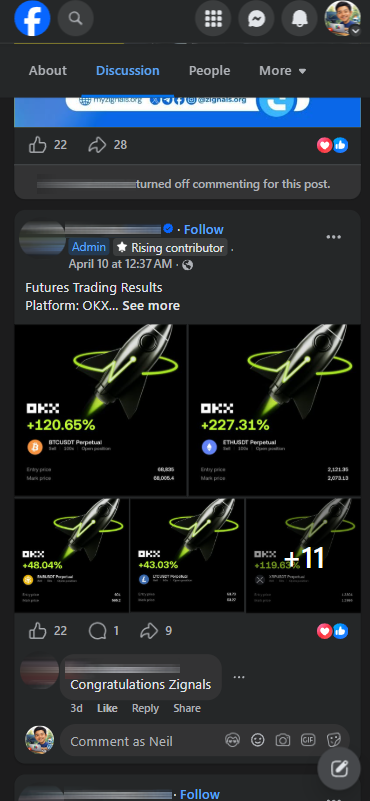
Those are not proof because images are so easy to fabricate. Kayang-kaya pekein.
A real platform should be connected to the live market via API Keys from Binance or OKX.
Every trade should be synced in real-time so you can see what they are trading and if there is actual activity.
Better yet, it should be connected to a public audit platform.
Technical Receipt: When we checked the website’s code, specifically the file ohlc.js, we found that the charts they show are hardcoded. The data isn't live; it's using data from 2016 and 2018:
JavaScript
var seriesData = [{
    x: new Date(2016, 01, 01),
    y: [51.98, 56.29, 51.59, 53.85]
  }];
Even the dashboard categories in dashboard19.js are stuck in September 2019:
JavaScript
xaxis: {
    type: 'datetime',
    categories: ["2019-09-19T00:00:00", "2019-09-19T01:30:00"]
}
In short, the profit you see in your account is just 'gawa-gawa', hardcoded numbers designed to fool you.
In the world of crypto trading, is there really such a thing as "fixed profit"?
The answer is none, especially since Zignals claims to be doing a "pooled fund" system.
No platform or trader can offer fixed profit.
Crypto is extremely volatile.
Whether it’s AI, manual, or whatever kind of trading, there will always be losses.
The 1% daily and 30% monthly promise is just pang-uuto to make people feel safe.
In real trading, profit is variable, sometimes high, sometimes low, and sometimes there are losses.
A fixed profit is a classic sign of a Ponzi Scheme.
A 1% daily profit with no fail is equal to 360% in one year.
That means your capital more than triples in a year while you do nothing.
Even big institutional hedge funds only target 7% to 15% per year.
Common sense tells us: if a trader could really guarantee 360% a year, they wouldn't need to solicit small investments from people.
They would just borrow from a bank and become billionaires instantly.
This kind of investment is impossible.
If this were real, nobody would be poor anymore.
The only purpose of this platform is to take your money once enough people have deposited.
In Zignals, you earn 10% the moment your recruit deposits.
Why is the commission taken from the deposit?
In a legit affiliate program (like Eazybot or Binance), the commission is taken from the company’s profit or transaction fees, never the deposit.
In Binance, you only earn when your recruit actually trades and pays a transaction fee.
In Zignals, taking commissions from deposits is a sign of a Pyramid Scheme.
The money just goes around until nobody new joins, and then the SCAM happens.
Zignals uses "Affiliate Bonus Points" (1 point = 1 peso) to hide how much they are really paying out across 12 levels:
Where does this money come from?
You aren't buying tools or subscriptions.
The company has no other source of income except the deposits of the people your recruits recruit up to the 12th level.
This is a massive Pyramid Scheme.
This is the most alarming one.
They offer an "Asset Management Program" where you pay 300,000 Pesos for an office signage setup and cashier system.
You essentially become a "front" for their Ponzi Scheme.
Is this honorable?
No. Because the 2.5% you earn from cash-ins/outs and the 10% referral incentives still come from the pockets of new recruits.
There is no honorable product or service being sold here.
Lastly, the very foundation of their website is a cheap template.
We found these comments in their code:
JavaScript
//Project:  edulearn - Responsive Admin Template
//Primary use:   This file is for demo purposes only.
They are using a system meant for "demo purposes" to handle real people's money.
Even their chat support has scripted "fake" messages:
JavaScript
var fake = ['Did you purchase the template?'];
They didn't even bother to remove the default questions from the template they bought!
Zignals is a platform that must be avoided.
It is a Ponzi Scheme, a FAKE trading platform that lives only on new recruits depositing money.
Once the recruitment stops, the SCAM happens, and only the early recruiters will have made money.
My review is clear: avoid Zignals. It is not a good place to invest, and it is definitely not something you should promote.
It is a Ponzi Scheme, plain and simple.
Now, I want to ask you: what can you say about this platform now that you’ve seen the red flags in their code?
Comment your thoughts below.

In my YouTube comment section, I often see people defending platforms by saying, “It’s legitimate! They have charity events and have helped so many people”.
It has become a common trend for reviewed platforms to use community outreach as a badge of legitimacy.
However, the reality is far more sinister. Most scams weaponize charity to build unearned trust.
But how exactly do they use "giving back" to steal from thousands?
Let's dive deep into the strategic layers of the "Charity Trap".
In the online world, people are quick to believe what they see in photos and videos. Scammers know this and use charity as a strategic tool to:
Here are the seven ways scams use charity to manipulate you:
This is the first layer where everything begins. Scammers use slogans like "giving back to the community" or "helping people while members earn" to bait victims. They flood their pages with outreach images and donation videos to gain instant testimonials.
Once you are inside the system, the strategy shifts toward diverting your attention.
Scammers rebrand the narrative to give their scheme a "moral" reason for existing.
This is an "open secret" used not just by online scammers, but also in high-level financial crimes.
This is a member-driven front that often goes unnoticed.
A sudden surge in charity events is often a major red flag that a platform is about to collapse.
When legal issues or complaints arise, charity is used as a primary defense.
The goal of all these tactics is the same: to grow the pool of money and prolong the life of the system through constant recruitment.
If a platform uses charity as a core part of its marketing, lacks clear transparency, and links its "good deeds" directly to recruitment, you must be extremely suspicious.
Do not assume a platform is legitimate just because they show you photos of a feeding program.
In many cases, you are simply being used to lure more victims into the trap.
What are your thoughts on these tactics? Have you seen a platform use these "charity hooks" before? Let me know in the comments below!
In the world of online investments, the promise of quick riches is a powerful magnet.
You might have heard of a platform called Celestra claiming to offer a "multi-layered earning system" where your funds grow through daily performance and network leverage within a supposedly transparent framework.
But is a 300% return in 60 days actually possible, or is it just another digital trap?
Let’s break down the facts based on their provided information and technical setup.
Celestra markets itself as a high-tech financial platform.
Originally operating under the domain mycelestra.net, they have recently migrated to a new domain: celestra.com.ph.
According to their official Facebook group, they claim to use "staking" and "trading" to generate massive profits for their users.
However, a closer look reveals that Celestra is not a legitimate investment firm. Instead, it bears all the hallmarks of a Fake Trading platform, Ponzi Scheme, Pyramid Scheme, and VIP Task Scam.
Celestra uses the term "staking" to describe their investment plans, but their version is a far cry from how actual blockchain technology works.
On their Facebook group, Celestra claims to have made millions from trading. However, these "results" are entirely made up.
Celestra’s investment plans, such as the "Quartz" plan, require a minimum of 500 pesos and promise a 5% daily return, totaling 300% in 60 days.
Mathematically, this is impossible and unsustainable.
No legitimate company can offer a fixed 5% daily income indefinitely.
In real trading and staking, there is no such thing as a guaranteed fixed income.
When a platform promises such high, consistent returns, it is almost certainly a Ponzi Scheme.
Since there is no real trading or staking happening, where does the money come from? The answer lies in their aggressive Multi-Level Marketing (MLM) system.
Celestra offers:
This is a classic Pyramid Scheme.
In real trading, commissions are taken from transaction fees, not from a user's initial deposit.
In Celestra, the commissions are taken directly from the money new members put in.
The platform only survives as long as new recruits keep joining.
The most alarming sign is that Celestra's IP address is already linked to another domain called prosperium.app.
This site features the exact same setup: staking, referrals, unilevel, and leadership bonuses.
This indicates that the same developer/owner is behind both, and they are already preparing a "backup" site.
This is a common exit sign, once the influx of new recruits for Celestra slows down, the platform will vanish like bubbles, and the owners will move on to the next domain.
The answer is a definitive NO. Celestra is a clear example of a Ponzi and Pyramid scheme masquerading as a high-tech trading platform.
The profits are unrealistic, the trading is fake, and the entire system relies on exploiting new members.
Investing or promoting this platform is not a "marangal" (honorable) way to earn money because it is designed to fail, leaving the majority of participants with nothing while only the early recruiters and owners profit.
Protect your hard-earned money. Avoid celestra.com.ph and similar schemes.
What are your thoughts on this platform?
Have you encountered similar offers before?
Let us know in the comments below!
Would you like me to help you draft a social media warning post based on this review to help protect your community?
Nowadays, we are seeing a massive surge of "task earning" platforms popping up all over the internet. Let's talk about these task scams because they are everywhere, and they are getting more sophisticated.
We need to discuss the different types of task scams and how you can easily identify if an app or website is a task fraud.
At first glance, a lot of these platforms actually look legit. Some early users might even show proof of earnings, which makes it tempting.
But make no mistake, the root purpose of these task scams is to lure in as many users as possible and collect a massive amount of money.
Let's break down the exact patterns so that with just one look, you can instantly identify if a platform is a task scam.
This is the most common modus out there.
The usual process goes like this: you register on a website or app, and they give you "free tasks" where you can supposedly earn right away.
However, they will quickly tell you that this is just a "system trial."
Because of this, you won't be able to withdraw your money since the earnings from those free tasks won't ever reach the minimum withdrawal threshold.
To continue earning and to finally cash out, they will tell you that you need to upgrade your account and deposit real money.
The tasks usually involve watching videos, clicking products, downloading fake apps, faking product sales, social media engagement, or even crypto trading simulations.
The big problem here?
You are not doing real tasks.
There is no true revenue or actual income being generated.
It is simply a simulated program designed to trick you into thinking you are working for your earnings.
Once you deposit, you'll either be forced to recruit people to cash out, asked to deposit more for the next level, or the platform will just completely shut down and disappear.
This is the more specific and modern structure of the task scam that is very trendy today.
This model features VIP levels or tiers.
For example, they offer a VIP 0 (free trial), VIP 1 (requires a small deposit), VIP 2 (medium deposit), all the way up to the highest VIP level.
The pattern is clear: the higher the VIP level you pay for, the more tasks you get, the higher the commission, and the higher your daily income.
They might promise $3 a day for VIP 1 and $10 a day for VIP 2.
At first, it looks realistic. But the income depends entirely on the deposits of new members, not on a real business model.
This is exactly why analysts and scam investigators call this the VIP Task Platform Scam.
What is an advanced fee scam?
This is a modus where you are required to pay money first before you can get your reward or withdraw your earnings.
You will often experience this when a platform is about to close down or when a task scam stops allowing withdrawals.
Your dashboard might show that you have a lot of money earned, but you just can't cash it out.
The system will make excuses, telling you to upgrade, deposit an "unlock fee," or pay a "tax" or "withdrawal fee" to get your money.
Once you pay, they won't release your funds. Instead, they will invent a new excuse for you to pay again, or they will vanish like a bubble.
Many task platforms use a referral system with a multi-level commission structure.
For instance, you earn 10% for Level 1 invites, 3% for Level 2, and 1% for Level 3.
It becomes a full-blown Ponzi Scheme when the system solely relies on new recruits and their deposits.
In this model, the payouts given to the old members come directly from the money of the new members because there is absolutely no real external revenue.
Once the recruitment slows down, the platform collapses and the system shuts down. Almost all task scams have this hidden modus built into them.
Scammers also use fake e-commerce tasks to trick people.
They will ask you to "order" a product, click a buy button, or submit a review, claiming that you are helping boost the ranking or sales of those products.
The reality is, there are no real products involved.
Everything the user does is a pure simulation.
This modus is often used by platforms pretending to be an Amazon task platform, a Shopee part-time job, or a Lazada promotion system.
There are also task scams that use cryptocurrency trading as a front.
They offer automated trading tasks, daily trading missions, or signal trading tasks.
They will show a dashboard indicating that you are earning daily profits from trading.
But again, there is absolutely no real trading happening, and no actual profit is being made.
Everything you see is simulated or entirely made up.
They just use the buzzwords of crypto to make the platform look high-tech and legit.
Some platforms claim you can earn by boosting engagement, watching views, or clicking links, a model known as click farming.
While real click farming exists where actual companies pay for micro-tasking, the scam version has no real company and no real marketing campaign behind it.
They just use this explanation to make the tasks look legal, but nothing of value is actually being produced to generate real revenue.
Aside from taking your money, there is another modus that is arguably the most dangerous of all: Data Farming disguised as task earning platforms.
The main goal of these platforms isn't just to steal your deposit, but to harvest a huge volume of user data that they can use maliciously or sell.
This often goes unnoticed because they present themselves as "100% free earning apps" with no deposit required.
Data farming collects massive amounts of information: personal info, device details, browsing behavior, social media accounts, email accounts, identity verification data, and worst of all, saved emails and passwords linked to your device or Google account.
They use "simple tasks" to extract this data.
How to spot data farming in a task app:
More often than not, you will see all these types of scams combined into one single earning opportunity.
When you see red flags like guaranteed income, requiring a deposit before you can earn or withdraw, VIP tier systems, multi-level referral structures, and an unknown company with no clear business model, that is a massive TASK SCAM or TASK FRAUD.
In a true earning opportunity, you do not need to deposit money and refer a ton of people (who also need to deposit) just for you to earn.
These combinationsm task-based scams, advanced fee fraud, Ponzi scheme recruitment, fake task systems, and data farming, all exist in one vicious ecosystem.
That’s why you need to be very careful and do your research before joining any online earning platform.
It might look like a simple and easy way to earn money online, but countless people are losing their hard-earned money to these frauds.
Got a Platform You Want Me to Check?
I hope you learned a lot from this post.
If you have a platform, opportunity, website, or company that you want me to review to find out if it is a scam or legit, just comment the name of the platform on any of my videos on my YouTube channel, and I’ll make a review about it.
Until next time, stay safe online!

If you are a freelancer, remote worker, content creator, cruise ship crew member, or someone who regularly receives remittances from the US, you know the struggle of finding a reliable virtual bank account.
Enter Polar Finance (or PolarFi) a legal and highly trusted financial service provider that offers exactly the kind of service you need.
If this is your first time hearing about PolarFi and you want to know what they offer, you are in the right place.
Let’s dive deep into what PolarFi is, how it works, and why it might just be the best tool to handle your US Dollar (USD) earnings.
PolarFi is a financial technology (fintech) application designed specifically to help remote workers, especially those earning in US Dollars, manage their finances efficiently.
While they offer several features, the core product of the PolarFi app is giving you access to your very own U.S. bank account.
The best part? You do not need a US ID or a Social Security Number (SSN) to get one.
All you need is your smartphone and a local, government-issued ID from your home country to verify your identity and open your account.
Beyond just giving you a US account number and routing number for direct deposits (like ACH transfers from clients), PolarFi is packed with features designed to help you move and grow your money.
With PolarFi, you can send money to over 120 countries with low fees and highly transparent exchange rates. And yes, the Philippines is fully supported.
How do you withdraw your money if you are in the Philippines? It’s incredibly easy. Because PolarFi supports local channels, you can seamlessly transfer your USD and receive it in Philippine Pesos (PHP) directly to:
The processing is fast and, in many cases, real-time.
Aside from receiving and sending money, you can actually use PolarFi to earn passive income through their "Save" feature.
Once you keep your money inside the PolarFi app, you can earn 2% to 6% annual interest on your saved USD. What makes this mind-blowing is that the interest is paid out and credited to your account every single second.
Unlike traditional financial providers, PolarFi does not require you to "lock up" your funds (time deposits). You can withdraw your money anytime you want. There is no minimum maintaining balance required to earn this interest, and you can start saving with as little as $1.
If you want to grow your money further, PolarFi gives you the option to invest. You can buy and invest in Gold, Bitcoin, and Ethereum.
The market is open 24/7 inside the app, and unlike other platforms that require a huge capital to start, PolarFi has no minimum investment. You can start building your portfolio with just $1.
One of the biggest concerns for freelancers is losing a huge chunk of their hard-earned money to hidden charges and transfer fees. So, why use PolarFi instead of receiving USD directly to your local bank?
Because PolarFi's fees are incredibly low. First, there are no monthly maintenance fees and no minimum balance requirements. Second, it saves you from the nightmare of SWIFT transfer fees.
Let’s visualize this based on my personal experience:
Usually, when a client pays you via SWIFT transfer directly to a local bank (let's use Security Bank as an example), your money goes through a lot of deductions before it even reaches you:
If a client pays you $100, after all the SWIFT and bank fees, your estimated net receive will only be around ₱4,800 to ₱5,100.
Now, let's look at PolarFi:
If you route that same $100 through your PolarFi US Account, there are no wire fees and no tax deductions on the transfer. PolarFi only takes a small margin of about 1% to 2% upon conversion.
Your net receive will be around ₱5,500 to ₱5,700.
If you want to save money and keep more of your earnings, avoiding direct local bank SWIFT transfers and using PolarFi is a no-brainer.
Yes! While PolarFi is a fintech app and not a bank itself, they partner with fully licensed and regulated banks to hold and protect your funds.
The application also uses bank-level security and high-end encryption to ensure your data and money are safe.
Opening an account is simple and user-friendly:
💡 Pro-Tip Based on My Experience:
Sometimes, if your reason for opening an account isn't completely clear to their system, the PolarFi team might send you a follow-up email.
They will simply ask how and why you intend to use the app.
When I registered, I forgot to state my specific reason, so they emailed me.
I just replied and explained that I am using it to receive my salary as a freelancer.
Once I explained it, they verified my account very quickly. Don't panic if you receive an email—just answer honestly!
Want to get a head start? If you want to claim an extra $25 when you make your first deposit, you can use my referral code.
👉 2DM79J4Y
Just use the link or type the code upon signing up, and the $25 bonus will be credited to you as my way of saying thank you!
To wrap things up, here are the top five reasons why PolarFi is highly recommended for your freelance salary:
If you want to maximize your income and manage your money easily, try PolarFi today.
Now, I want to hear from you! Which feature of PolarFi do you like the most? Let me know in the comments section below!

Today, let’s talk about the Online Business Academy (OBA).
Because aside from the many requests about this topic, I also keep seeing a lot of posts online that promise:
But the real question is:
What is OBA? How do you earn here? And is it really recommended?
Let’s break everything down.
For those who have no idea or are hearing this for the first time, let’s clarify.
The Online Business Academy (OBA) is presented as a training system or online learning platform that teaches people how to promote and sell a business using the internet.
However, it is important to understand:
👉 It is NOT a standalone company
👉 It does NOT have its own independent business model
👉 It does NOT have its own real product ecosystem
Instead, OBA is connected to an existing business.
In reality, once you go deeper into the system, you will find out that it is connected to:
So in simple terms:
👉 OBA is NOT the business
👉 OBA is the training system used to recruit people into an MLM business using online methods
If you scroll on Facebook, TikTok, or even YouTube, you will notice that most posts about OBA look very similar.
Common examples:
You will also see:
At first glance, it looks like:
But once you message them or attend a webinar, the ending is almost always the same:
👉 You will be introduced to an MLM business
👉 Specifically Empowered Consumerism under AIM Global
Here’s the truth:
👉 You do NOT earn directly from OBA
OBA is only used as a training system, while the real income comes from the MLM system.
According to the presentation:
You can earn around ₱1,000 per person you recruit who pays for an account ID.
You can earn around ₱1,800 for every two recruits (binary pairing).
And based on their presentation, if your recruits also recruit others consistently, they show a projection that you can earn millions (like ₱3.5M).
But aside from that, the real earning structure comes from the MLM system:
👉 Which means:
Your income depends heavily on recruitment and network growth.
The system is actually very simple.
Whatever the current members are doing, that is exactly what you will do.
You post on Facebook or TikTok:
Not products — but OBA itself.
Your goal is to make people curious.
Once someone messages you:
They will send you to a video or Zoom meeting where:
You will be asked to pay:
Once you fully pay:
👉 You enter Empowered Consumerism (MLM system)
Based on the modules:
👉 In short:
You are trained to recruit people online.
Here are all the red flags you need to know:
It is advertised as:
But the real business is MLM.
What you learn:
What you don’t learn:
If you remove Empowered Consumerism:
👉 There is no business left in OBA
If your goal is:
👉 real digital skills
👉 long-term online business
👉 sustainable income
❌ OBA is NOT recommended
If your goal is:
👉 MLM
👉 recruitment-based income
👉 online networking
✔️ You can try it — but you must fully understand the structure.
Ask yourself this:
If you remove recruitment and Empowered Consumerism, is there still a business in OBA?
If the answer is no,
👉 then OBA is simply a training system for recruitment.
The global payments industry is rapidly evolving as traditional financial institutions move closer to blockchain technology and digital assets.
One of the latest developments involves Mastercard expanding into blockchain-based payments through partnerships involving Binance, PayPal, and Ripple.
This move highlights a significant shift in how traditional payment networks are integrating with cryptocurrency infrastructure.
Instead of competing with blockchain, major financial companies are now exploring ways to incorporate it into their existing systems.
For users, investors, and businesses, this development signals a growing convergence between traditional finance (TradFi) and digital finance powered by blockchain.
For decades, Mastercard has operated as one of the largest payment networks in the world, connecting banks, merchants, and consumers through card-based transactions.
However, the rise of cryptocurrency and blockchain payments has created a new financial landscape where money can move:
By expanding into blockchain payments, Mastercard is aiming to:
• Modernize its payment infrastructure
• Support digital asset transactions
• Enable faster international transfers
• Integrate stablecoins and crypto wallets
• Stay competitive in the evolving fintech market
Instead of resisting blockchain technology, Mastercard is positioning itself as a bridge between traditional financial systems and decentralized networks.
Binance, one of the world’s largest cryptocurrency exchanges, plays a critical role in providing:
• Crypto liquidity
• Trading infrastructure
• Blockchain connectivity
Through partnerships with companies like Mastercard, Binance can help facilitate crypto-based payments and conversions between digital assets and fiat currencies.
This means that users could potentially:
• Pay using crypto but settle in fiat
• Convert crypto instantly during payment
• Access crypto-linked payment cards
Although regulatory challenges exist in various countries, Binance remains a major player in the global crypto ecosystem.
PayPal has already taken significant steps into cryptocurrency by allowing users to:
• Buy and sell crypto
• Hold digital assets inside the PayPal wallet
• Pay merchants using crypto (converted to fiat)
PayPal also launched PayPal USD (PYUSD), a stablecoin designed for digital payments and transfers.
By integrating blockchain payment systems with Mastercard's network, PayPal could expand:
• Crypto checkout solutions
• Global remittances
• Stablecoin transactions
This could make blockchain payments easier for millions of PayPal users worldwide.
Ripple focuses on blockchain technology designed specifically for international money transfers.
Its payment network, RippleNet, enables financial institutions to move money across borders quickly and with lower fees.
Ripple’s technology could help Mastercard improve:
• International settlement speed
• Transaction costs
• Liquidity management
This is particularly important for remittance-heavy regions where cross-border transfers are expensive and slow.
This partnership represents a larger trend in the financial industry where traditional payment companies are integrating blockchain technology rather than competing with it.
Potential outcomes include:
Consumers may soon be able to pay with cryptocurrency while merchants receive local fiat currency automatically.
Blockchain-based systems can reduce settlement times from days to seconds.
Stablecoins could become a major tool for everyday digital payments.
The future financial system may combine:
• Traditional banking networks
• Blockchain payment rails
• Digital wallets
• Decentralized finance infrastructure
Despite the potential benefits, several challenges remain.
Cryptocurrency regulations vary widely across countries. Companies like Binance have faced regulatory scrutiny in multiple jurisdictions.
Financial institutions must ensure blockchain payments meet strict compliance standards such as:
• Anti-Money Laundering (AML)
• Know Your Customer (KYC)
• Fraud prevention
Cryptocurrency price volatility remains a concern, although stablecoins may help mitigate this issue.
If this collaboration develops further, it could have a significant impact on the broader cryptocurrency market.
Possible effects include:
• Increased institutional adoption of blockchain
• Higher liquidity in crypto markets
• Wider acceptance of digital assets for payments
• More integration between banks and blockchain networks
For crypto users and investors, this signals that blockchain technology is gradually becoming part of the mainstream financial infrastructure.
The expansion of Mastercard into blockchain payments alongside Binance, PayPal, and Ripple highlights an important shift in the global financial ecosystem.
Rather than replacing traditional financial systems, blockchain technology is increasingly being integrated into them.
If successful, this partnership could accelerate the adoption of digital payments powered by blockchain, bringing cryptocurrency one step closer to everyday use.

In recent weeks, posts circulating on Facebook groups such as “Legit Earnings Apps” have been promoting a platform called gptassess.ph or AI Gain, claiming that users can earn money simply by asking questions to Google AI.
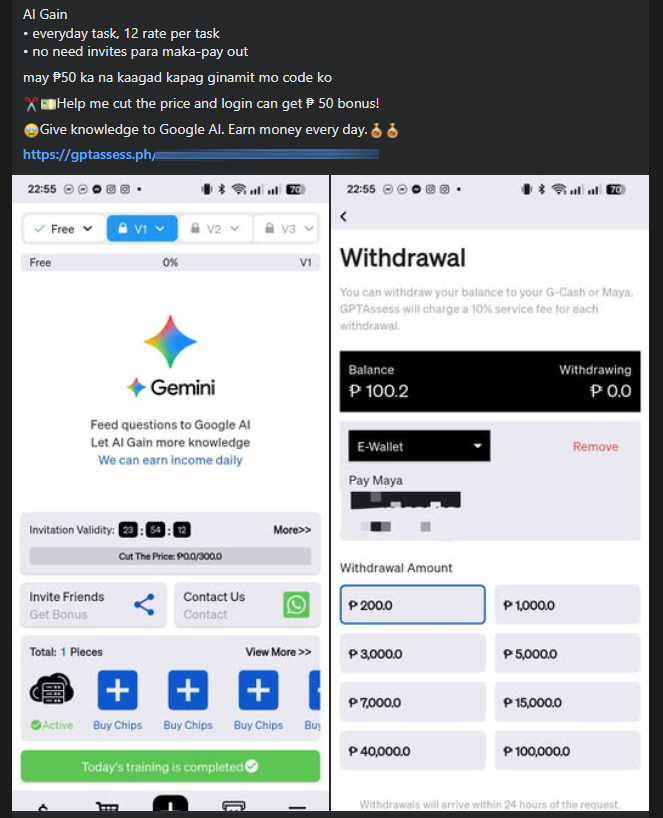
According to the posts, participants can earn ₱8 to ₱12 per question, receive 50 free rewards for new users, and start earning immediately without needing referrals.
At first glance, the opportunity looks attractive, especially for people looking for simple online income.
However, after examining the website and the claims being made in social media promotions, several serious red flags appear.
In this article, we will analyze what gptassess.ph is, how it claims to work, and whether it is truly a legitimate opportunity.
The website gptassess.ph presents itself as a platform connected to Google AI or Gemini, encouraging users to register using their Google accounts. The landing page shows branding similar to Google services and includes statements such as:
The website also provides a simple step-by-step process:
Step 1: Register for AiGain
Step 2: Download AiGain
Step 3: Login and help cut price
According to the promotional posts on Facebook, the platform allegedly allows users to earn money by interacting with AI, specifically by asking questions or completing simple tasks.
The main marketing claim being used to attract users is the idea that you can earn money simply by asking questions to AI. Promotional posts typically include statements such as:
Screenshots are also shared showing a supposed earnings dashboard labeled “Google Text AI Income”, displaying daily earnings and balances.
This type of promotion is designed to create the impression that users can generate easy passive income using Google AI technology.
However, when evaluating these claims carefully, they begin to raise serious doubts.
One of the first things to verify when dealing with any service claiming to be related to Google is the domain name.
Official Google services normally operate under domains such as:
However, the website being promoted is hosted on:
gptassess.ph
This is not an official Google domain and there is no public record indicating that the site is owned or operated by Google.
Any website can place the Google logo on its page, but that does not mean it is affiliated with Google.
The website displays the phrase “Google AI Officially Certified Partner.”
In reality, Google has specific partner programs such as:
There is no widely recognized certification called “Google AI Officially Certified Partner” used in this manner on random websites.
When a platform makes claims about partnerships with large technology companies, those claims should normally be verifiable through official directories or announcements. In this case, no such verification appears to exist.
Another concerning element is the instruction to download an application called AiGain after registration.
Downloading software from unknown platforms can be risky. If the application is not distributed through trusted platforms like the Google Play Store or Apple App Store, it may contain:
Users should always be cautious when asked to install applications from unfamiliar sources.
The website encourages users to register using their Google account.
While Google sign-in can be legitimate, it can also be abused by phishing sites to collect user data or request permissions.
If the system is not properly secured or uses misleading authentication flows, it may collect:
This information can potentially be used for data harvesting or unauthorized account activity.
Many of the promotional posts include screenshots showing earnings labeled “Google Text AI Income.”
However, screenshots alone are not reliable proof of legitimacy. Images showing earnings can easily be:
Without verifiable withdrawal proof, payment records, or company transparency, such screenshots should be treated with caution.
The structure used by gptassess.ph resembles a pattern seen in many task earning schemes that circulate on social media.
These schemes usually follow a similar process:
These requirements may include:
In many cases, users are never able to withdraw the displayed earnings.
Participating in platforms like this may expose users to several potential risks, including:
If the downloaded application is malicious or poorly secured, it could also attempt to access sensitive information stored on the device.
Based on the available information, the promotional claims surrounding gptassess.ph should be approached with extreme caution.
The platform displays multiple warning signs, including:
Because of these factors, users should be very careful before interacting with this website.
There is a strong possibility that this type of platform could be used for phishing activities or data farming, especially if it collects Google account information, email addresses, or encourages users to download external applications.
If an application from such a platform is installed, there is also the potential risk that personal data or account information could be exposed.
Always remember the following safety tips when encountering online earning opportunities:
Online opportunities can be legitimate, but it is always better to research carefully and stay safe before sharing personal information or installing applications.
Finding a job today is not easy, especially for people who do not have a college degree or a diploma to present.
Because of this reality, many platforms are emerging online claiming to offer opportunities for people to earn money even without traditional employment.
One of the platforms currently gaining attention is Novaluxia.
According to the information shared during meetings and promotional materials, Novaluxia claims to be changing the world of employment by allowing people to become part of a community through the Novaluxia App.
It is difficult to find a job, especially if you did not finish a college education and have no diploma to present.
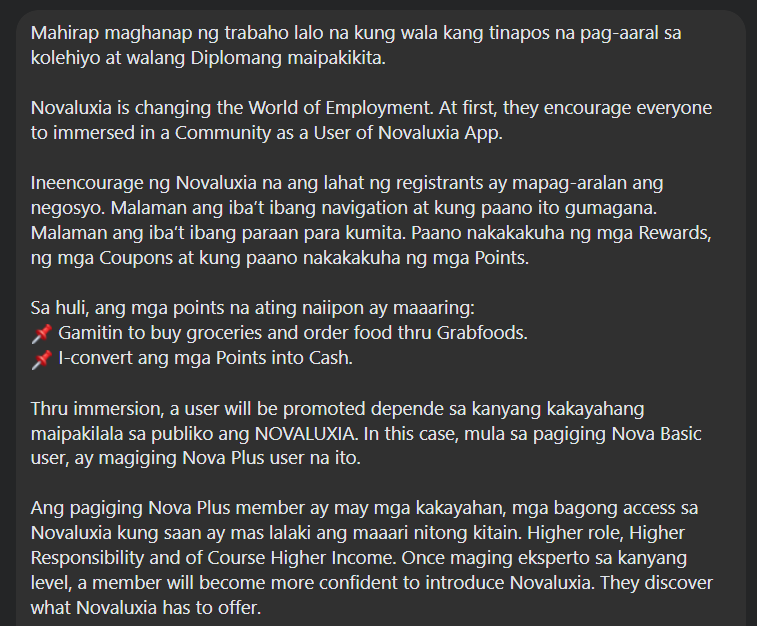
Novaluxia claims that it is changing the world of employment. At first, they encourage everyone to immerse themselves in the community as a user of the Novaluxia app.
Novaluxia encourages all registrants to study the business. They are encouraged to learn the different navigation features and how the system works. They are also encouraged to understand the different ways to earn, how to receive rewards, coupons, and how to accumulate points.
Eventually, the points that users accumulate may be:
📌 Used to buy groceries or order food through GrabFood.
📌 Converted into cash.Through immersion in the platform, a user may be promoted depending on their ability to introduce Novaluxia to the public. In this case, a Nova Basic user can be promoted to a Nova Plus user.
Being a Nova Plus member comes with new abilities and additional access within Novaluxia, which may increase a member’s earning potential. With a higher role comes higher responsibility and, of course, higher income. Once a member becomes experienced at their level, they may become more confident in introducing Novaluxia to others and helping them understand what the platform offers.
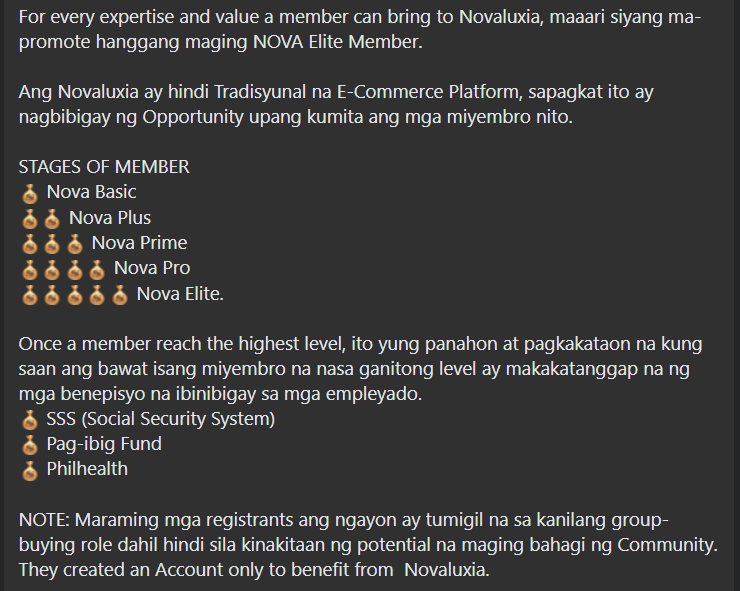
For every expertise and value a member brings to Novaluxia, they may continue to be promoted until they reach the level of a NOVA Elite Member.
Novaluxia claims that it is not a traditional e-commerce platform because it provides an opportunity for its members to earn.
STAGES OF MEMBERSHIP
💰 Nova Basic
💰💰 Nova Plus
💰💰💰 Nova Prime
💰💰💰💰 Nova Pro
💰💰💰💰💰 Nova EliteOnce a member reaches the highest level, this is supposedly the stage where members at that level may begin receiving benefits similar to employees, such as:
💰 SSS (Social Security System)
💰 Pag-IBIG Fund
💰 PhilHealthNOTE: Many registrants have already stopped participating in the group-buying role because they were not considered to have the potential to become part of the community. They created accounts only to benefit from Novaluxia.
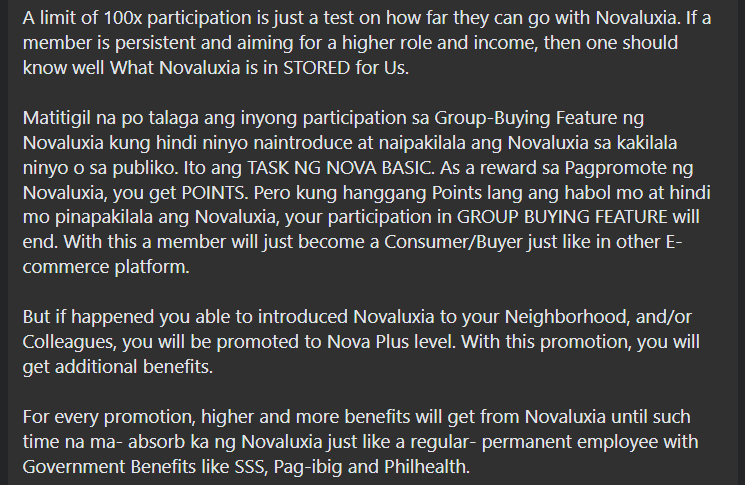
The limit of 100 participations is said to be a test to determine how far members are willing to go with Novaluxia. If a member is persistent and aiming for a higher role and higher income, they are encouraged to fully understand what Novaluxia has in store for them.
Participation in the Novaluxia group-buying feature will eventually stop if members do not introduce Novaluxia to their acquaintances or to the public. This is considered the task of a Nova Basic member. As a reward for promoting Novaluxia, members receive points. However, if a member only wants to earn points without introducing Novaluxia to others, their participation in the group-buying feature will end. In that case, the member will simply become a consumer or buyer like in other e-commerce platforms.
However, if a member is able to introduce Novaluxia to their neighborhood or colleagues, they may be promoted to the Nova Plus level. With this promotion, they will receive additional benefits.
With every promotion, members gain higher levels and more benefits from Novaluxia until they are eventually absorbed into the company like a regular permanent employee with government benefits such as SSS, Pag-IBIG, and PhilHealth.
However, after reviewing the available information, training discussions, and the explanations provided by the platform itself, several important questions arise about how the system actually works.
This updated review will analyze the latest explanations from Novaluxia, how their system operates, and whether the platform is something users should trust.
Novaluxia presents itself as a community-driven platform where members can participate in different activities within the app.
According to their explanation, users are encouraged to:
• learn how the platform works
• understand the navigation and features
• discover different ways to earn rewards
• collect coupons and points
Members accumulate points, which they claim can be used for:
• buying groceries
• ordering food through GrabFood
• converting points into cash
The platform promotes the idea that members can grow inside the community and eventually achieve higher roles.
Novaluxia organizes its members into several stages:
Nova Basic
Nova Plus
Nova Prime
Nova Pro
Nova Elite
Members are supposedly promoted depending on their ability to introduce Novaluxia to other people and expand the community.
As members move to higher levels, they are promised:
• more access to features
• higher earning opportunities
• greater responsibilities within the platform
At the highest level, Novaluxia even claims that members may receive benefits similar to employees, including:
SSS (Social Security System)
Pag-IBIG Fund
PhilHealth
This type of messaging makes the platform appear like an alternative form of employment.
However, this claim raises important questions which we will analyze later.
One of the main activities inside Novaluxia is the Group Buying feature.
Members participate in group-buying activities and receive points or rewards depending on the outcome of the participation.
These points are then presented as something that can eventually be converted into cash.
However, based on the explanations shared during meetings, there is a critical condition attached to continued participation.
If a member does not introduce Novaluxia to other people or promote the platform, their group-buying participation will eventually stop.
This means users are required to:
• introduce the platform to others
• promote Novaluxia publicly
• invite new users into the system
Otherwise, their earning activity will be limited.
Based on the statements shared in their explanations:
Participation in the group-buying feature will end if you do not introduce Novaluxia to others.
This statement is very important.
It means that participation in earning activities is not only based on using the platform, but also on bringing new users into the system.
Members who successfully introduce the platform to others can be promoted from Nova Basic to Nova Plus, which unlocks additional benefits.
As promotions continue, members are expected to bring more value to the platform, which usually involves expanding the network.
One of the most interesting parts of the Novaluxia messaging is the idea that members can eventually become absorbed by the platform like regular employees.
According to their statements, high-level members may receive benefits similar to employees such as:
SSS
Pag-IBIG
PhilHealth
However, it is important to note that there is currently no publicly verified information confirming that Novaluxia is registered as an employer capable of legally providing these benefits to independent members.
Without formal employment contracts, payroll structure, and government registration as an employer, this claim remains uncertain.
After analyzing the platform structure, several characteristics become noticeable.
First, the platform emphasizes community growth and recruitment as a key requirement for advancement.
Second, participation in earning activities is tied to promotion and introducing new members.
Third, rewards are distributed through a points system, which is later converted to cash.
The most critical question therefore becomes:
Where does the money actually come from?
In many legitimate platforms, earnings are generated through:
• product sales
• service fees
• external business revenue
However, based on discussions and explanations surrounding Novaluxia, it appears that rewards and payouts are largely connected to participation within the system itself.
If the majority of payouts are funded by the participation or deposits of new members rather than real product sales, the system becomes dependent on continuous recruitment.
When a system relies heavily on new participants to sustain payouts, it becomes structurally risky.
Novaluxia does have some characteristics that resemble multi-level marketing (MLM):
• ranking levels
• promotions within a network
• community growth incentives
However, traditional MLM systems usually generate revenue from product sales to external customers.
If the primary source of income is not product sales but participation funds, the structure moves closer to a recruitment-based model rather than a legitimate MLM.
Another possibility is that the platform is using employment-style language to attract users.
Terms like:
• promotion
• higher roles
• permanent employee
• government benefits
can make the platform appear like a real job opportunity.
However, if users are actually earning from participation, recruitment, or internal rewards instead of real employment contracts, the opportunity cannot be considered a traditional job.
This type of messaging is sometimes used in pseudo-employment platforms.
Based on the available information, Novaluxia shows several warning signs that users should carefully consider.
These include:
• strong focus on recruitment
• rank-based promotions
• rewards based on participation
• unclear external revenue sources
• employment-style promises without verified employment structure
These characteristics make the system high risk, especially for people who invest money expecting guaranteed returns.
As a platform reviewer, it is important to evaluate systems objectively based on structure and sustainability.
At this time, the available information suggests that Novaluxia operates in a recruitment-driven model with internal reward circulation.
Because the long-term sustainability of such systems depends heavily on continuous growth of new participants, the risk level is significantly higher compared to traditional online platforms.
For this reason, Novaluxia cannot currently be recommended as a safe or reliable earning platform.
Users should be extremely cautious before participating, especially if participation requires depositing money or recruiting other people.
Novaluxia presents itself as a platform that aims to transform employment by creating opportunities for its community members.
However, after analyzing its structure, promotion system, and reward mechanics, several concerns remain about how sustainable and transparent the system truly is.
Based on the available information, the platform appears to operate closer to a recruitment-driven or pyramid-style model rather than a traditional e-commerce platform where income is generated from real product sales or external business revenue.
Anyone considering joining should carefully evaluate the risks, understand where the money comes from, and avoid participating in any system that requires recruiting others or investing funds without clear and verifiable revenue sources.
Online opportunities can be helpful, but it is always important to prioritize platforms with transparent business models, real product demand, and sustainable income structures.