

Table of Contents
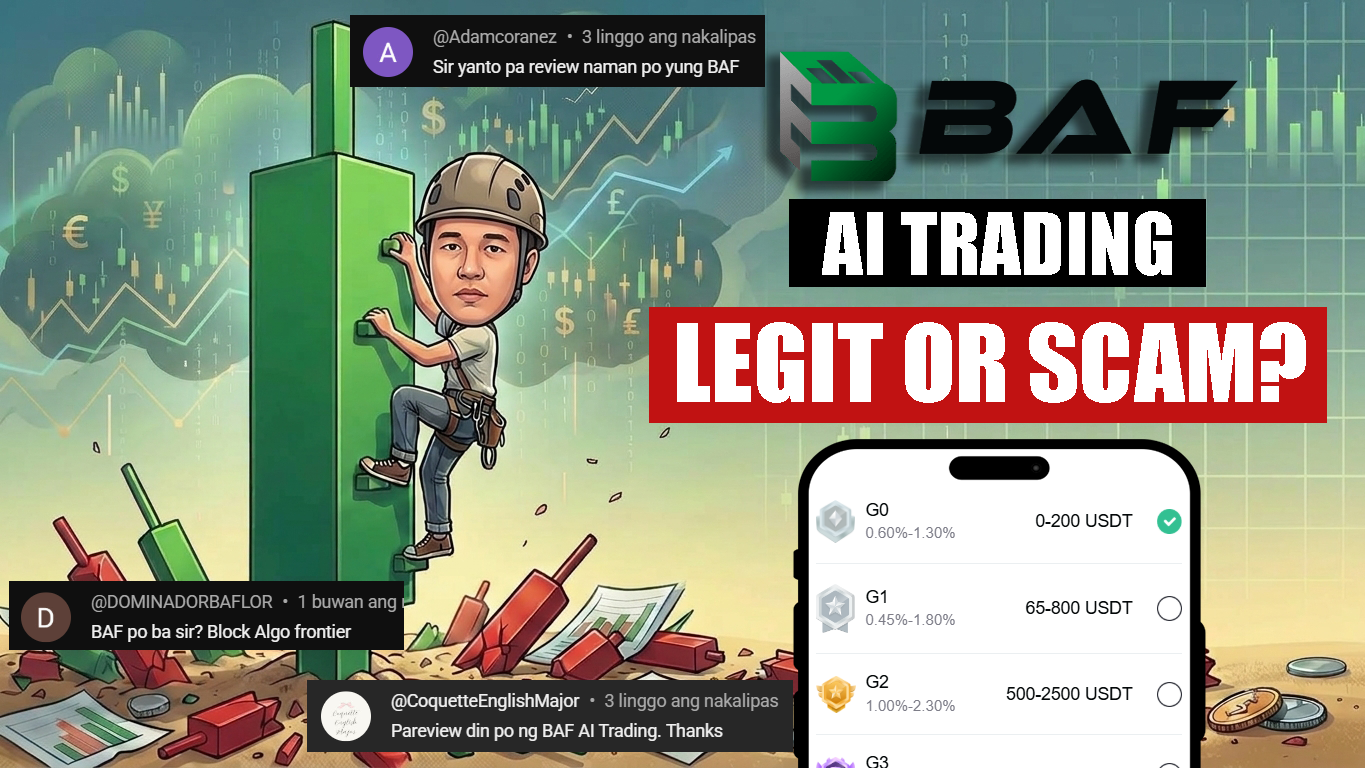
Evaluating code fragments and corporate documents to draft public warnings regarding fraudulent platforms requires dissecting a company's underlying mechanics.
BlockAlgo Frontier (BAF - baf9.ai) presents itself as a highly sophisticated platform, but underneath the technical jargon, it operates on a classic deceptive model.
When compiling documentation for a formal complaint, much like detailing fraudulent recruitment practices and corporate registration records found in Tarlac City, Central Luzon, the specific mechanics of BAF's operations provide overwhelming evidence of a scam.
What is BAF and What Do They Claim?
BAF claims to be the "world's first Web3 ecosystem quantitative trading platform built on a dynamic algorithm network."
The GitBook documents state that unlike traditional platforms where users buy low and sell high based on emotion, BAF utilizes an intelligent algorithmic network to automate arbitrage and quantitative trading.
Their core claims include:
- Dynamic Algorithmic Matching: The platform claims to capture market trends in real-time, automatically adjusting pricing to maintain liquidity and balance buy/sell pressure.
- Immunity to Market Volatility: They claim their algorithms stabilize prices and preserve liquidity even during market downturns, shielding investors from risk.
- Global Institutional Trust: BAF asserts that it has become the "preferred platform trusted by global institutional investors" and renowned trading teams.
What They Offer & How Users Supposedly Earn
The platform markets a completely risk-free, automated income stream through a few distinct channels:
- "Quantitative Tasks": Users log in and click a button to initiate a "task order" which takes exactly 30 minutes to complete. Upon completion, the user receives a guaranteed quantitative commission.

- C2C Arbitrage Simulation: BAF provides an example where the algorithm buys 1 BTC at $88,000 and automatically sells it via a "reservation mechanism" at $88,600, netting a guaranteed profit. They promise users 50% of the trading income, which they claim leads to net profits of 1.8% to 4.6% per trade.
- Tiered VIP System: The amount of funds required, the number of tasks a user can perform daily, and the commission rate all magically increase as the user reaches "higher levels."
- Community & Referral Income: Heavy emphasis is placed on inviting friends and promoting the platform to earn multi-level marketing (MLM) bonuses.
Pros and Cons
Pros (What makes the illusion convincing):
- Polished Documentation: The use of GitBook and professional Web3/DeFi terminology (e.g., "dynamic algorithm network," "liquidity premiums," "deep liquidity assurance") creates a highly convincing facade of technological legitimacy.
- Simplicity: The "30-minute task" system is entirely frictionless, appealing directly to inexperienced individuals who want the profits of crypto without having to learn how to trade.
Cons (The Reality):
- Zero Transparency: There is no verifiable proof of the "dynamic algorithm" or the institutions supposedly backing them.
- Locked Capital: Users must continuously recharge (deposit funds) to hit VIP tiers, making it exceedingly difficult to withdraw initial capital.
- Unsustainable Math: Promising guaranteed daily returns of 1.8% to 4.6% is mathematically impossible in any financial market.
Red Flags & Technical Breakdown
Legitimate algorithmic trading relies on strict technical indicator logic, such as ensuring a fresh support or resistance entry rule applies strictly to a breakout and explicitly excludes a zone touch, or precisely adjusting margin allocation to lower unrealized PnL while maintaining a fixed x20 leverage without adding external funds. BAF’s system ignores actual market mechanics entirely.
- Red Flag 1: The "Task" Model (Click Farming Scam) Legitimate quantitative trading algorithms run continuously on servers (via API connections to actual exchanges like Binance or OKX), executing thousands of trades per second based on PHP/Python code. BAF requires users to log in and manually click a button to "start a quantitative task" that has a fake 30-minute progress timer. This is a notorious hallmark of a Task Scam (or Order Grabbing Scam). The timer and the clicking are purely theatrical elements designed to make the user feel they are "working" for the money.
- Red Flag 2: Guaranteed Arbitrage with Zero Risk BAF claims a guaranteed spread (e.g., buying at $88,000 and selling at $88,600). In real markets, arbitrage opportunities are closed by institutional trading bots in milliseconds. It is impossible to guarantee a 1.8% to 4.6% net profit per trade. Legitimate exchanges offer trading bots (like Grid bots or DCA bots), but they heavily disclaim the risks of market volatility and never guarantee fixed percentage yields.
- Red Flag 3: VIP Tiers and MLM Structure Requiring higher deposit amounts ("effective quantitative funds") and mandatory referral quotas ("number of promotions") to unlock higher commission rates is the literal definition of a Ponzi scheme. The platform pays early users using the crypto deposits of newer users. Once recruitment slows down, the platform will initiate a "rug pull," freezing withdrawals.
- Red Flag 4: Lack of Blockchain Verifiability For a platform claiming to be a "Web3 ecosystem," there are no smart contract addresses, third-party audit reports (like CertiK), or on-chain transaction hashes provided to verify that these trades are actually occurring on a decentralized ledger.
- Red Flag 5: Extended Lock-up "Insurance Funds" and High-Yield Staking Traps The platform utilizes long-duration "Insurance Funds" (ranging from 7 days up to 500 days) promising daily return rates between 0.18% and 1.4% (with 500-day funds offering 1%-1.2% daily). In legitimate decentralized finance, fixed high-yield staking over extended periods with zero market risk exposure does not exist. These lock-up funds are classic Ponzi mechanisms engineered to lock user capital for lengthy periods, preventing mass withdrawals while creating an illusion of long-term stability before an eventual exit scam.
- Red Flag 6: Aggressive Multi-Level Recruitment Missions The platform aggressively pushes long-term missions rewarding direct and indirect downline recruitment (e.g., offering fixed USDT bonuses for inviting friends to deposit 100 USDT or more, such as 10 USDT for 1 referral or 68 USDT for 5 referrals). This structural heavy reliance on mandatory network expansion and referral milestones rather than organic utility or market revenue underscores its multi-level marketing (MLM) recruitment scheme nature.
- Red Flag 7: The BFT Token Illusion and Synthetic Trading Pair Manipulation The platform introduces an internal digital asset named the BFT token (paired against USDT on internal interfaces) to simulate an ecosystem economy, but it exhibits every technical indicator of a completely fraudulent, synthetic token:
- Complete Absence of Blockchain Footprint: The BFT token has no smart contract address deployed on public blockchains (such as Ethereum, Binance Smart Chain, or Arbitrum) and possesses zero liquidity pools on decentralized exchanges (DEXs) like Uniswap or PancakeSwap. It exists exclusively as database rows and dummy variables inside the platform's isolated backend ledger.
- Ticker Hijacking & Name Confusion: The platform deliberately leverages the "BFT" ticker to mimic historically legitimate or unrelated third-party assets (such as BnkToTheFuture or The Big Five Token indexed on price tracking sites like CoinMarketCap), tricking users into searching public directories and falsely assuming the internal token holds external market value.
- Hardcoded Custom Chart Rendering & WebSocket Manipulation: Technical code analysis of the platform's frontend modules (such as
WalletKlineChartand associated WebSocket handlers) reveals that candlestick movements, high/low parameters, and timeframes (5min, 15min, 1-hour, 4-hour) are entirely fabricated via internal socket feeds (wss://api.${this.common.getMainDomain()}/ws). The price bars do not reflect global order book liquidity or real supply-and-demand metrics; instead, they are programmatically generated UI illusions designed to mimic genuine crypto volatility. - Fake Airdrops as Psychological Traps: The platform frequently distributes unsolicited "free BFT tokens" to user accounts as promotional airdrops. This creates a false sense of asset ownership and wealth accumulation, psychologically priming victims to deposit real, hard-earned USDT capital to "unlock," "stake," or trade against their phantom BFT holdings.
Conclusion: Scam or Legit?
BlockAlgo Frontier (BAF) is unequivocally a scam.
It is a repackaged Ponzi scheme utilizing the standard "Order Grabbing/Task Scam" script, dressed up in cryptocurrency and Web3 buzzwords.
The profits do not come from a "dynamic algorithm network" or C2C trading spreads; they come directly from the deposits of new victims.
What are your thoughts on these types of online investment platforms? Leave a comment below with your experiences!


Discussion (0)
Leave a comment
No comments yet. Be the first to share your thoughts!