

Table of Contents
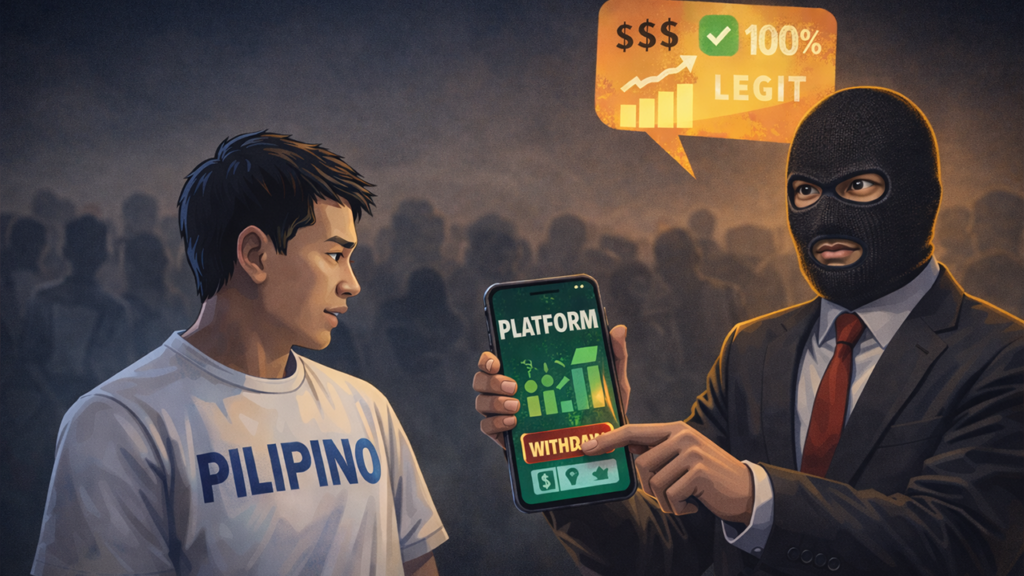
Filipinos fall for scams at an alarming rate compared to many other countries in Southeast Asia.
In recent years, the Philippines has repeatedly ranked among countries heavily targeted by online scam, crypto schemes, fake investment platforms, task-based earning apps, referral pyramids, and impersonation fraud.
What’s more concerning is not just the number of scams, but how quickly many people believe them.
Why does this happen?
This article explores the issue using a research-informed approach, blending behavioral psychology, socioeconomic realities, digital literacy gaps, and cultural patterns, while keeping the discussion practical and grounded.
Economic Pressure and the Urgency Effect
In behavioral economics, scarcity changes decision-making.
When people feel financially pressured, their brain shifts into short-term survival mode.
Long-term risk evaluation becomes weaker. Immediate relief becomes more attractive.
In the Philippines:
- Many households live paycheck-to-paycheck
- A large percentage depend on remittances
- Underemployment remains common
- Inflation impacts daily essentials
When someone encounters a message like:
“Earn ₱1,500 per day with just your phone.”
“Guaranteed 5% daily income.”
“Limited slots only.”
The brain does not process it as “Is this regulated?”
It processes it as:
“This could solve my problem right now.”
Research in scarcity theory shows that financial stress reduces cognitive bandwidth.
People under pressure are statistically more vulnerable to high-reward promises.
Social Proof in a Relationship-Based Culture
The Philippines is highly relationship-driven.
Trust often comes from:
- Family
- Friends
- Church members
- Workmates
- Community groups
Scammers understand this.
Instead of cold marketing, they use:
- “PM me for details”
- “Kumita na ako dito.”
- “Legit po ito, tested na.”
- Screenshots of withdrawals
When a known person shares it, skepticism drops.
In collectivist cultures, social validation is stronger than institutional validation.
A recommendation from a cousin may feel more trustworthy than a warning from a regulatory body.
That’s powerful.
And dangerous.
Authority Illusion and Visual Legitimacy
Many scam platforms look professional:
- Clean websites
- Fake SEC certificates
- Corporate-style logos
- “AI-powered” branding
- Fake office addresses
Psychological studies show that design quality heavily influences perceived credibility.
If a website:
- Looks modern
- Has a dashboard
- Shows charts
- Displays “live earnings”
People assume legitimacy.
The average user does not verify:
- Domain registration history
- Company registration status
- Regulatory compliance
- Audited financial statements
The appearance of structure becomes mistaken for actual structure.
Low Financial and Digital Literacy
This is not an insult, it’s a systemic issue.
Many people:
- Don’t understand how real investments generate returns
- Don’t know how exchanges operate
- Don’t know what regulation means
- Don’t understand risk-reward balance
If someone promises 5% daily profit, a financially trained person immediately asks:
“Where is that yield coming from?”
“What’s the underlying asset?”
“How is capital protected?”
But without financial literacy, returns are evaluated emotionally, not structurally.
Digital literacy gaps also mean:
- People don’t check WHOIS records
- Don’t verify app developer background
- Don’t read terms and conditions
- Don’t understand Ponzi mechanics
This makes them ideal targets.
The Hope Bias
There is a psychological phenomenon called optimism bias.
People believe:
- “Hindi ito scam kasi naka-withdraw yung kakilala ko.”
- “Hindi ako maloloko.”
- “Mauna akong makalabas bago mag-collapse.”
Even when red flags exist, hope overrides logic.
In fact, many victims see the warning signs but choose to ignore them.
Because hope feels better than doubt.
Distrust of Institutions
Here’s a controversial but important angle.
Some Filipinos distrust:
- Government agencies
- Regulatory bodies
- Traditional banks
- Mainstream financial systems
When authorities warn about a platform, some people react with:
“Pinipigilan lang nila kasi ayaw nila kumita tayo.”
This mindset creates a counter-psychology effect.
Warnings are interpreted as suppression.
Scammers exploit this by positioning themselves as:
- “Decentralized”
- “Anti-bank”
- “People’s platform”
- “Freedom finance”
It becomes emotional rebellion, not investment logic.
The Referral Trap Structure
Many scam platforms use a structured recruitment model:
- Daily earning cap without referrals
- Upgrade required
- Commission-based rank system
- Team volume incentives
This transforms victims into recruiters.
Once someone invites others:
- They become emotionally committed
- They defend the platform
- They ignore red flags
This is known in behavioral studies as commitment escalation.
The deeper someone gets involved, the harder it is to admit it’s a scam.
Fast Validation vs Slow Truth
Legitimate sources:
- Move slowly
- Require verification
- Include disclaimers
- Don’t guarantee profit
Scammers:
- Offer instant dashboards
- Show instant “earnings”
- Provide quick withdrawals (early phase)
- Use urgency tactics
Human psychology prefers immediate feedback.
Truth is slow.
Scams are fast.
Guess which one wins attention?
Why Legitimate Warnings Are Ignored
When content creators or analysts publish warnings, reactions often include:
- “Bakit negative ka?”
- “Ikaw ba SEC?”
- “May proof ka ba?”
Ironically, scammers rarely get asked for proof.
This reflects confirmation bias.
People seek information that supports what they already want to believe.
If someone wants to earn easily, they’ll reject content that contradicts that hope.
Is This a Filipino Problem?
Not entirely.
Scams exist globally.
But in the Philippine setting, several factors combine:
- Strong social trust networks
- Financial pressure
- Rapid digital adoption
- Limited enforcement
- High social media penetration
This creates a high-risk environment.
Conclusion: It’s Not About Intelligence
Believing a scam is not about being “bobo.”
It’s about:
- Psychological pressure
- Emotional hope
- Social influence
- Financial urgency
- Systemic literacy gaps
Scammers are not lucky.
They are strategic.
They study behavior.
The real solution is not shame.
It’s education, critical thinking, and structural awareness.
Before trusting any platform, ask:
- How does it really generate money?
- Is the revenue sustainable?
- Is it regulated?
- Who carries the actual risk?
- If recruitment stops, does the income stop?
If you cannot answer those clearly, pause.
Because in finance,
when something feels too easy, someone else is carrying the risk — and it might be you.


Discussion (0)
Leave a comment
No comments yet. Be the first to share your thoughts!